TRENDEFRARAtlas of the Sultans · Ottoman monuments
Green Mosque Complex (Yeşil Külliye)
Monument · Mosque complex, Bursa, 1414–1424
- Type
- Complex (külliye)
- Built
- 1414–1424
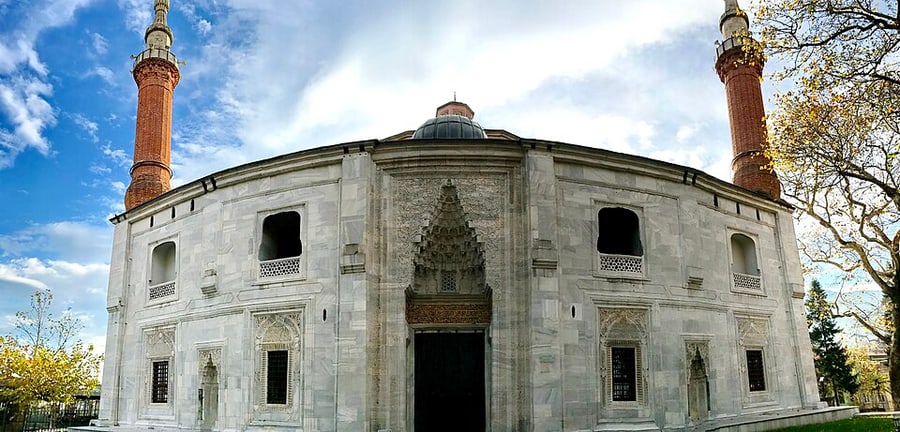

Mehmed I's complex on the hill
The complex was built by Mehmed I (Çelebi Sultan Mehmed), who reunited the state after the struggle with his brothers. Since his grandfather Murad I had founded a complex in the west of the city and his father Bayezid I in the east, he placed his own in the middle of the city, on a hill overlooking the plain. Called Imaret-i Sultan in the documents, the group of buildings consists of a mosque, a madrasa, an imaret (public kitchen), a tomb and hans; it became known as the Yeşilcami (Green Mosque) Complex because of the tiles in the mosque, the tomb and the madrasa, and it also gave its name to the quarter where it stands.
Construction of the mosque began in 817 (1414), and according to the inscription on the portal the building was finished in Dhu al-Hijja 822 (December 1419). The inscription in the royal lodge states that its painted decoration was made by Ali b. Ilyas Ali and that the decoration was completed in August 1424. The wording on the portal shows that Hacı Ivaz Pasha also drew up the plans of the building. With its six inscriptions naming the founder, the architect, the chief designer and the tile and woodwork masters, the complex is unique in Ottoman architecture. According to the article, the Ottoman craftsmen whom Timur had taken to Tabriz after the Battle of Ankara (1402) brought masters from Tabriz with them on their return, and these worked above all on the making of the tiles.
The tiled mosque and the royal lodge
The mosque follows the zaviye-tabhane scheme (with side rooms for dervishes and travellers) known as the Bursa type or reverse-“T” plan. From the entrance hall one passes into the main space with its pool, covered by a dome 13 m in diameter and 25 m high; there are iwans on either side and tabhane rooms at the corners. The royal lodge above the hall is designed like a small pavilion and faced with relief tiles in yellow, navy blue, turquoise and white. On the tiled mihrab, which is reached by steps and is 10.67 m high, one reads the phrase “amel-i üstadan-ı Tebriz” (the work of the masters of Tabriz); the article regards this mihrab as the most perfect example of early Ottoman architecture. In its plan and tile decoration the mosque closely resembles the Blue Mosque (Gökmescid) in Tabriz.
Madrasa, tomb and hans
The madrasa west of the mosque measures 36 × 38.5 m and has three iwans. Although thirty students were registered in the endowment deed, only thirteen rooms were built, which shows that the madrasa was left unfinished. Renowned scholars such as Mehmed Şah Fenari and Ebüssuud Efendi taught at this madrasa, known as the Bursa Sultanisi. The Tomb of Mehmed I, rising on a hillock opposite the mosque, is the symbol of Bursa with its tiles; at 25.5 m it is the tallest of the Ottoman tombs, and its sarcophagus with relief tiles has no equal. The Silk Han (Ipek Hanı), which provided income for the complex, and the Geyve Han, which Hacı Ivaz Pasha built and presented to the sultan, also belong to the complex.
Earthquakes and restorations
Two minarets were planned for the mosque, but only one was built. When this minaret was badly damaged in the earthquake of 1855, it was taken down to its base and rebuilt, and in 1869 a second minaret was added so that a mahya (illuminated message strung between minarets) could be hung. The mosque underwent major repairs many times from 1552 to the 1940s and was taken into a new comprehensive restoration in 2010. When built, all the walls of the mosque were decorated with painted ornament; today this survives only in the domes. The tomb was reopened to visitors in 2009 after a long restoration, and the ruined imaret was restored and began to be used as a coffeehouse.
Source: TDV Encyclopedia of Islam (TDV İslâm Ansiklopedisi), “YEŞİLCAMİ KÜLLİYESİ” (Doğan Yavaş)
Related sultans
Cite as: Atlas of the Sultans, “Green Mosque Complex (Yeşil Külliye) · Ottoman monuments”, https://padisahlaratlasi.com/en/monuments/green-mosque-complex-yesil-kulliye/ (last updated 21 November 2026). Corrections · Image credits