TRENDEFRARAtlas of the Sultans · 16 / 39 · sultan
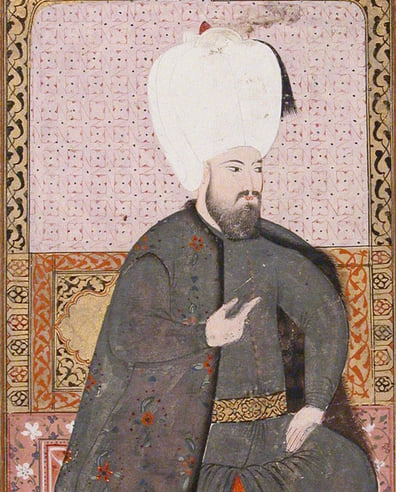
Portrait made in his lifetime — early 17th c.
Ahmed I
Abolishing fratricide in favour of seniority was the dynasty's most lasting legal change. Having to treat Austria as an equal at Zsitvatorok was the first official admission that Ottoman supremacy over Europe had ended.
Open the reign of Ahmed I on the map▶ Watch the 1-minute video: YouTube · Instagram · TikTok
Interesting fact
When the foundations of the Sultan Ahmed (Blue) Mosque were laid, he worked with a golden pickaxe himself until he broke into a sweat. With him began the rule that the eldest member of the dynasty inherits the throne; so he was succeeded not by his son but by his brother Mustafa I.
Source: TDV İslâm Ansiklopedisi (Turkish), article “AHMED I”
Life
Sultan at fourteen
Ahmed was born in Manisa on 28 April 1590, in the years when his father Mehmed III was sanjak governor of Saruhan; his mother was Handan Sultan. Because of the Celali disturbances he was never sent out to a sanjak; that is, he never held the provincial post in which a prince traditionally learned the business of government. When his father died on 22 December 1603, he came to the throne at the age of fourteen.
His first act was to send his grandmother Safiye Sultan, whose interference in affairs of state under Murad III and Mehmed III had given rise to many incidents, to the Old Palace (Eski Saray). At the start of his reign the state was at war with both Iran and Austria, while Anatolia was going through the most intense phase of the Celali revolts.
The Peace of Zsitvatorok
On the Austrian front the grand vizier Lala Mehmed Pasha recaptured Pest and Vác (Vaç) in 1605, but the siege of Esztergom came to nothing because of bad weather. On the ground prepared by Kuyucu Murad Pasha, who had been charged with ending the war that had been going on for thirteen years, an Ottoman delegation headed by the beylerbeyi of Buda, Kadızade Ali Pasha, met the Austrian representatives at Zsitvatorok (Zitvatorok). After twenty-three days of talks, a treaty of seventeen articles was signed in 1606.
The treaty abolished Austria's annual tribute and established a relationship close to equality between the two states. The TDV article notes that historians generally agree that the growth of the Ottoman state came to a halt with this treaty. The revolts in Anatolia played a large part in the Ottomans' acceptance of this peace.
The Celali revolts and Iran
Tavil Ahmed, who rebelled immediately after Ahmed's accession, defeated Nasuh Pasha, the commander (serdar) sent against the Celalis, and the beylerbeyi of Anatolia; his son Mehmed seized the governorship of Baghdad with a forged imperial decree (ferman), and Baghdad could be recovered only in 1607. In the east, when Cigalazade Sinan Pasha was defeated by a sudden attack from Shah Abbas, he had the beylerbeyi of Aleppo, Canbolatoğlu Hüseyin Pasha, executed on the pretext that he had been late in coming to his aid; this in turn started a new and major revolt.
Charged with suppressing the Celalis, the grand vizier Kuyucu Murad Pasha kept Kalenderoğlu occupied with the governorship of the sanjak of Ankara and marched first against Canbolatoğlu, defeating him on the plain of Oruç; he then eliminated the rebels in Anatolia one by one with harsh methods. So that the people who had abandoned their villages would return, Ahmed issued a decree of justice (adaletname) on 30 September 1609. Murad Pasha marched against Shah Abbas in 1610, but no battle took place, and the pasha died in Diyarbekir in 1611. The peace made with Iran broke down when the promised silk was not sent, and war began again.
The Sultan Ahmed Mosque and diplomacy
Ahmed's most lasting work is the mosque that bears his name, the Sultan Ahmed Mosque (Sultanahmet Camii). Tradition holds that when the foundations were being laid he worked on them himself with a golden pickaxe until he broke into a sweat. Together with a madrasa, soup kitchen (imaret), hospice (tabhane), hospital (darüşşifa), school (mektep) and shops, the mosque formed a great complex. Ahmed also had the walls of the Kaaba, which were on the point of collapse, repaired by sending master builders from Istanbul.
In his reign the trade agreements with England, France and Venice were renewed; in July 1612 the first trade agreement with the Netherlands was concluded. The Ottoman fleet also enjoyed a successful period in these years.
The order of succession, character and death
In Ahmed's reign the way the Ottoman throne changed hands was fundamentally transformed. He did not have his brother Mustafa killed; for accession to the throne, which until then had followed no fixed rule, the principle that the eldest and most mature male of the dynasty should become sultan (ekberiyet and erşediyet) was adopted, and the other princes began to be kept in a special section of the palace, the place called the “kafes” (the Cage). In keeping with this rule, Ahmed was succeeded not by his son but by his brother, Mustafa I.
The TDV article portrays him as a sultan who did not give himself up to pleasure, pious and charitable, who won the people's trust but was harsh by nature and did not forgive those who betrayed him. He was fond of hunting and of the javelin game cirit; he wrote poetry under the pen name “Bahti” and left a small divan. After a stomach illness that lasted fifty-one days he died on 22 November 1617 at the age of twenty-seven and was buried in the tomb beside the mosque he had built.
Source: TDV Encyclopedia of Islam (TDV İslâm Ansiklopedisi), “Ahmed I” (Mücteba Ilgürel); the main sources of this article are Peçevi, Selaniki, Hasanbeyzade, Topçular Kâtibi Abdülkadir Efendi and Naima.
Meanwhile in the world
Contemporary rulers
- James IKing of England and Scotland · 1603–1625First Stuart monarch on the English throne
- Philip IIIKing of Spain and Portugal · 1598–1621Expelled the Moriscos from Spain and governed through royal favourites
- Henry IVKing of France · 1589–1610First Bourbon king; assassinated in 1610
- Abbas I (the Great)Safavid Shah · 1588–1629Reorganized the army and moved the capital to Isfahan
- JahangirMughal Emperor · 1605–1627Son and successor of Akbar
- Michael RomanovTsar of Russia · 1613–1645Founder of the Romanov dynasty, which ruled Russia until 1917
- Wanli EmperorEmperor of Ming China · 1572–1620During his reign Matteo Ricci established Jesuit missions in China
What was happening in the world?
- 1605The first part of Cervantes's Don Quixote was published in Madrid.
- 1607The English founded Jamestown in Virginia, their first permanent colony in the New World.
- 1608Samuel de Champlain founded Quebec, the first permanent French settlement in North America.
- 1609Kepler published Astronomia nova, containing his first two laws of planetary motion.
- 1611The King James Version of the English Bible, prepared under James I's patronage, was published.
- 1616The English playwright William Shakespeare died in his native Stratford-upon-Avon.
Sources: britannica.com [1] [2] [3] [4] [5] [6] [7] [8] [9] [10] [11] [12] · kids.britannica.com [1]
Family
| Father | Mehmed III |
|---|---|
| Mother | Handan Sultan |
| Consorts | Kösem Sultan (Mahpeyker), Mahfiruz Hatice Sultan |
| Children | Osman II, Murad IV, Ibrahim, Şehzade Mehmed, Şehzade Bayezid, Şehzade Kasım, Atike Sultan, Gevherhan Sultan |
Major achievements
- Construction of the Sultan Ahmed (Blue) Mosque (1609–1617)
- Seniority adopted in place of fratricide — a fundamental change in dynastic law
- The Celali revolts crushed by Kuyucu Murad Pasha
- One of the youngest sultans, enthroned at thirteen
- The Austrian emperor treated as an equal for the first time at Zsitvatorok
Treaties
- Peace of Zsitvatorok (1606, Austria) — the first document marking the end of Ottoman supremacy
- Treaty of Nasuh Pasha (1612, Persia)
Grand viziers
| Name | From | To | Length |
|---|---|---|---|
| Yavuz Ali Pasha | October 4, 1603 | July 26, 1604 | 296 days |
| Lala Mehmed Pasha | August 5, 1604 | June 21, 1606 | 1 year, 320 days |
| Derviş Pasha | June 22, 1606 | December 9, 1606 | 170 days |
| Kuyucu Murad Pasha | December 11, 1606 | August 5, 1611 | 4 years, 237 days |
| Nasuh Pasha | August 1611 | October 17, 1614 | 3-4 years |
| Öküz Mehmed Pasha | October 17, 1614 | November 17, 1616 | 2 years, 31 days |
| Kayserili Halil Pasha | November 17, 1616 | January 18, 1619 | 2 years, 62 days |
Battles and treaties
| Year | Event | Result / parties |
|---|---|---|
| 1606 | Treaty: Peace of Zsitvatorok | Ottoman Empire, Habsburg Monarchy |
| 1606 | Revolt: Revolt of Canbolatoğlu Ali Pasha | Kuyucu Murad Pasha defeated Canbolatoğlu on the plain of Oruç (24 October 1607) |
| 1607 | Revolt: Revolt of Kalenderoğlu | Defeated by Kuyucu Murad Pasha at the Göksun pass (9 August 1608); beaten once more near Bayburt, he fled to Iran |
| 1612 | Treaty: Treaty of Nasuh Pasha |
Full infoboxes are in the site’s “Battles and Treaties” tab; source: TDV Encyclopedia of Islam.
Death
He died in 1617 at twenty-seven of typhus and gastric bleeding.
Territorial change
| Year | Region | Event | Source |
|---|---|---|---|
| 1607 | − Azerbaijan–Shirvan–Yerevan | Shah Abbas's offensive: Tabriz (1603), Yerevan (1604), Ganja (1606) and Shirvan (1607) fell to the Safavids; the Treaty of Nasuh Pasha (1612) recognised it | TDV İA, “AHMED I” |
| 1607 | − Dagestan–Derbent | Derbent and Baku passed to the Safavids in the Shirvan campaign (1607); the Treaty of Nasuh Pasha (1612) pulled the border back to the 1555 line | TDV İA, “AHMED I” |
| 1607 | − Eastern Georgia (Kartli and Kakheti, Tbilisi) | Shah Abbas's offensive (1603–1607) — Kartli and Kakheti returned to Safavid influence; Treaty of Nasuh Pasha (1612) | TDV İA, “AHMED I” |
| 1612 | − Western Georgia (Mingrelia–Imereti) | Treaty of Nasuh Pasha (1612) | TDV İA, “AHMED I” |
The lands that changed hands in this period, and the battles or treaties that brought the changes, can be seen on the map: map of the reign of Ahmed I.
Cite as: Atlas of the Sultans, “Ahmed I: Reign Map, Wars and Conquests (1603–1617)”, https://padisahlaratlasi.com/en/sultans/i-ahmed/ (last updated 21 November 2026). Corrections · Image credits
Terms on this page: Şehzade · Seniority succession
Grand viziers of this reign: Kuyucu Murad Pasha
Monuments of this reign: Ibrahim Pasha Mosque · Sinan Pasha Mosque (Prizren) · Safiye Sultan Mosque · Tomb of Mehmed III · Ekmekçizade Ahmed Pasha Bridge · Sultan Ahmed Mosque and Complex · Ekmekçizade Ahmed Pasha Caravanserai · Aynalıkavak Pavilion · Aslan Pasha Mosque
Women of the dynasty in this reign: Kösem Sultan
State organisation: The Timar System
Myths and misconceptions: Did the eldest son always inherit the Ottoman throne?