TRENDEFRARAtlas of the Sultans · Ottoman monuments
Ekmekçizade Ahmed Pasha Bridge
Monument · Bridge, Edirne, 1607–1608
- Type
- Bridge
- Built
- 1607–1608
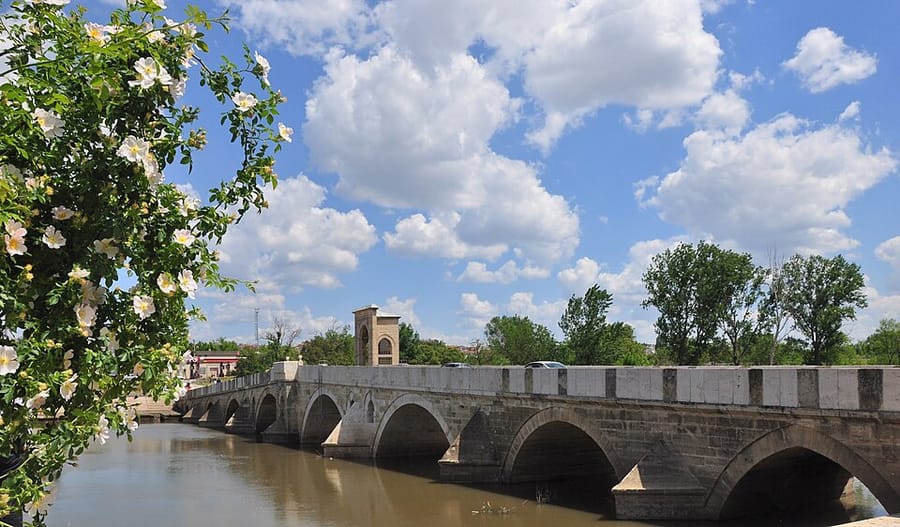

A stone bridge over the Tunca
This stone bridge over the Tunca River in Edirne was built by the chief treasurer (başdefterdar) Ekmekçizade Ahmed Pasha (d. 1618); a wooden bridge is said to have stood on the site before. According to the chronogram poem by the Edirne poet Kami on the inscription pavilion, the bridge was built in 1607–08, although some authors report that it was completed in 1615. As the last of the city's bridges, it was first called the New Bridge and later the Old Bridge. The claim that it is the work of the court chief architect Sedefkar Mehmed Agha is mere conjecture.
Built of finely dressed stone, the bridge is 136.30 metres long and 6.90 metres wide, with ten semicircular arches, the largest spanning 15 metres. In the middle, an ornate inscription pavilion bearing the marble inscription rises on a projection. Damaged in places by floods, the bridge was repaired in the 1960s: the collapsed sections were completed with a flat concrete deck without arches, and the pavilion was rebuilt.
The chronograms
The poet Kami's five-couplet poem says that Ahmed Pasha served as treasurer for eighteen years and built this matchless bridge for the sake of God, adding that he asks only a prayer of those who cross it. At the end of the poem it is recorded that the bridge was built in 1016 (1607–08) and that the inscription was written in 1116 (1704). For 1615, the completion date given by some, Oral Onur quotes a chronogram couplet attributed to Kadı Mehmed Şerif, but the original of this text has not been seen.
Shortly before the First World War a plan was made to widen the bridge's deck; according to Rifat Osman Bey, it met with strong opposition from the architect Kemaleddin Bey.
Piers and inscription pavilion
The cutwaters of the piers are polygonal on the upstream side and pointed on the downstream side. Only beside the central arches are pointed-arched flood openings set above or beside the cutwaters. The central pavilion opens onto the deck as a tall pointed-arched iwan, flanked by lower pointed-arched openings. Its downstream wall consists of loophole-like openings separated by stone piers, and the marble inscription is placed above these openings.
Source: TDV Encyclopedia of Islam (TDV İslâm Ansiklopedisi), “EKMEKÇİZÂDE AHMED PAŞA KÖPRÜSÜ” (Semavi Eyice)
Related sultans
Cite as: Atlas of the Sultans, “Ekmekçizade Ahmed Pasha Bridge · Ottoman monuments”, https://padisahlaratlasi.com/en/monuments/ekmekcizade-ahmed-pasha-bridge/ (last updated 21 November 2026). Corrections · Image credits