TRENDEFRARAtlas of the Sultans · Ottoman monuments
Aslan Pasha Mosque
Monument · Mosque, Ioannina, 1618
- Type
- Mosque
- Built
- 1618
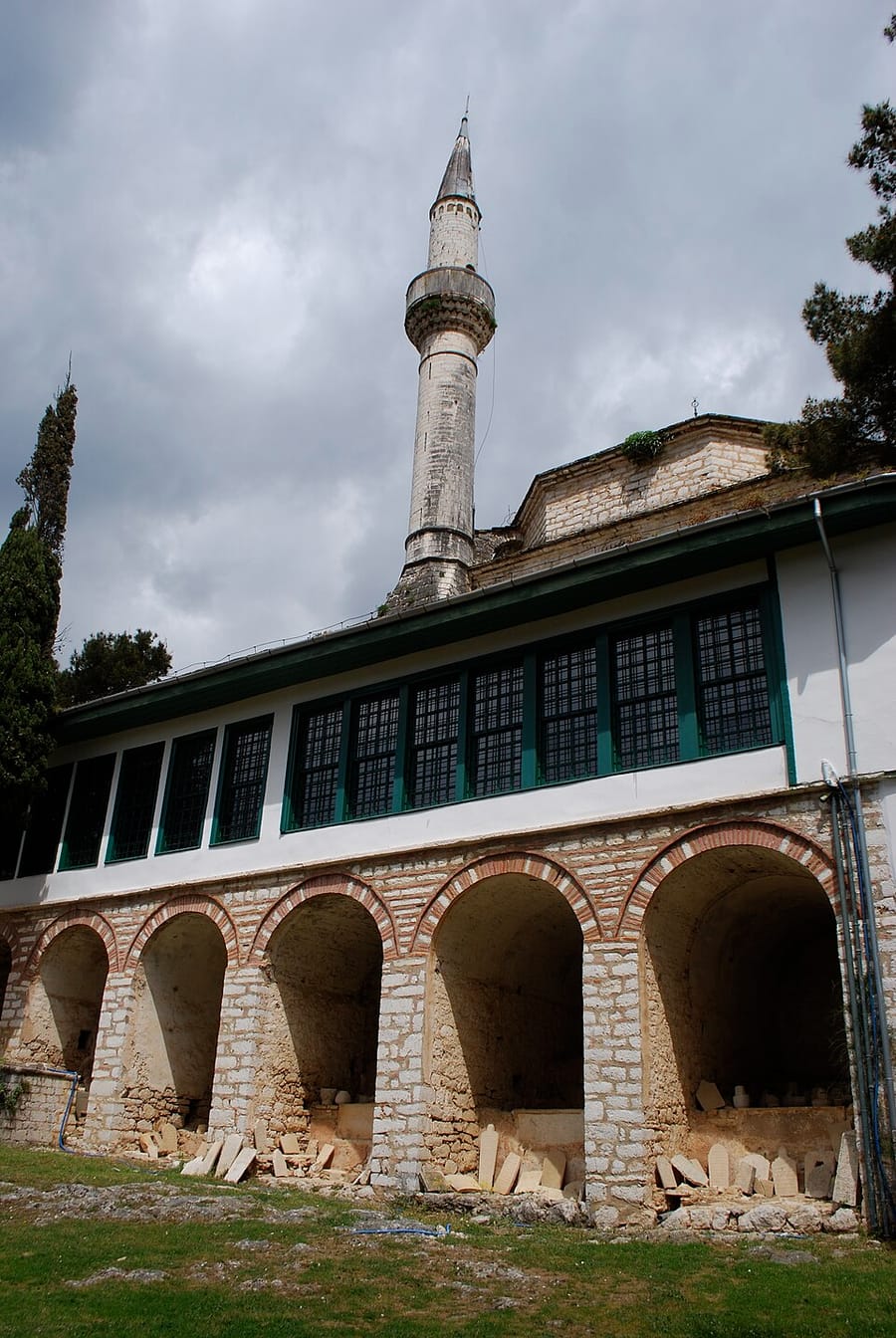

The mosque of a complex in Ioannina Castle
Standing on high ground within the castle of Ioannina, the mosque was built, according to its endowment deed of December 1608, by Arslan (Aslan) Pasha, governor of the sanjak of Trikala and later governor-general of Rumelia, together with a madrasa, a dervish lodge with soup kitchen and a tomb. Evliya Çelebi, who visited Ioannina in 1670–71, praised its architecture, decoration, minbar and minaret, and recorded the inscription over its door dated 1618. On the side of the courtyard facing the lake stood Arslan Pasha's large soup kitchen.
Reached by a stairway, the mosque is built of cut stone and consists of a square prayer hall covered by a single dome. As in most mosques of the Balkans, it has a tall, blind octagonal drum, supported on four sides by arched buttresses. The tiled dome is not hemispherical but pyramidal, continuing the lines of the drum. The broad graveyard on the qibla side contains the tombs of Arslan Pasha's family; the octagonal, tile-roofed tomb of Arslan Pasha himself stood there until recently.
The complex at Yanya
Arslan Pasha was the son of Zülfikar Bey, governor of the district of Yanya; from 1611 to 1787 the governors appointed to the district of Yanya came from Arslan Pasha's family. The complex was built on the Second Acropolis within the castle, on the site of the former Prodromos Monastery. In this period, by decisions taken in 1613 and 1618, the town's Christian population was moved outside the walls and the churches and monasteries inside the castle were confiscated. The complex comprised a domed mosque, a large madrasa, a soup kitchen for travellers and the poor, a tomb and, below the Second Acropolis outside the walls, a large double bath. The madrasa is reported to have been built in 1612.
Additions and present state
In front of the courtyard gate, Kapıcıbaşı Mustafa Bey built a pavilion whose chronogram was composed by Evliya Çelebi. Adjoining the mosque is an annex with many windows and masonry arches on its lower floor. An inscription on the upper part of the four marble columns that carry the inner arcades gives information about Arslan Pasha. The buildings of the complex are among the rare examples to have survived in this part of Greece; they have been restored, and the mosque now serves as a museum.
Source: TDV Encyclopedia of Islam (TDV İslâm Ansiklopedisi), “ARSLAN PAŞA CAMİİ” (Semavi Eyice)
Related sultans
Cite as: Atlas of the Sultans, “Aslan Pasha Mosque · Ottoman monuments”, https://padisahlaratlasi.com/en/monuments/aslan-pasha-mosque/ (last updated 21 November 2026). Corrections · Image credits