TRENDEFRARAtlas of the Sultans · Grand viziers
Kuyucu Murad Pasha
Grand vizier, 1606–1611
 AI

From Yemen to Mezőkeresztes
His place and date of birth are not known for certain; since it is recorded that he was over ninety when he died, he is estimated to have been born around 1522. The sources state that he was of Croatian origin; he was taken into the palace as a devşirme recruit. He became steward (kethüda) to Mahmud Pasha, governor-general of Yemen and Egypt, and married his daughter. In 1575 he became governor-general of Yemen; on rumours that he had amassed wealth unjustly he was dismissed in 1580, imprisoned in Yedikule, and his fortune was confiscated.
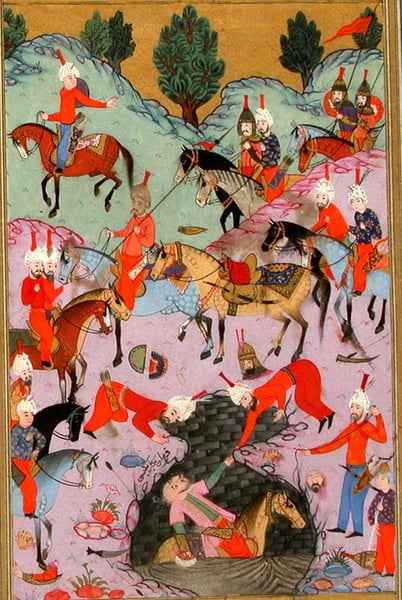
After he was pardoned he held various posts. During the withdrawal in the Tabriz campaign of 1585 he fell with his horse into a deep well and was taken prisoner by the Safavids; he was released after the treaty of 1590. After the governorships-general of Cyprus, Damascus and Diyarbekir he took part in the Austrian wars and distinguished himself greatly in the Battle of Mezőkeresztes (Haçova).
Zsitvatorok and the grand vizierate
After the accession of Ahmed I he became a vizier in 1605 and was appointed commander-in-chief in Hungary. At the end of negotiations conducted under his chairmanship, the Treaty of Zsitvatorok was signed in November 1606. When the Celali revolts came to threaten Bursa, Grand Vizier Derviş Pasha was dismissed and executed, and on the recommendation of Şeyhülislam Sun'ullah Efendi, Murad Pasha became grand vizier on 11 December 1606.
Campaigns against the Celalis
In the summer of 1607 he marched against Canbolatoğlu Ali Pasha, who had rebelled in Syria. He secured his rear by giving the sanjak of Ankara to Kalenderoğlu, scattered the rebel groups along his route, and in October 1607, on the plain of Oruç, routed Canbolatoğlu, who was acting together with Ma'noğlu Fahreddin (Fakhr al-Din Ma'n). In August 1608 he defeated Kalenderoğlu at Alaçayır, pursued the fleeing Celalis for six days and six nights and caught them at the Kara Hasan pass. In December 1608 he returned to Istanbul with some 400 Celali banners.
In 1609, on rumours of an Iranian campaign, he assembled his army at Üsküdar and eliminated the rebel Yusuf Pasha, who had answered his summons; the sources call this the “Üsküdar campaign”. With the decree of justice (adaletname) he issued, he tried to prevent officials from oppressing the reaya (tax-paying subjects) and to bring back the people who had abandoned their homes.
The Iranian campaign, his death and his nickname
In 1610 he marched against Iran; the two armies met near Tabriz but no fighting took place, and he spent the winter in Diyarbekir. During preparations for a new campaign he died on 5 August 1611; it is rumoured that Nasuh Pasha, with whom he was at enmity, had him poisoned. After his death his belongings in the army and his money, amounting to 6.5 million akçe, were confiscated by Grand Vizier Nasuh Pasha, and his steward and his chief gatekeeper were killed. His body, after being temporarily buried in Diyarbekir, was moved to his tomb in Vezneciler, Istanbul, next to the medrese he had built in his lifetime.
The sources present him as a pious statesman attached to the order and traditions of the state; it is said, however, that he went to excess in eliminating the Celalis, killing some 60-70,000 rebels and having them thrown into wells he had dug at the places where he camped. According to one account the nickname “Kuyucu” (the Well-Digger) comes from this, and according to another from his falling into a well and being taken captive in 1585. He belonged to the Nakşibendi order; on campaign he carried with him a sword he had acquired in Yemen, said to have belonged to Khalid ibn al-Walid. On 9 October 1609 he was among those who struck the first pickaxe blows into the foundations of the Sultan Ahmed Mosque.
Source: TDV Encyclopedia of Islam, “KUYUCU MURAD PAŞA” (Ömer Işbilir)
Related sultans
Cite as: Atlas of the Sultans, “Kuyucu Murad Pasha · Grand viziers”, https://padisahlaratlasi.com/en/grand-viziers/kuyucu-murad-pasha/ (last updated 21 November 2026). Corrections · Image credits