TRENDEFRARAtlas of the Sultans · Ottoman monuments
Ibrahim Pasha Mosque
Monument · Mosque, Razgrad, 1533–1616
- Type
- Mosque
- Location
- Bulgaria
- Built
- 1533–1616
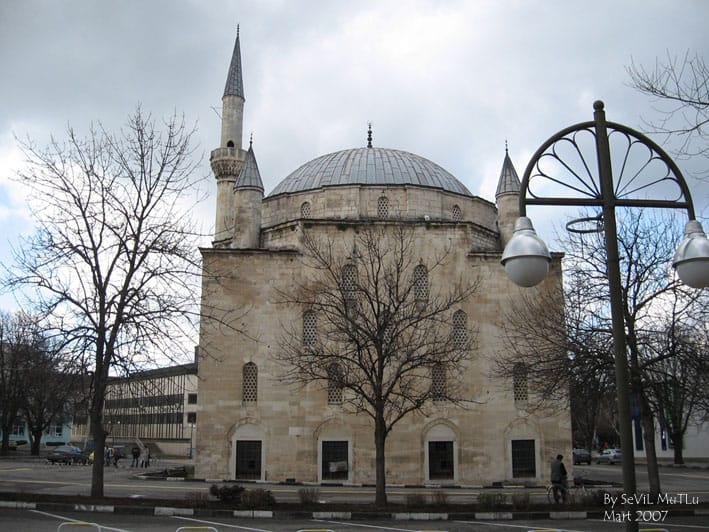

A grand vizier's mosque in Razgrad
Standing in present-day Razgrad in northern Bulgaria, known in the Ottoman period as Hezargrad, the mosque was built by the grand vizier Makbul Ibrahim Pasha as the centre of a complex (külliye). The deed of endowment (vakfiye) for the mosque and a school is dated September–October 1533. Evliya Çelebi records that the mosque was accompanied by a public kitchen (imaret), a madrasa, a Qur'an school, a primary school and a bath. According to an Arabic inscription of 1616 in the mosque, the building had not been fully finished and was completed in that year by Mahmud Pasha.
The square building, about 20 × 20 m, is built of finely cut stone, with three rows of windows on its facades; the prayer hall is covered by a lead-clad dome estimated to be no less than 18 m in diameter. The small turrets with conical caps at the corners, where the square body turns into an octagon, are unique in Turkish architecture and are thought to have been added during an 18th- or 19th-century restoration. The town suffered in the Ottoman–Russian wars of 1810 and 1828–1829, and the withdrawing Russian army wrecked the mosque's portico and carried off its marble columns. Closed after the Second World War, the mosque was placed under protection but had not been restored by 2000; the other buildings of the complex have been lost.
Endowment deed and sources
The endowment deed of 1533, drawn up by the chancery scribe Mehmed bin Kara Üveys, assigns lands in the sanjak of Nikopol to the mosque and the school and is kept in the Topkapı Palace Museum Archive. Ayvansarayi reports that Ibrahim Pasha also had mosques in Thessaloniki, where the Hagia Sophia had been converted from a church, as well as in Kavala and Hezargrad. Evliya Çelebi, who passed through Hezargrad in 1652, writes that Ibrahim Pasha developed the town because he came from there; in fact the pasha was from Parga on the Adriatic coast. According to Evliya, the mosque's interior was extremely ornate, and the Kurşunlu Han, one of the town's twelve khans, and most of its roughly 300 shops also belonged to Ibrahim Pasha's endowment.
An excavation in the 1980s uncovered walls of a smaller mosque beneath the present building. Ekrem Hakkı Ayverdi mentions a panel stating that the mosque's roof was built in 1603 and traditions giving the dates 1616 and 1625; according to him, the imaret and the double bath of the complex were repaired in 1659–60 and 1753–54.
Wrong dates and neglect
F. Kanitz mistakenly converted the year 1025 in the inscription as 1614 and claimed that the mosque was built by Macedonian-Vlach architects; Eyice, however, stresses that with all its exterior proportions and very wide dome the building belongs to Ottoman art. Kanitz writes that in the 1870s the mosque, despite an income of 7,000 gold pounds from seven endowed villages, was poorly maintained and damp seeping through the roof was damaging it everywhere; right next to the mosque stood a mansion built by Midhat Pasha during his years as governor of the Danube province.
In 1976 Ayverdi found the mosque abandoned, its portico in ruins and its door chained shut. The Bulgarian Ministry of Culture placed the mosque under protection, and the Chief Mufti's Office of Bulgaria collected money for its restoration.
Façades and minaret
The pointed-arched windows on the façades follow a rhythmic arrangement: four in the lower row, three in the second and two in the top row. The flat pilasters between the windows of the dome's drum are foreign to classical-period mosques; Eyice therefore thinks the drum was altered in the 18th or 19th century. The portico destroyed by the Russians was rebuilt in timber and mud brick. On either side of the main door are seating niches with muqarnas, and the wooden door leaves are of interlocking work. The minaret, adjoining the right side, has a long faceted base like 16th-century minarets, a chamfered shaft and a balcony on three rows of muqarnas corbels; like the minarets in the former Ottoman lands of Europe, it is slender and tall.
Source: TDV Encyclopedia of Islam (TDV İslâm Ansiklopedisi), “İBRÂHİM PAŞA CAMİİ” (Semavi Eyice)
Related sultans
Cite as: Atlas of the Sultans, “Ibrahim Pasha Mosque · Ottoman monuments”, https://padisahlaratlasi.com/en/monuments/ibrahim-pasha-mosque/ (last updated 21 November 2026). Corrections · Image credits