TRENDEFRARAtlas of the Sultans · 22 / 39 · sultan
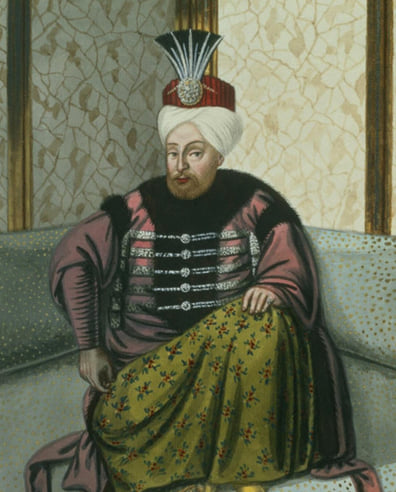
Imaginary portrait (made later) — artist and date unknown
Mehmed IV
Avcı (“the Hunter”)
His reign saw both the empire's last great expansion and its heaviest reversal. The state, revived under the Köprülü viziers, lost Hungary and Transylvania within four years of the second siege of Vienna.
Open the reign of Mehmed IV on the map▶ Watch the 1-minute video: YouTube · Instagram · TikTok
Interesting fact
He came to the throne in 1648 at the age of seven. A childhood interest in hunting grew into a great passion, which is why he is called “Avcı” (the Hunter).
Source: TDV İslâm Ansiklopedisi (Turkish), article “MEHMED IV”
Life
A seven-year-old sultan
Mehmed was born in Istanbul on 2 January 1642. His father was Sultan Ibrahim and his mother Hatice Turhan Sultan. Because of his passion for hunting he is known by the epithet “the Hunter” (Avcı). He spent his childhood in the palace and was educated by the imperial imams.
As his father's erratic behavior continued, he was placed on the throne on 8 August 1648, at the age of seven, with the approval of his grandmother Kösem Sultan, the statesmen and the Janissaries. The first years of his reign passed in turmoil, with power divided between his grandmother Kösem Sultan and his mother Turhan Sultan, and with the aghas of the kapıkulu troops holding the state in their grip. The first of these upheavals was the 1648 revolt of the sipahis protesting Ibrahim's murder (the Sultan Ahmed Mosque incident).
Palace feuds and the Plane Tree Incident
To rid herself of her young rival Turhan Sultan, who had won the support of the Janissary aghas, Kösem Sultan planned to depose Mehmed and enthrone his brother Suleiman; but before she could carry this out she was killed by palace aghas on 2 September 1651. Turhan Sultan, as valide sultan (queen mother), gained a decisive voice in government.
The empty treasury and the inability to pay salaries led to new revolts. Tarhuncu Ahmed Pasha, appointed grand vizier in 1652 on condition that no one interfere in his financial decisions, tried to curb waste and close the budget deficit by auditing the customs and the expenses of the palace kitchen and the arsenal; but he was killed in March 1653 because of the discontent caused by the new taxes he imposed. In March 1656, under pressure from rebellious sipahis and Janissaries, the young sultan was forced to have the palace aghas they demanded put to death; their bodies were hung from a plane tree in Sultanahmet Square. In the chronicles this event is called the “Plane Tree Incident” (Çınar Vakası) or “Vak'a-i Vakvakıyye”. The war with Venice over Crete was also going against the Ottomans; the Venetian fleet had blockaded the Dardanelles.
The Köprülü era
This crisis was overcome with Köprülü Mehmed Pasha, who was appointed grand vizier on 15 September 1656 on the recommendation of the architect Kasım Ağa and under certain conditions that Turhan Sultan accepted. Köprülü brought order back to the state with broad powers and harsh methods. The Venetian fleet was defeated, the Dardanelles were reopened and the islands at the mouth of the strait were recovered; the Transylvanian (Erdel) question was settled in the Ottomans' favor, and Abaza Hasan Pasha's great revolt in Anatolia was suppressed. After the great fire of 1660, work began on completing the Yeni Cami (New Mosque) complex, which had stood unfinished for sixty-three years. On 30 October 1661, on his recommendation, his son Fazıl Ahmed Pasha became grand vizier; the TDV article describes this as a period reminiscent of the Ottoman state's age of ascendancy.
Under Fazıl Ahmed Pasha, Uyvar was conquered, and in 1664 the twenty-year Treaty of Vasvár was signed with Austria. With the capture of Candia (Kandiye) in 1669, the Cretan war, which had lasted twenty-five years, came to an end. The sultan waited in the Morea during this siege. On 5 June 1672 he set out on the Polish campaign with a magnificent ceremony; it is said that he took part in the siege of Kamieniec (Kamaniçe) in disguise, alongside the soldiers. With the Treaty of Buczacz (Bucaş), Podolia passed to the Ottomans. According to the atlas, in 1683 the Ottoman state was still at its last great extent, exceeding 5 million km².
Vienna and deposition
On the death of Fazıl Ahmed Pasha in 1676, Merzifonlu Kara Mustafa Pasha, a product of the Köprülü school, became grand vizier. Because of the Ukrainian Cossacks, the first Ottoman-Russian war broke out; during the 1678 Chyhyryn (Çehrin) campaign the sultan did not cross the Danube and preferred to hunt at Silistra. Kara Mustafa Pasha chose Vienna as his target in pursuit of a great success; the rout at Vienna in 1683 opened a new and very difficult period in Ottoman history.
With Austria, Poland, Venice and Russia taking part, the war turned into a struggle on many fronts. According to the TDV article, despite these setbacks Mehmed IV did not give up his hunting pleasures, and after his mother's death in 1683 he made wrong decisions under the influence of those around him. Buda (Budin) fell in 1686; although, in response to public reaction, he announced that he had given up hunting, opinion of him did not change. After the defeat at Mohács in August 1687, the army, whose pay was in arrears, mutinied and marched on Istanbul, and Mehmed IV was deposed on 8 November 1687; he was succeeded by his brother Suleiman II.
Last years and death
After his deposition he lived under watch in the palace; when Suleiman II set out on the Hungarian campaign in 1689 he was taken to Edirne, and he also lived to see the reign of his other brother, Ahmed II. He died on 6 January 1693 in Edirne, the city he loved so much. His body was brought to Istanbul and buried in the tomb of his mother, Turhan Sultan, beside the Yeni Cami.
With a reign of nearly forty years, he is one of the longest-reigning sultans. Edirne, where he spent most of his reign, relived its former glory in his time; he took a close personal interest in the great wedding festivities he had organized there in 1675. The number of composers and performers grew during his reign; some of the compositions of Hafız Post and Buhurizade Mustafa Itri have survived to the present day. The TDV article assesses him as a sultan who reigned during a highly critical period of Ottoman history but who did not play an effective role in affairs of state; the successes of his era were largely the work of the Köprülü grand viziers.
Source: TDV Encyclopedia of Islam (TDV İslâm Ansiklopedisi), “Mehmed IV” (Abdülkadir Özcan); the main sources of this article are Naima, Karaçelebizade, Abdi Pasha's Vekayi'name, Silahdar Fındıklılı Mehmed Ağa and Defterdar Sarı Mehmed Pasha.
Meanwhile in the world
Contemporary rulers
- Louis XIVKing of France · 1643–1715The 'Sun King', emblem of absolute monarchy and builder of Versailles
- Leopold IHoly Roman Emperor · 1658–1705Habsburg ruler whose long reign was marked by rivalry with France
- Charles IIKing of England, Scotland and Ireland · 1660–1685Restoration king who brought back the monarchy after the Commonwealth
- Alexis (Aleksey Mikhaylovich)Tsar of Russia · 1645–1676Romanov tsar whose 1649 law code legally defined serfdom
- Abbas IISafavid Shah of Iran · 1642–1666Regarded as the ablest Safavid ruler after Abbas I
- AurangzebMughal Emperor of India · 1658–1707Last of the great Mughals; the empire reached its greatest extent
- KangxiEmperor of China (Qing dynasty) · 1661–1722His 61-year rule is the longest official reign in Chinese history
What was happening in the world?
- 1648The Peace of Westphalia ended the Thirty Years' War and recognized Dutch and Swiss independence.
- 1649King Charles I of England was executed in London after the Civil War, and a commonwealth was proclaimed.
- 1666The Great Fire of London destroyed much of the City, including old St Paul's Cathedral and some 13,000 houses.
- 1682Louis XIV made the Palace of Versailles the official seat of the French court and government.
- 1687Isaac Newton published the Principia, setting out his laws of motion and the law of universal gravitation.
Sources: britannica.com [1] [2] [3] [4] [5] [6] [7] [8] [9] [10] [11] [12] · iranicaonline.org [1]
Family
| Father | Ibrahim |
|---|---|
| Mother | Turhan Hatice Sultan |
| Consorts | Emetullah Rabia Gülnuş Sultan, Afife Kadın |
| Children | Mustafa II, Ahmed III, Hatice Sultan |
Major achievements
- Enthroned at six and reigned thirty-nine years — the second-longest reign
- Reforms of the Köprülü viziers Mehmed Pasha and Fazıl Ahmed Pasha; finances and army set in order
- Conquest of Crete completed: fall of Candia (1669)
- Conquest of Kamianets (1672) and the annexation of Ukrainian lands — the last great expansion
- Second siege of Vienna (1683) and the beginning of the wars of the Holy League
- Long stays in Edirne and a passion for hunting
Treaties
- Peace of Vasvár (1664, Austria)
- Treaty of Buczacz (1672, Poland)
- Treaty of Bakhchisaray (1681, Russia)
Grand viziers
| Name | From | To | Length |
|---|---|---|---|
| Sofu Mehmed Pasha | August 7, 1648 | May 19, 1649 | 285 days |
| Kara Murad Pasha | May 21, 1649 | August 5, 1650 | 1 year, 76 days |
| Melek Ahmed Pasha | August 5, 1650 | August 21, 1651 | 1 year, 16 days |
| Abaza Siyavuş Pasha | August 21, 1651 | October 1, 1651 | 41 days |
| Gürcü Mehmed Pasha | October 1651 | June 20, 1652 | |
| Tarhuncu Ahmed Pasha | June 20, 1652 | March 21, 1653 | 274 days |
| Koca Derviş Mehmed Pasha | March 21, 1653 | October 28, 1654 | 1 year, 221 days |
| Ipşir Mustafa Pasha | October 28, 1654 | May 11, 1655 | 195 days |
| Kara Murad Pasha (term 2) | May 11, 1655 | August 19, 1655 | 100 days |
| Malatyalı Süleyman Pasha | August 19, 1655 | February 27, 1656 | 192 days |
| Deli Hüseyin Pasha | February 28, 1656 | March 5, 1656 | 6 days |
| Zurnazen Mustafa Pasha | March 5, 1656 | March 5, 1656 | 0 days |
| Abaza Siyavuş Pasha (term 2) | March 5, 1656 | April 25, 1656 | 51 days |
| Boynueğri Mehmed Pasha | April 26, 1656? | September 14, 1656 | |
| Köprülü Mehmed Pasha | September 15, 1656 | October 31, 1661 | 5 years, 46 days |
| Köprülüzade Fazıl Ahmed Pasha | November 1, 1661 | November 3, 1676 | 15 years, 2 days |
| Merzifonlu Kara Mustafa Pasha | November 5, 1676 | December 1683 | 7-8 years |
| Kara Ibrahim Pasha | December 1683 | December 18, 1685 | 2-3 years |
| Sarı Süleyman Pasha | December 18, 1685 | September 19, 1687 | 1 year, 275 days |
| Köprülü Damadı Siyavuş Pasha | September 23, 1687 | March 1, 1688 | 160 days |
Battles and treaties
| Year | Event | Result / parties |
|---|---|---|
| 1656 | Naval battle: Battle of the Dardanelles (1656) | Heavy defeat of the Ottoman fleet |
| 1656 | Revolt: Plane Tree Incident | The palace aghas and some thirty statesmen the troops demanded were killed and their bodies hung on the plane trees of the Hippodrome; the grand vizier and … |
| 1658 | Revolt: Revolt of Abaza Hasan Pasha | He defeated Murtaza Pasha, commander in Anatolia, at Ilgın; withdrawing to Aleppo for the winter, he was killed there with the viziers of his entourage in a … |
| 1663 | Siege: Siege of Érsekújvár (1663) | The fortress surrendered on terms; nearby fortresses were also taken |
| 1664 | Treaty: Peace of Vasvár | |
| 1664 | Battle: Battle of Saint Gotthard (1664) | Went against the Ottomans but was no complete rout; the Peace of Vasvár followed |
| 1669 | Siege: Conquest of Candia | Candia surrendered by agreement; the conquest of Crete was complete |
| 1672 | Siege: Conquest of Kamianets | Kamianets conquered; the province of Podolia was created |
| 1672 | Treaty: Treaty of Buczacz | |
| 1673 | Battle: Battle of Khotyn (1673) | The Ottoman army was defeated and Khotyn passed to the Poles; it was retaken in 1674 |
| 1677 | Campaign: Chyhyryn campaigns (1677–1678) | The 1677 siege failed; in 1678 the fortress was taken and razed |
| 1681 | Treaty: Treaty of Bakhchisaray | |
| 1683 | Siege: Second Siege of Vienna | The Ottoman army was defeated and withdrew; the wars of the Holy League began |
| 1685 | Campaign: Venetian conquest of the Morea (1684–1686) | The whole peninsula fell to Venice; ceded to Venice at Karlowitz (1699) |
| 1686 | Siege: Loss of Buda | Buda fell to the army of the Holy League |
| 1687 | Revolt: Army Revolt of 1687 | Mehmed IV was deposed and Suleiman II enthroned (8 November 1687) |
Full infoboxes are in the site’s “Battles and Treaties” tab; source: TDV Encyclopedia of Islam.
Death
He was deposed in 1687 after the defeat at Vienna and died under guard in Edirne in 1693.
Territorial change
| Year | Region | Event | Source |
|---|---|---|---|
| 1663 | + Nové Zámky (Uyvar) | Capture of Nové Zámky (September 1663) — the province of Uyvar was created; retaken by the Habsburgs after the defeat at Vienna (1685) | TDV İA, “UYVAR” |
| 1669 | + Crete | End of the Cretan War — conquest of Candia (1669) after a twenty-four-year siege | TDV İA, “MEHMED IV” |
| 1672 | + Podolia (Kamianets) | Polish campaign and conquest of Kamianets (1672), Treaty of Buczacz | TDV İA, “MEHMED IV” |
| 1672 | − Lahsa (Eastern Arabia–Qatar) | Lahsa left to the rule of the Bani Khalid (1672) | Kurşun, “Osmanlı Devleti’nin Basra Körfezi Siyaseti”, FSMİAD 12 (2018), p. 24 |
| 1685 | − Nové Zámky (Uyvar) | Capture of Nové Zámky (September 1663) — the province of Uyvar was created; retaken by the Habsburgs after the defeat at Vienna (1685) | TDV İA, “UYVAR” |
| 1686 | − Buda (central Hungary) | Fall of Buda (2 September 1686) — central Hungary passed to the Habsburgs; recognised by the Treaty of Karlowitz (1699) | TDV İA, “MEHMED IV” |
| 1687 | − Eastern Slavonia and Syrmia (Osijek–Vukovar) | Defeat at the second Battle of Mohács (August 1687) — Osijek and eastern Slavonia passed to the Habsburgs; Karlowitz (1699) | TDV İA, “SLAVONYA” |
| 1687 | − Western Slavonia (Virovitica–Čazma) | After the defeat at Mohács (1687) Virovitica and western Slavonia passed to the Habsburgs; Karlowitz (1699) | TDV İA, “SLAVONYA” |
| 1687 | − Morea (Peloponnese) | Venice's Morean campaign (1685–1687) — Koroni, Navarino, Nafplio, Patras and Mystras fell; the Treaty of Karlowitz (1699) left the Morea to Venice | TDV İA, “MEHMED IV” |
The lands that changed hands in this period, and the battles or treaties that brought the changes, can be seen on the map: map of the reign of Mehmed IV.
Cite as: Atlas of the Sultans, “Mehmed IV (Avcı (“the Hunter”)): Reign Map, Wars and Conquests (1648–1687)”, https://padisahlaratlasi.com/en/sultans/iv-mehmed/ (last updated 21 November 2026). Corrections · Image credits
Terms on this page: Vizier
Grand viziers of this reign: Köprülü Mehmed Pasha · Köprülüzade Fazıl Ahmed Pasha · Merzifonlu Kara Mustafa Pasha
Monuments of this reign: New Mosque and Complex (Eminönü) · Aynalıkavak Pavilion · Spice Bazaar · Köprülü Library · Hammouda Pacha Mosque · Tomb of Sultan Murad · Merzifonlu Kara Mustafa Pasha Mosque
Women of the dynasty in this reign: Kösem Sultan · Turhan Sultan · Gülnuş Emetullah Sultan
Capital in this reign: Edirne · Istanbul
Myths and misconceptions: Was Istanbul always the Ottoman capital? · Did the Ottomans reach their greatest extent under Suleiman the Magnificent? · Did women really rule the state during the “Sultanate of Women”? · Did the Ottoman state collapse right after the 1683 defeat at Vienna?