TRENDEFRARAtlas of the Sultans · Ottoman monuments
New Mosque and Complex (Eminönü)
Monument · Mosque and complex, 1598–1665
- Type
- Mosque
- Built
- 1598–1665

The work of two valide sultans
The founder of the complex in front of the port and commercial district of Eminönü is Safiye Sultan, the mother of Mehmed III. Construction was begun on 9 April 1598 by the architect Davud Ağa; the ground was strengthened with piles whose ends were tied together with lead bands. When Davud Ağa died in September 1598, Dalgıç Ahmed Ağa was appointed in his place and raised the building up to above the first row of windows. When Mehmed III died in 1603 and Safiye Sultan was sent to the Old Palace, construction was left unfinished.
After the great Istanbul fire of 1660, Hatice Turhan Valide Sultan, touring the devastated areas, decided to complete the unfinished mosque. Construction, resumed in 1661 under the responsibility of the chief architect Mustafa Ağa, was finished, and the mosque was opened for worship with the Friday prayer performed on 30 October 1665. The endowment deed and the inscriptions bear the date 1663–64.
The mosque and the buildings of the complex
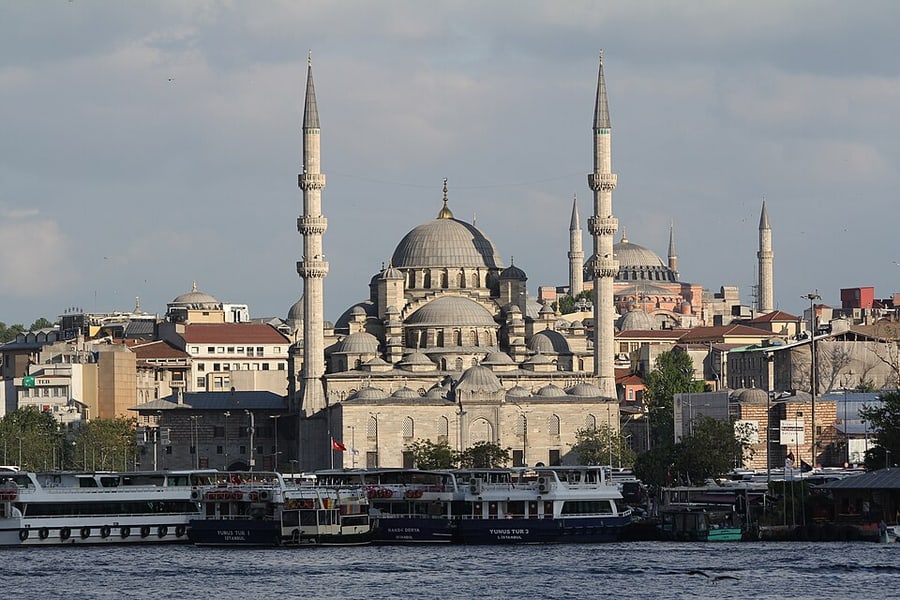
The mosque, continuing the arcaded-courtyard scheme of classical Ottoman architecture, is centrally planned. Its prayer hall, measuring 35.50 × 40.90 metres, is covered by a main dome 16.20 metres in diameter and by semi-domes in four directions. The columned galleries on the two side façades give the building a lively appearance. It has two minarets with three balconies each. The walls are faced up to above the second row of windows with tiles dominated by blue, turquoise and green; according to the author of the article, the technical decline of the 17th century is easily seen in these tiles.
The complex consists of the mosque, a royal pavilion, the arasta known as the Egyptian Bazaar (Mısır Çarşısı), a tomb, a darülkurra, a sebil, a fountain and a primary school. The madrasa, imaret and ribats (hostels) mentioned during the first construction were not built. The “L”-shaped market has eighty-eight shops in all. Forty-four people lie in the tomb, including Hatice Turhan Sultan, Mehmed IV, Mustafa II, Ahmed III, Mahmud I and Osman III, as well as other members of the dynasty. Later, Ahmed III added a library (1724–1725), and in the reign of Mahmud II a timekeeper's house was added in 1813.
Fires and a changing setting
The fires of 1688 and 1691 did great damage to the market; the shops were repaired. After falling into ruin over time, the market was altered in the 1940–1943 restoration and took its present form. The sebil and the fountain were damaged when an adjoining store burned, and were repaired in 1906.
In the second half of the 19th century, after the Galata Bridge was built, the outer courtyard wall of the mosque was demolished together with the shops around it because of the increased traffic, and a road was put through between the mosque and the market. When the primary school was also demolished in 1904, the unity of the complex, according to the author of the article, was broken.
The present state
The mosque was repaired in 1912–1913; in the restoration of recent years its painted decoration was renewed. The three-storey royal pavilion underwent a thorough repair in 2006-2009. The primary school and the courtyard wall of the mosque have not survived. The sebil and the fountain now stand on a separate island south of the mosque.
Source: TDV Encyclopedia of Islam (TDV İslâm Ansiklopedisi), “YENİCAMİ KÜLLİYESİ” (Ahmet Vefa Çobanoğlu)
Related sultans
Cite as: Atlas of the Sultans, “New Mosque and Complex (Eminönü) · Ottoman monuments”, https://padisahlaratlasi.com/en/monuments/new-mosque-and-complex-eminonu/ (last updated 21 November 2026). Corrections · Image credits