TRENDEFRARAtlas of the Sultans · Grand viziers
Merzifonlu Kara Mustafa Pasha
Grand vizier, 1676–1683
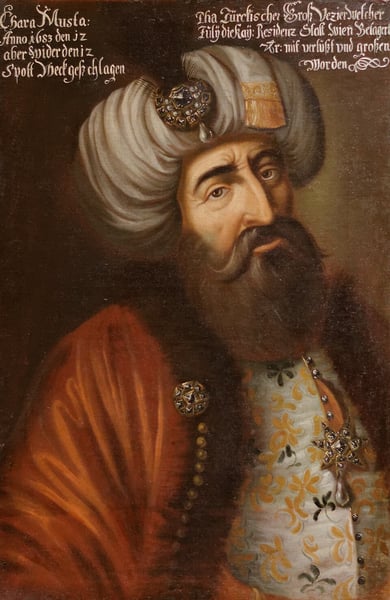 AI

At the side of the Köprülüs
He was born in 1634–35 in the village of Marınca near Merzifon, the son of the timar-holding sipahi Oruç Bey. When his father fell in Murad IV's siege of Baghdad he was orphaned at the age of four, and he was brought up together with the sons of his father's friend Köprülü Mehmed Pasha, under the latter's protection. According to another account, however, he was the son of a sipahi named Derviş and was born in 1626–27. He became Köprülü's son-in-law; during Köprülü's grand vizierate he served as his sword-bearer (silahdar) and as the official who presented his memoranda to the sultan (telhisçi).
When he brought the good news of the conquest of Ineu (Yanova) he was appointed master of the horse (mirahur), and two years later governor-general of Silistra. Under Fazıl Ahmed Pasha he served as grand admiral for more than four years; while the grand vizier was away on the Nové Zámky and Crete campaigns he governed Istanbul as deputy grand vizier. He distinguished himself in the siege of Kamianets and conducted the negotiations for the Treaty of Buchach in 1672. On the death of Fazıl Ahmed Pasha he became grand vizier on 5 November 1676.
The Chyhyryn campaign
The first important question of his grand vizierate was the situation of the Ukrainian Cossacks. When the first campaign, sent after Hetman Doroshenko, who was under Ottoman protection, surrendered Chyhyryn (Çehrin) to the Russians, produced no result, he set out in person in 1678 as commander-in-chief and captured the fortress of Chyhyryn. He had the fortress, which was difficult to defend, demolished and had two new fortresses built on the bank of the Dnieper. When the Russians attacked again, a second campaign was decided upon, but it was abandoned when peace terms accepting the river Özü (Dnieper) as the border were ratified in 1681; in 1680 a commercial treaty was signed with the Netherlands.
The siege of Vienna
The article states that Kara Mustafa Pasha, who took over from the Köprülüs a country whose internal and external problems had largely been resolved, tied the preservation of his office to successes on the scale of his predecessors'; it finds groundless, however, Cantemir's claims that he wanted to become German emperor. He proclaimed Imre Thököly, the leader of the Protestant Hungarians, king of Middle Hungary, rejected the proposals of Austria, which wished to renew the peace, and, having also won public opinion to his side through preachers, persuaded the sultan to go to war. While the target was Győr (Yanıkkale), at the council held at Székesfehérvár (Istolni Belgrad) it was decided to besiege Vienna; Mehmed IV expressed his surprise, saying that he had not been informed of this in advance.
The army arrived before Vienna on 14 July 1683; but because the large siege guns had not been brought, the siege dragged on and food shortages began. Polish forces under the command of Jan Sobieski held the Kahlenberg hill and got behind the army. In the battle of 12 September the right wing gave way first, and when the expected help from the Crimean khan did not arrive, panic broke out on the left wing as well; after holding out for five or six hours Kara Mustafa Pasha was forced to withdraw, taking with him the Holy Banner (sancak-ı şerif). Some 300 cannon and the army treasury were left behind.
Execution and character
At Győr he had Uzun Ibrahim Pasha, governor of Buda, who had been the first to abandon the camp, put to death; he regained control of the army and wanted to spend the winter in Belgrade and make good the defeat in the spring. But because of his obstinacy and harshness he also had powerful enemies at the palace; through their intrigues Mehmed IV issued a decree for his execution, and he was executed in Belgrade on 25 December 1683. There are different accounts of where his head was buried. The sources describe him as an intelligent, dignified, brave and able soldier, but very proud, stubborn and fond of fame. His külliye on the Divanyolu was completed by his son Ali Pasha; he also built a mosque, a library and a bedesten in Merzifon.
Source: TDV Encyclopedia of Islam, “MERZİFONLU KARA MUSTAFA PAŞA” (Abdülkadir Özcan)
Related sultans
City: Amasya
Cite as: Atlas of the Sultans, “Merzifonlu Kara Mustafa Pasha · Grand viziers”, https://padisahlaratlasi.com/en/grand-viziers/merzifonlu-kara-mustafa-pasha/ (last updated 21 November 2026). Corrections · Image credits