TRENDEFRARAtlas of the Sultans · Ottoman monuments
Spice Bazaar
Monument · Bazaar, Istanbul, 17th century
- Type
- Bazaar
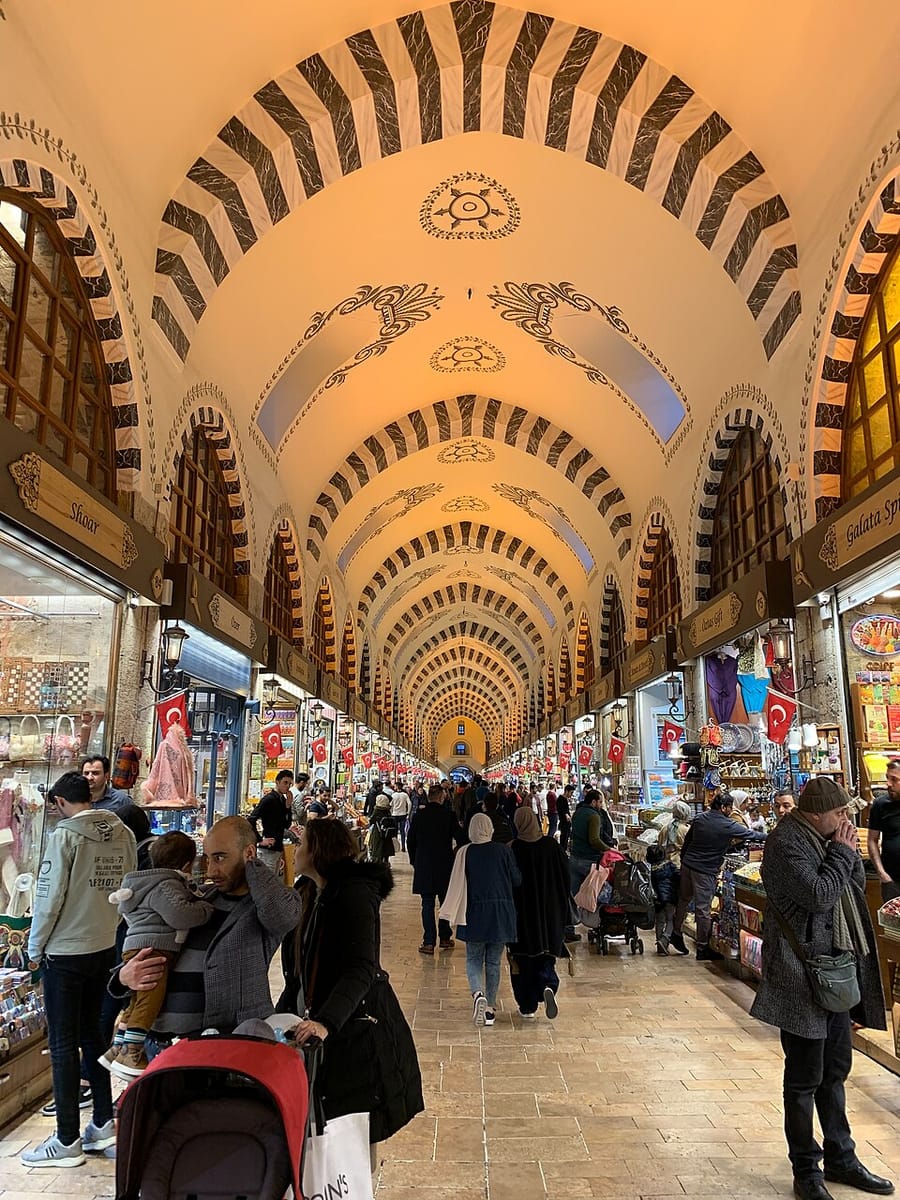

The market street of the New Mosque complex
The Spice Bazaar (Mısır Çarşısı, 'Egyptian Bazaar') in Eminönü is the arasta, or covered market street, of the Yeni Cami (New Mosque) complex built by Hatice Turhan Valide Sultan in the second half of the 17th century. Known at first as the Valide Çarşısı or Yeni Çarşı, it has been called Mısır Çarşısı since the mid-18th century. Its rows of facing shops form an L: the short arm lies to the north and the long arm runs south. Where the two vaulted streets meet is a cross-vaulted 'prayer square'.
The bazaar contains eighty-eight shops in all and opens to the outside through six gates, those at the ends of the arms fronted by porticoes. A fire on 8 March 1688 damaged the outer shops on the north side, and another that broke out inside the bazaar on 3 January 1691 caused heavy damage, after which the shops were repaired. The walls that once divided each shop into two rooms were later removed. Having fallen into disrepair over time, the building took its present form during the restoration of 1940–1943.
Shops and gates
Twenty-three shops line each side of the bazaar's long arm and eighteen each side of its short arm, with six more where the arms meet. Another eighteen shops face north along the outer front of the short arm. These outer shops and those behind them are vaulted, while the others are domed. The bazaar's streets are covered by vaults resting on pointed arches.
Besides the facing gates at the ends of the arms, a further pair of facing gates opens in a bay near the middle of the long arm. Above the porticoed gates at the ends of the arms are rooms covered by domes and vaults. The gate opening onto Tahmis Street is also porticoed, but has no room above it.
Part of the Yenicami complex
The arasta belongs to the Yenicami complex, begun in 1598 for Safiye Sultan by the architect Davud Agha and completed after the fire of 1660 by Hatice Turhan Valide Sultan; the complex's mosque opened for worship with the Friday prayer of 30 October 1665. Besides the mosque and the arasta, the complex includes a royal pavilion, a mausoleum, a school for Qur'an reciters, a sebil, a fountain and a primary school. In the mausoleum between the bazaar and the mosque lie forty-four people, among them Hatice Turhan Sultan, Mehmed IV, Mustafa II, Ahmed III, Mahmud I and Osman III.
After the Galata Bridge was built in the second half of the 19th century, rising traffic led to the demolition of the wall enclosing the mosque's outer courtyard, together with the shops that had gradually multiplied around it; a road was cut between the mosque and the bazaar and the courtyard disappeared. With the demolition of the primary school in 1904, the unity of the complex was lost.
Related sultans
Cite as: Atlas of the Sultans, “Spice Bazaar · Ottoman monuments”, https://padisahlaratlasi.com/en/monuments/spice-bazaar/ (last updated 21 November 2026). Corrections · Image credits