TRENDEFRARAtlas of the Sultans · 21 / 39 · sultan
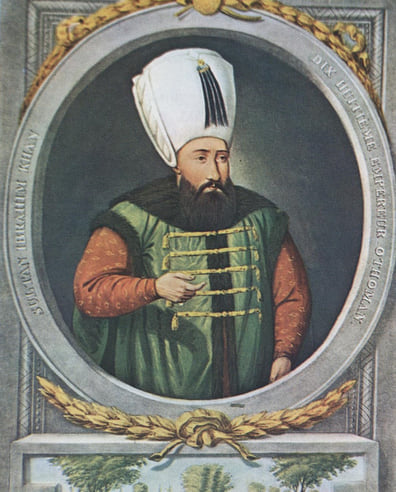
Imaginary portrait (made later) — artist and date unknown
Ibrahim
He came to the throne as the last male of the dynasty; three of his sons later became sultan, so the Ottoman line continued through him. His extravagance and the influence of his court circle led to the uprising that ended his reign.
Open the reign of Ibrahim on the map▶ Watch the 1-minute video: YouTube · Instagram · TikTok
Interesting fact
When he came to the throne he was the only surviving male of the dynasty: Murad IV’s sons had died very young and his brothers had been killed. The survival of the Ottoman line depended on him.
Source: TDV İslâm Ansiklopedisi (Turkish), article “İBRÂHİM”
Life
A youth lived in fear
Ibrahim was born on 4 November 1615. He was the last of the three sons of Ahmed I who came to the throne; his mother was Kösem Mahpeyker Sultan. His years as a prince coincided with the most turbulent period of the Ottoman palace: the crisis brought on by the mental instability of his uncle Mustafa I, the deposition and murder of his elder brother Osman II, and the revolts of the first ten years of his other elder brother, Murad IV.
According to the TDV article, the events he witnessed in these years and the constant danger of death under which he lived shook the mental balance of Ibrahim, who was of a highly sensitive nature. He was deeply affected when Murad IV had his brothers Bayezid and Süleyman strangled in August 1635, and Kasım as he set out on the Baghdad campaign. Tradition holds that Murad, on his deathbed, obtained a fatwa to have him killed as well, but that Kösem Sultan prevented it. Even so, according to the article, he had received what could be considered a good education as a prince.
Accession
When Murad IV died on 8 February 1640, Ibrahim saw the palace official (kapı ağası) sent by Grand Vizier Kemankeş Kara Mustafa Pasha to bring the news of the death, took it for a trap to kill him, and refused to come out of the place where he was confined. His mother persuaded him; after seeing his brother's body he took the throne, and the official ceremony of allegiance was held on 9 February 1640. He was twenty-five years old and the only living male member of the dynasty; for this reason the TDV article refers to him as, in a sense, the “second founder” of the dynasty.
The era of Kemankeş Mustafa Pasha
In the first years of his reign the state was largely run by Grand Vizier Kemankeş Kara Mustafa Pasha. The pasha tried to put the treasury in order and to reduce the number of kapıkulu (the sultan's salaried household troops). As recommended in the memoranda attributed to Koçi Bey and presented to the sultan, a new coinage of sound standard was struck (January 1641), and a general survey (tahrir) was carried out in Anatolia to re-establish the household counts on which the avarız tax would be based; in his imperial rescripts the sultan called for fairness in the collection of taxes. Campaigns in which the Crimean khan also took part were organized to recover Azov, which had fallen into the hands of the Don Cossacks; during the second campaign, in 1642, the Cossacks abandoned the fortress before the Ottoman forces arrived, and Azov was recovered. On 19 March 1642 the Treaty of Zsitvatorok with the Habsburgs was renewed at Szöny.
Mustafa Pasha, however, clashed with figures in the sultan's circle, such as his tutor Cinci Hüseyin Efendi. His rivals, who were also backed by the sultan's favorites and by his mother, eventually prevailed, and Mustafa Pasha was executed in 1644. The TDV article notes that this execution set off the process of palace infighting that would lead all the way to Ibrahim's deposition.
The Cretan campaign
Ships belonging to the retired chief black eunuch (kızlarağası) Sünbül Ağa, bound for Egypt, were attacked and plundered by Maltese corsairs near Crete. On the grounds that the corsairs had found shelter in Venetian Crete, a great campaign was prepared. Only en route was it revealed that the target of the fleet, which set out from Navarino in June 1645, was Crete; the first objective was Chania (Hanya), and the city was taken that same summer. On 15 November 1646 the fortress of Rethymno (Resmo) was also captured.
In 1647 Candia (Kandiye), the island's main center, was placed under blockade; but this exceptionally strong fortress could be taken only in 1669, twenty-four years later. Venetian attempts to close the Dardanelles turned the Cretan war into a threat to Istanbul as well.
Last years, deposition and death
In the last years of his reign the sultan's erratic behavior increased. Grand Vizier Hezarpare Ahmed Pasha fed his passion for furs and imposed a sable tax, trying in this way both to keep the sultan occupied and to protect his own position; Vecihi writes that the craze for sable and ambergris became very widespread. Contrary to custom, Ibrahim married one of his concubines, Hümaşah Sultan, known as Telli Haseki, and had a magnificent wedding held for her in the palace. The emptying of the treasury and the losses on the fronts wore down both the people and the army.
Ibrahim was deposed on 8 August 1648 by the joint action of the leading statesmen, the ulema and the Janissaries; he was succeeded by his seven-year-old son, Mehmed IV. Kâtib Çelebi writes that, on the strength of a fatwa obtained on 18 August 1648, he was put to death by the executioner Kara Ali in the presence of the şeyhülislam, the grand vizier and the agha of the Janissaries. He was buried in the tomb of Mustafa I beside the door of the Hagia Sophia Mosque, which later came to be known after him as the “Tomb of Ibrahim”.
Source: TDV Encyclopedia of Islam (TDV İslâm Ansiklopedisi), “İbrâhim” (Feridun M. Emecen); the main sources of this article are Kâtib Çelebi, Naima, Karaçelebizade, Vecihi, documents in the Topkapı Palace archives and the reports of Western observers.
Meanwhile in the world
Contemporary rulers
- Ferdinand IIIHoly Roman Emperor · 1637–1657Ended the Thirty Years' War with the Peace of Westphalia in 1648
- Philip IVKing of Spain · 1621–1665King during Spain's decline as a great power
- Charles IKing of England, Scotland and Ireland · 1625–1649His quarrels with Parliament led to civil war and his execution
- Louis XIVKing of France · 1643–1715The Sun King, symbol of absolutism, reigned 72 years
- Abbas IISafavid Shah · 1642–1666Brought a brief revival amid the Safavid decline
- Shah JahanMughal Emperor · 1628–1658Built the Taj Mahal for his wife Mumtaz Mahal
- Shunzhi EmperorEmperor of Qing China · 1644–1661First Qing (Manchu) emperor enthroned in Beijing
What was happening in the world?
- 1640The December revolution in Portugal ended 60 years of Spanish rule; the Duke of Braganza became King John IV.
- 1642The English Civil War began when Charles I raised his standard at Nottingham.
- 1642Dutch navigator Abel Tasman became the first European to sight Tasmania and the coast of New Zealand.
- 1643Evangelista Torricelli invented the mercury barometer, becoming the first to create a sustained vacuum.
- 1644The Manchus entered Beijing; the Ming dynasty ended and the Qing dynasty began its rule over China.
- 1648The Peace of Westphalia ended the Thirty Years' War and the Eighty Years' War; Spain recognized Dutch independence.
Sources: britannica.com [1] [2] [3] [4] [5] [6] [7] [8] [9] [10] [11] [12]
Family
| Father | Ahmed I |
|---|---|
| Mother | Kösem Sultan |
| Consorts | Turhan Hatice Sultan, Saliha Dilaşub Sultan, Hatice Muazzez Sultan, Şivekar Sultan |
| Children | Mehmed IV, Suleiman II, Ahmed II, Şehzade Selim, Atike Sultan, Gevherhan Sultan, Bican Sultan |
Major achievements
- Azov recovered from the Cossacks (1642)
- Cretan campaign begun and Chania conquered (1645)
- Enthroned as the dynasty's only male, ensuring its continuation
Treaties
None recorded.
Grand viziers
| Name | From | To | Length |
|---|---|---|---|
| Kemankeş Kara Mustafa Pasha | December 24, 1638 | January 31, 1644 | 5 years, 38 days |
| Sultanzade Mehmed Pasha | January 31, 1644 | December 17, 1645 | 1 year, 320 days |
| Nevesinli Salih Pasha | December 17, 1645 | September 16, 1647 | 1 year, 273 days |
| Köse Musa Pasha | September 16, 1647? | September 21, 1647 | |
| Hezarpare Ahmed Pasha | September 21, 1647 | August 7, 1648 | 321 days |
| Sofu Mehmed Pasha | August 7, 1648 | May 19, 1649 | 285 days |
Battles and treaties
| Year | Event | Result / parties |
|---|---|---|
| 1645 | Siege: Conquest of Chania | The fortress of Chania was taken; the Cretan War began |
| 1647 | Revolt: Revolt of Varvar Ali Pasha | His army scattered in a surprise attack by Ipşir Mustafa Pasha; he was captured and executed, his head sent to Istanbul (20 May 1648) |
| 1648 | Revolt: Deposition of Sultan Ibrahim | Ibrahim was deposed and strangled ten days later; the seven-year-old Mehmed IV was placed on the throne |
Full infoboxes are in the site’s “Battles and Treaties” tab; source: TDV Encyclopedia of Islam.
Death
He was deposed in an uprising in 1648 and strangled ten days later.
Territorial change
The lands that changed hands in this period, and the battles or treaties that brought the changes, can be seen on the map: map of the reign of Ibrahim.
Cite as: Atlas of the Sultans, “Ibrahim: Reign Map, Wars and Conquests (1640–1648)”, https://padisahlaratlasi.com/en/sultans/ibrahim/ (last updated 21 November 2026). Corrections · Image credits
Terms on this page: Şehzade
Grand viziers of this reign: Kemankeş Kara Mustafa Pasha
Monuments of this reign: Aynalıkavak Pavilion · Çinili Mosque · Basketmakers' Kiosk
Women of the dynasty in this reign: Kösem Sultan · Turhan Sultan
Myths and misconceptions: Did women really rule the state during the “Sultanate of Women”?