TRENDEFRARAtlas of the Sultans · Ottoman monuments
Yıldırım Mosque (Bursa)
Monument · Mosque, Bursa, 1391–1395
- Type
- Mosque
- Built
- 1391–1395

The Bursa complex of Bayezid I
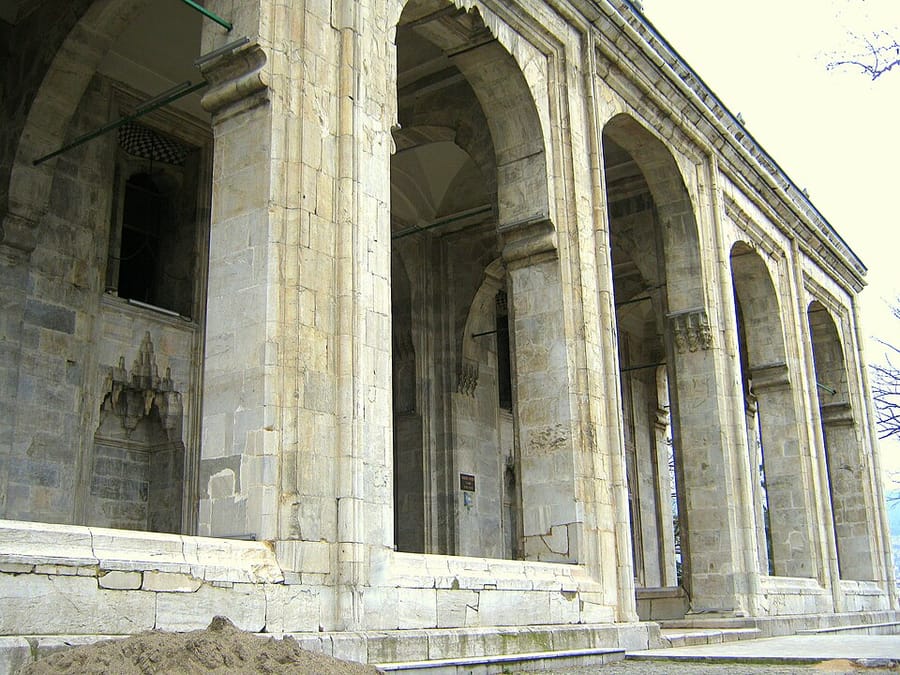
The complex stands on a hill in eastern Bursa, in the district that now takes its name, Yıldırım, from it. It was built between 1391 and 1395 by Bayezid I, known as Yıldırım (the Thunderbolt); its endowment deed is dated 1400. It comprises a mosque, a madrasa, a soup kitchen (imaret), a bathhouse, a tomb and, at some distance, a hospital (darüşşifa). The mosque, of the type with side rooms (zaviye or tabhane), resembles the mosques of Orhan Gazi and Murad I but surpasses them in architecture and craftsmanship. Its portal, the fine muqarnas of its window frames and its marble work stand out, and the so-called Bursa arch was used here for the first time. The main dome is 12 m wide and 22 m high.
Designed with two minarets, the mosque received only one, which fell in the 1855 earthquake; two later minarets also collapsed over time. A minaret added in 1972 was removed in 2011 and two minarets were built according to the original design. The madrasa, where scholars such as Molla Gürani and Ebussuud Efendi taught, has served as a health facility since 1948. The hospital, the first hospital building in Ottoman architecture, is today an eye hospital. The arcaded tomb of Bayezid I was built in 1406 by his son Prince Süleyman; the soup kitchen has not survived.
Land, water and stonework
The land on which the complex was built, known as the Şüşteri Garden, belonged to the endowment of Orhan Gazi; in exchange, the village of Ortakızık was given to the Orhan Gazi endowment. Water from Akçağlayan, one of the famous springs of Uludağ, was brought to the complex by aqueducts, which have not survived. Of the wall that enclosed the buildings, only one gate remains. The carved marble frames around the windows and doors appear here for the first time; this workmanship was later applied with mastery in the Green Mosque at Bursa and the Çelebi Sultan Mehmed Mosque at Dimetoka. The appearance of a building faced with lace-like carved marble, after walls of alternating rough river stone and brick and then cut küfeki limestone and brick, marks a rise in architectural standards.
The interior layout
Entering from the five-bay portico, one finds guest rooms on either side, facing iwans on either side of the main dome, which is 12 m in diameter, side domed rooms beside these, and the main prayer hall, 11.50 m in diameter, raised by steps. The plaster niches and hearths lining the qibla walls of the side domed rooms, together with chimneys in the roof, show that these spaces were permanently occupied. The eastern room bears a prayer in naskh script, the western one the hadith “Generosity comes from faith, and faith is in Paradise” in thuluth script. The narrow room on the upper floor, reached by a steep staircase, is called the royal loge in repair documents but was probably a retreat for seclusion. There is no painted or wooden decoration; only on the outer mihrabs, the window frames and above the hearths are there small tile inlays.
Madrasa, hospital and tomb
The most carefully built part of the madrasa, 80 m below the mosque, is the classroom iwan with its dome on Turkish triangles and muqarnas pendentives; in 1906 seventy-three students studied here. According to the endowment deed, three physicians, syrup makers, pharmacists, a baker and a cook were paid from the endowment in the hospital, which measures 29 × 53 m; the building was for a time used as a powder magazine and arsenal and was restored in the late 1990s. The square tomb is the first tomb with a portico in Ottoman architecture; of the five cenotaphs inside, three belong to Bayezid I, his son Isa Çelebi and his wife. The small bath of the complex still stands today.
Source: TDV Encyclopedia of Islam (TDV İslâm Ansiklopedisi), “YILDIRIM KÜLLİYESİ” (Doğan Yavaş)
Related sultans
Cite as: Atlas of the Sultans, “Yıldırım Mosque (Bursa) · Ottoman monuments”, https://padisahlaratlasi.com/en/monuments/yildirim-mosque-bursa/ (last updated 21 November 2026). Corrections · Image credits