TRENDEFRARAtlas of the Sultans · 20 / 39 · sultan
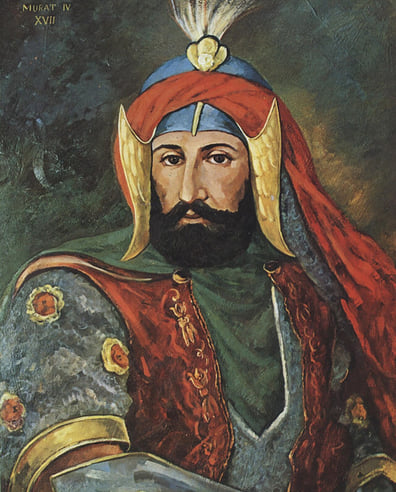
Imaginary portrait (made later) — artist and date unknown
Murad IV
He restored the authority of the state with harsh, even ruthless methods and retook Baghdad. The eastern border he drew at Zuhab (Kasr-ı Şirin) is still largely in force four centuries later.
Open the reign of Murad IV on the map▶ Watch the 1-minute video: YouTube · Instagram · TikTok
Interesting fact
After the great Istanbul fire of 1633, when gossip spread in the coffeehouses, he had them torn down, replaced them with lodgings for bachelors, tanners and farriers, and banned tobacco.
Source: TDV İslâm Ansiklopedisi (Turkish), article “MURAD IV”
Life
On the throne as a child
Murad was born in Istanbul on 27 July 1612. His father was Ahmed I and his mother Mahpeyker (Kösem) Sultan. The sources say little about his years as a prince. After the killing of Osman II, when he and his brothers were brought out into the palace garden, at the instigation of the grand vizier Davud Pasha, to be taken to Üsküdar, one of the palace gate aghas (kapı ağaları) tried to kill him, and he was saved only by the intervention of the other aghas.
When the mental instability of his uncle Mustafa I brought the state to an impasse, the leading men of the state deposed him; Murad, probably through his mother's influence, was placed on the throne on 10 September 1623, at the age of eleven. The next day he was girded with the sword by Aziz Mahmud Hüdayi at the tomb of Eyüp Sultan, and five days later he was circumcised.
Kösem Sultan's regency and the revolts
In the first nine years of his reign, government lay mostly in the hands of statesmen under the influence of his mother Kösem Sultan; Murad had no influence on events. In the east, at Erzurum, Abaza Mehmed Pasha, claiming vengeance for the blood of Osman II, had taken control of the region, killed Janissaries and marched as far as Ankara. In Baghdad, as a result of the revolt of Bekir Subaşı, the city passed into Safavid hands in 1624. Hafız Ahmed Pasha's siege of Baghdad in 1626 also failed.
In Istanbul, strongmen (zorbalar) had come to run the state. In 1632 the sipahis rose up, marched on the palace and forced the sultan to hold an emergency council on foot (ayak divanı), demanding that his close associates be killed; saying they no longer had any trust in the sultan, they asked to see his brothers Bayezid, Süleyman, Kasım and Ibrahim. This event affected Murad deeply. On 18 May 1632 he had the grand vizier Receb Pasha, who had been backing the rebels from behind the scenes, summoned inside after the council meeting and killed, and he eliminated the strongmen one by one. From then on he took the government entirely into his own hands.
A harsh order
Murad resorted to very harsh methods to restore authority. After the fire of 2 September 1633, which reduced a fifth of Istanbul to ashes, he was disturbed by the gossip in the coffeehouses, and, encouraged by Kadızade Mehmed Efendi, who held coffee and tobacco to be forbidden (haram), he had the coffeehouses torn down and banned tobacco. The TDV article notes that his hostility to tobacco became pathological and that because of it he had many people put to death, in Istanbul and on campaign; the same source also records that, despite the tradition that he loathed tobacco and opium, he was very fond of drink.
Order was restored in the provinces as well: the revolt of the Druze emir Ma'noğlu Fahreddin (Fakhr al-Din Ma'n), who had set up an independent government in Lebanon, was suppressed in 1635.
Yerevan and Baghdad
In 1635 Murad went on campaign against Iran in person. Along the way he punished those who neglected their duties, judges (kadı) who had been complained about, and tobacco smokers. Yerevan (Revan) surrendered on 8 August 1635 after eleven days of resistance. But the fortress was lost again soon afterwards.
In 1638 he set out on his greatest campaign. Before leaving, he had his brother Prince Kasım, whom he regarded as a danger to himself, killed; he had already had Bayezid and Süleyman killed earlier. The army left Istanbul on 8 May 1638 and laid siege to Baghdad. The grand vizier Tayyar Mehmed Pasha was killed while fighting by a bullet that struck him in the forehead; the next day, 24 December 1638, the fortress commander Bektaş Han surrendered Baghdad. Murad had the tombs of Imam-ı Azam (Abu Hanifa) and Abdülkadir Geylani restored. The Treaty of Kasr-ı Şirin (Treaty of Zuhab), signed on 17 May 1639, ended the Ottoman–Iranian wars for a long time and became the basis of the border in the centuries that followed.
Character and death
Murad is famous among the Ottoman sultans for his physical strength: the sources relate that he would lift his sword-bearer (silahtar) by the sash and carry him around the room, that he wrestled with champion wrestlers (pehlivan), used a heavy mace, and was a master of weapons such as the sword, the bow and the spear (harbe). He knew Arabic and Persian and wrote poetry under the pen name “Muradi”; his interest in music went as far as composing. The Revan and Baghdad Kiosks, which he built in Topkapı Palace to commemorate the victories of Yerevan and Baghdad, are among the finest works of the period. Figures such as Evliya Çelebi, Kâtib Çelebi, Nef'î and Koçi Bey grew up in his time.
After the return from Baghdad the disease in his feet (gout, nikris) grew much worse. He fell ill on the day after a night of revelry; despite every treatment he grew worse day by day and died on 8 February 1640, in the room where he had had his brother Kasım strangled. Tradition holds that on his deathbed he ordered that Ibrahim, his only surviving brother, should also be killed, and that his mother Kösem Sultan prevented the order from being carried out. At his funeral, the three horses he had ridden in his wars were led before the coffin with their saddles turned backwards, and he was buried in his father's tomb beside the Sultan Ahmed Mosque.
Source: TDV Encyclopedia of Islam (TDV İslâm Ansiklopedisi), “Murad IV” (Ziya Yılmazer); the main sources of this article are Kâtib Çelebi, Peçevi, Topçular Kâtibi Abdülkadir Efendi, Karaçelebizade, Evliya Çelebi and Naima.
Meanwhile in the world
Contemporary rulers
- Ferdinand IIHoly Roman Emperor · 1619–1637Leading champion of the Catholic Counter-Reformation in the Thirty Years' War
- Philip IVKing of Spain · 1621–1665King during Spain's decline as a great power
- Charles IKing of England, Scotland and Ireland · 1625–1649His quarrels with Parliament led to civil war and his execution
- Louis XIIIKing of France · 1610–1643Came to the throne as a child on his father Henry IV's death
- Gustavus Adolphus (Gustav II Adolf)King of Sweden · 1611–1632Killed fighting at Lützen during the Thirty Years' War
- Shah JahanMughal Emperor · 1628–1658Built the Taj Mahal for his wife Mumtaz Mahal
- Tokugawa IemitsuShogun of Japan · 1623–1651Set Japan on a policy of seclusion lasting over two centuries
What was happening in the world?
- 1628William Harvey published De motu cordis, showing that the heart pumps blood around a closed circulation.
- 1632Shah Jahan began building the Taj Mahal at Agra as the tomb of his wife Mumtaz Mahal.
- 1633The Inquisition condemned Galileo for upholding Copernican theory; he spent the rest of his life under house arrest.
- 1635The Académie française was formally established under the patronage of Cardinal Richelieu.
- 1637Descartes published his Discourse on Method, containing the proposition “I think, therefore I am.”
- 1639Japan expelled the Portuguese; foreign trade was restricted to Dutch and Chinese merchants at Nagasaki.
Sources: britannica.com [1] [2] [3] [4] [5] [6] [7] [8] [9] [10] [11] [12]
Family
| Father | Ahmed I |
|---|---|
| Mother | Kösem Sultan |
| Consorts | Ayşe Sultan |
| Children | Şehzade Ahmed, Şehzade Numan, Kaya Sultan, Safiye Sultan (his sons died young, so the throne passed to his brother Ibrahim) |
Major achievements
- Yerevan (1635) and Baghdad (1638) campaigns; Baghdad retaken after fifteen years
- The eastern border permanently drawn by the Treaty of Zuhab
- Elimination of the Celali rebels and the Janissary chiefs; central authority restored
- Bans on tobacco, alcohol and coffeehouses; night-time inspections
- Finances balanced and a budget surplus achieved
Treaties
- Treaty of Zuhab (Kasr-ı Şirin) (1639, Persia) — the basis of today's Turkey–Iran border
Grand viziers
| Name | From | To | Length |
|---|---|---|---|
| Kemankeş Ali Pasha | August 30, 1623 | April 3, 1624 | 217 days |
| Çerkez Mehmed Pasha | April 3, 1624 | January 28, 1625 | 300 days |
| Hafız Ahmed Pasha | February 8, 1625 | December 1, 1626 | 1 year, 296 days |
| Kayserili Halil Pasha (term 2) | December 2, 1626 | April 6, 1628 | 1 year, 126 days |
| Hüsrev Pasha | April 6, 1628 | October 25, 1631 | 3 years, 202 days |
| Hafız Ahmed Pasha (term 2) | October 25, 1631 | February 10, 1632 | 108 days |
| Topal Receb Pasha | February 10, 1632 | May 18, 1632 | 98 days |
| Tabanıyassı Mehmed Pasha | May 18, 1632 | February 2, 1637 | 4 years, 260 days |
| Bayram Pasha | February 1637 | August 27, 1638 | 1-2 years |
| Tayyar Mehmed Pasha | August 27, 1638 | December 23, 1638 | 118 days |
| Kemankeş Kara Mustafa Pasha | December 24, 1638 | January 31, 1644 | 5 years, 38 days |
Battles and treaties
| Year | Event | Result / parties |
|---|---|---|
| 1623 | Siege: Loss of Baghdad | Baghdad passed to the Safavids and stayed in their hands until 1638 |
| 1632 | Revolt: Revolt of the Zorbas (1632) | Grand Vizier Hafız Ahmed Pasha was killed by the rebels; in May 1632 Murad IV eliminated Topal Receb Pasha and the ringleaders and took personal control of … |
| 1635 | Campaign: Yerevan campaign | Yerevan was taken; it passed back to the Safavids on 1 April 1636 |
| 1635 | Revolt: Revolt of Fakhr al-Din Maʿn | Küçük Ahmed Pasha, governor of Damascus, captured Fakhr al-Din; sent to Istanbul, he was executed together with his sons except Hüseyin, who was spared (1635) |
| 1638 | Siege: Recapture of Baghdad | Baghdad was recovered and remained Ottoman for good |
| 1639 | Treaty: Treaty of Zuhab (Kasr-ı Şirin) | Opponent: Safavid Empire (Persia) |
Full infoboxes are in the site’s “Battles and Treaties” tab; source: TDV Encyclopedia of Islam.
Death
He died in 1640 at twenty-eight of cirrhosis and gout; heavy drinking is believed to have played a part.
Territorial change
| Year | Region | Event | Source |
|---|---|---|---|
| 1623 | − Baghdad–Basra | Bekir Subaşı's revolt followed by Safavid occupation (1623); recovered in the Baghdad campaign (1638), Treaty of Zuhab (Kasr-ı Şirin, 1639) — the eastern border has lasted to this day | TDV İA, “BAĞDAT” (disputed date: The TDV article on Baghdad dates the surrender of the citadel to 28 November 1623; the article on Murad IV renders the hijri year 1033 as 1624) |
| 1635 | − Yemen–Asir | Revolt of the Zaydi Imam al-Qasim and his son al-Mu'ayyad (1629–1635) — the last Ottoman troops left Mocha (22 October 1635) | TDV İA, “YEMEN” |
| 1638 | + Baghdad–Basra | Bekir Subaşı's revolt followed by Safavid occupation (1623); recovered in the Baghdad campaign (1638), Treaty of Zuhab (Kasr-ı Şirin, 1639) — the eastern border has lasted to this day | TDV İA, “MURAD IV” |
The lands that changed hands in this period, and the battles or treaties that brought the changes, can be seen on the map: map of the reign of Murad IV.
Cite as: Atlas of the Sultans, “Murad IV: Reign Map, Wars and Conquests (1623–1640)”, https://padisahlaratlasi.com/en/sultans/iv-murad/ (last updated 21 November 2026). Corrections · Image credits
Terms on this page: Şehzade · Celali revolts
Grand viziers of this reign: Kemankeş Kara Mustafa Pasha
Monuments of this reign: Topkapı Palace · Büyük Valide Han · Babaeski Bridge
Women of the dynasty in this reign: Kösem Sultan
State organisation: The devshirme system · The Enderun and the palace organisation
Myths and misconceptions: Did women really rule the state during the “Sultanate of Women”? · Did the devshirme take every Christian child?