TRENDEFRARAtlas of the Sultans · Ottoman monuments
Babaeski Bridge
Monument · Bridge, Babaeski, 1633–1634
- Type
- Bridge
- Location
- Turkey
- Built
- 1633–1634
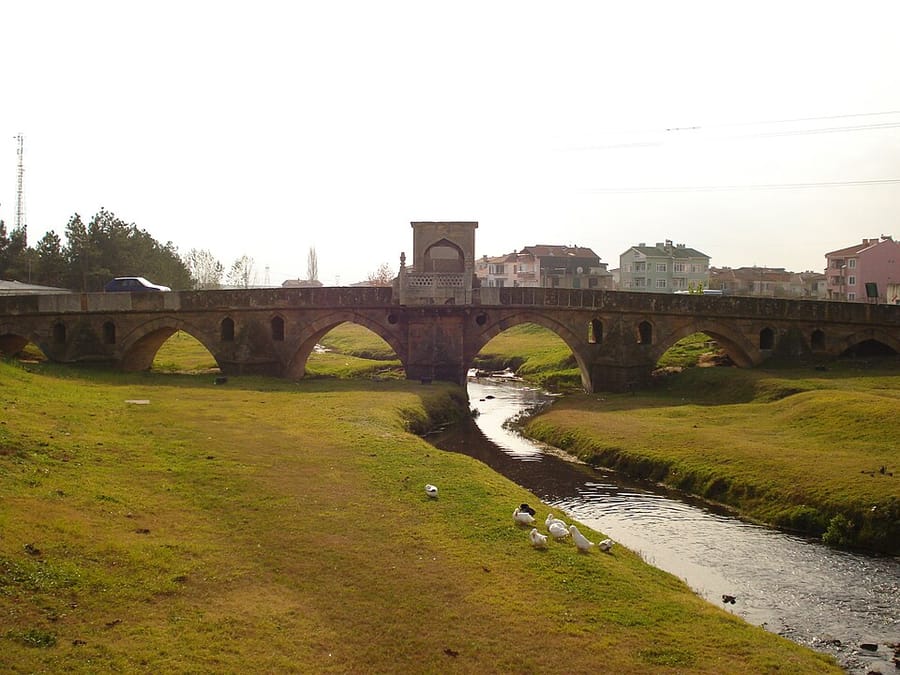

A bridge on the Rumelian campaign road
Spanning a stream that forms one of the branches of the Ergene river east of Babaeski, the bridge was built in 1633–34 in the reign of Sultan Murad IV, according to the five-couplet verse inscription in its inscription kiosk. It lies on the great caravan and campaign road leading from Istanbul into the Balkans (Rumelia). A line of the inscription shows that it was built not by the sultan himself but by one of his servants (kul), but who exactly is not known for certain. Evliya Çelebi describes it as the charitable work of Çoban Veli Kasım Ağa, a shepherd who converted to Islam and rose to the rank of kul kethüdası in the Janissary corps; the story linking it with the court architect Kasım Ağa has no sound basis.
Built of finely dressed stone, the bridge is 72 m long and 5.85 m wide. Evliya Çelebi counted seven arches; six are visible today, the seventh apparently having silted up. The widest of the pointed arches spans 7.30 m. In the inscription kiosk at the middle of the bridge, which has stone parapets, is a marble inscription framed by carved rosettes and tulips, and opposite it an open-air prayer place (namazgah) with four turban-topped stone posts at its corners. Besides marking the old campaign road, the bridge is one of the finest works of Turkish bridge building.
The inscription and the tale of Kasım Ağa
The “holy war” of Sultan Murad mentioned in the inscription must be the Polish campaign of 1633–34. According to Evliya Çelebi, Kasım Ağa, a Christian by birth, became a Muslim while tending sheep in this area; later, imprisoned under Murad IV, he vowed that if he were freed he would build a bridge where he had once grazed his flocks. On his release he kept his vow and spent four hundred purses on the bridge.
Cutwaters and stone posts
The piers between the arches have cutwaters and buttresses with caps, shaped as half pyramids on the upstream side and half cones on the downstream side; a small vent opens on each side of every cap. A pair of stone posts stands in front of the inscription, and the four posts at the corners of the open-air prayer place opposite have turban-shaped finials. Rifat Osman Bey, citing the architect Kemaleddin Bey, wrote that these posts might indicate that the founder was a vizier, but this conjecture is not very convincing.
Source: TDV Encyclopedia of Islam (TDV İslâm Ansiklopedisi), “BABAESKİ KÖPRÜSÜ” (Semavi Eyice)
Related sultans
Cite as: Atlas of the Sultans, “Babaeski Bridge · Ottoman monuments”, https://padisahlaratlasi.com/en/monuments/babaeski-bridge/ (last updated 21 November 2026). Corrections · Image credits