TRENDEFRARAtlas of the Sultans · Ottoman monuments
Büyük Valide Han
Monument · Inn (han), Istanbul, 17th century
- Type
- Inn and caravanserai
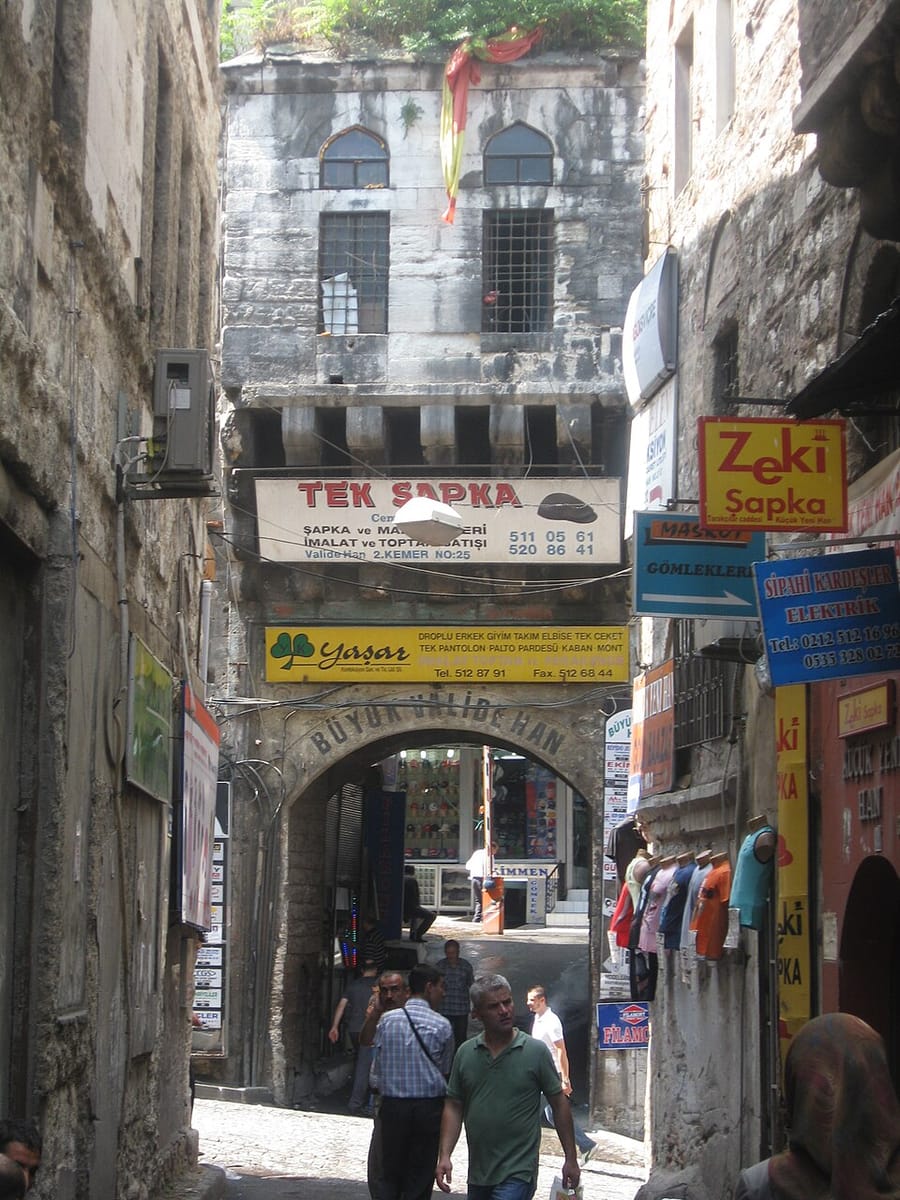

Kösem Sultan's great han
Covering a large area from Çakmakçılar Yokuşu to Uzunçarşı, the Büyük Valide Han is, by its dimensions, the largest commercial inn (han) in Istanbul. It was built during the reign of Murad IV (1632–1640) by the sultan's mother, Kösem Sultan, to provide income for her charitable foundations, above all the Çinili Mosque in Üsküdar. According to Evliya Çelebi, the palace of Cerrah Mehmed Pasha had previously stood on the site. The square tower at one corner is older than the han and is thought to date from the Byzantine period; according to Naima, Kösem Sultan's personal fortune was kept in this tower.
Built to an irregular plan on sloping ground, the han has a triangular first courtyard, a second courtyard measuring 63 × 66 metres and a third courtyard with stables beneath it; it is said to have had 210 rooms. Its residents were mostly Iranians, and Muharram ceremonies were held around the Mescid-i Iraniyan (Mosque of the Iranians) in the courtyard; Iranians are also said to have secretly printed their first editions of the Quran here. Badly damaged over the last century by neglect and haphazard additions, parts of the han were pulled down in 1926 as unsafe.
A tower from Byzantine times
The tower at the corner of the third courtyard measures 12 × 12 m and is about 25 m high. According to A. M. Schneider it dates from the Byzantine period and may have belonged to the Vigla, seat of the commander of the imperial palace guard. Petrus Gyllius, who studied Istanbul between 1544 and 1555, calls it the Tower of Eirene, and Melchior Lorichs shows it in all its bulk in the great panorama he drew in 1553–1555. When it was joined to the han, its exterior was partly renewed in Turkish wall technique and a domed room was built inside. The tower, built of alternating courses of stone and brick, has round openings resembling gun ports. According to Naima, Kösem Sultan's personal fortune of twenty chests of gold florins, kept here, passed to the state after her death.
Guests and printing presses
The rooms were mostly occupied by bachelors, some of whom, such as Lari Mehmed Efendi and Yeğen Mehmed Pasha, later became well-known figures. Besides Iranian and Azeri Shiites, Armenian merchants and foreigners also stayed here. The French traveller J. de Thévenot, who came in 1652, considered it the finest han in the city; he wrote that foreign merchants found a cheap room and a storeroom for their goods, and that every traveller was given a bed, covers, a carpet and cushions. At the end of the 19th century G. des Godins de Souhesmes described a Muharram ceremony watched by 8,000 spectators. Presses in the han printed pirated editions of popular books and Istanbul's first illustrated religious books and plates, while Armenian booksellers on the slope sold books brought from France.
Architecture and the last century
The façade with shops on Çakmakçılar Yokuşu is of regular cut stone and brick; above the gate is a windowed projection resembling a kiosk, resting on seven consoles of four tiers each. The ground-floor rooms are barrel-vaulted and the upper rooms domed; each room has a hearth and cupboard niches. The domes were originally covered with lead, but the covering was removed because it had fallen into ruin.
Part of the han collapsed in the summer of 1906; these sections are thought to have cracked in the earthquake of 1894. When the wooden Mescid-i Iraniyan in the courtyard was ruined by fire, it was rebuilt in its present form in 1951 by the Iranian Aid Society. The iron-plated gate leaves are still in place. By 1989 the portico arches of the second courtyard had been hidden by new construction and the third courtyard was entirely filled in.
Source: TDV Encyclopedia of Islam (TDV İslâm Ansiklopedisi), “BÜYÜK VÂLİDE HANI” (Semavi Eyice)
Related sultans
Cite as: Atlas of the Sultans, “Büyük Valide Han · Ottoman monuments”, https://padisahlaratlasi.com/en/monuments/buyuk-valide-han/ (last updated 21 November 2026). Corrections · Image credits