TRENDEFRARAtlas of the Sultans · 19 / 39 · sultan
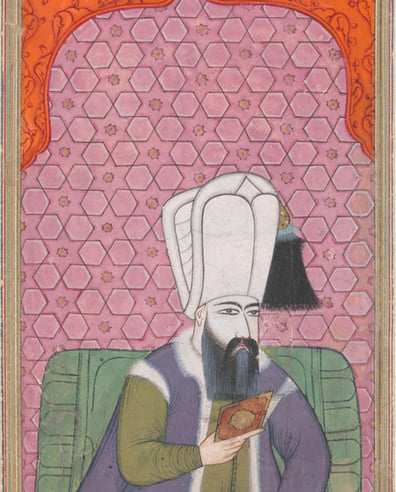
Imaginary portrait (made later) — late 17th – early 18th c.
Mustafa I
second reign
His second reign was the period of weakest central authority. He was deposed again within a year; the revolt of Bekir Subaşı that would cost Baghdad began in this short period.
Open the reign of Mustafa I on the mapInteresting fact
He was enthroned twice and deposed twice (1617–1618 and 1622–1623). He was the first sultan to come to the throne by succession from brother to brother rather than from father to son.
Source: TDV İslâm Ansiklopedisi (Turkish), article “AHMED I”
Life
A prince under watch in the palace
Mustafa was probably born in 1591–1592 in Manisa, in the years when his father Mehmed III was sanjak governor of Saruhan. The name of his mother, who was of Abkhazian (Abaza) origin, is not known. When his father left Manisa in 1595 to take the throne, he was taken to Istanbul together with his brothers and received his early education in the palace.
When his brother Ahmed, a few years his senior, came to the throne at fourteen, Mustafa was the only other male member of the dynasty still alive; for this reason he was not killed, despite the custom of fratricide. According to the 1612 report of the Venetian ambassador Contarini, Ahmed I twice considered having him killed but changed his mind, once because of a sudden illness and the other time because of a great storm. According to the TDV article, being kept under very strict watch in the palace deeply shook his already fragile mental health and destroyed his mental balance altogether.
First reign: ninety-six days
The unexpected death of Ahmed I at a young age opened the way to the throne for Mustafa. The şeyhülislam Hocazade Esad Efendi passed over Ahmed's eldest son Osman and placed Osman's uncle Mustafa on the throne; according to the sources, suggestions that Mustafa's condition might improve over time influenced this decision. It is also reported that Kösem Sultan, one of Ahmed's consorts, was among those who blocked Osman's accession in order to clear the way for her own sons.
Mustafa ascended the throne on 22 November 1617 and was girded with the sword at Eyüp. The sources give little information about his reign; historians mostly describe his erratic behaviour: it is written that he went out on sea excursions at inappropriate times, threw gold coins to the fish as feed, and pulled off his viziers' turbans, baring their heads. The leading men of the state deposed him on 26 February 1618, and his nephew Osman II became sultan. Mustafa went back to the room in which he had been confined.
Second reign: the rebels' sultan
Four years later, the Janissaries and sipahis who rose against Osman II calculated that if they put the former sultan on the throne, they could make him do whatever they wanted. When the rebels entered the palace on 19 May 1622, one of them spoke Mustafa's name; Mustafa was brought out of the place where he was shut away and seated on the throne for a second time. According to Tugi, he was taken by carriage to the Old Palace, where his mother was. Shortly afterwards Osman II was killed in Yedikule.
Throughout his second reign, too, he had no influence at all on affairs of state; he had no say even in the appointment of grand viziers. His mother and Kara Davud Pasha even planned to have Ahmed I's sons Murad and Ibrahim killed in order to secure his reign; Mustafa knew nothing of this. Grand viziers such as Kara Davud Pasha and Mere Hüseyin Pasha frequently made use of the troops in their struggles for power. In Erzurum, Abaza Mehmed Pasha rose in revolt, claiming vengeance for the blood of Osman II.
Deposition and last years
No group any longer expected anything of the sultan. The new grand vizier Kemankeş Ali Pasha, in agreement with the şeyhülislam Yahya Efendi and the kazaskers (chief military judges), decided that the sultan should be deposed. On the morning of 10 September 1623 Mustafa was shut up again in the room where he had formerly been confined, and his nephew Murad IV was placed on the throne in his stead. His first reign had lasted ninety-six days, the second one year, three months and twenty-two days.
Mustafa lived for fifteen more years in this room; nothing whatever is known about this period of his life. He died on 20 January 1639. One of the sources writes that his death was natural; the TDV article, however, notes that the possibility has also been raised that Murad IV, who had earlier had two of his brothers killed, played a part in this death. According to Evliya Çelebi, his body was left unattended for a time and no place could be found to bury him; in the end he was buried in a building in front of Hagia Sophia, with earth brought from the Hasbahçe.
Mustafa, twice enthroned and twice deposed, had a reign that was the first example of the heavy toll taken on the Ottoman throne by the “kafes” (the Cage) system and the rising power of the household troops (kapıkulu).
Source: TDV Encyclopedia of Islam (TDV İslâm Ansiklopedisi), “Mustafa I” (Feridun M. Emecen); the main sources of this article are Peçevi, Hasan Beyzade, Tugi, Bostanzade Yahya, Kâtib Çelebi and the reports of Venetian ambassadors.
Meanwhile in the world
Contemporary rulers
- Ferdinand IIHoly Roman Emperor · 1619–1637Leading champion of the Catholic Counter-Reformation in the Thirty Years' War
- Philip IVKing of Spain and Portugal · 1621–1665King during Spain's decline as a great power
- James IKing of England and Scotland · 1603–1625First Stuart monarch on the English throne
- Louis XIIIKing of France · 1610–1643Came to the throne as a child on his father Henry IV's death
- Abbas I (the Great)Safavid Shah · 1588–1629Reorganized the army and moved the capital to Isfahan
- JahangirMughal Emperor · 1605–1627Son and successor of Akbar
- Michael RomanovTsar of Russia · 1613–1645Founder of the Romanov dynasty, which ruled Russia until 1917
What was happening in the world?
- 1617The Treaty of Stolbovo between Sweden and Russia blocked Russia's access to the Baltic Sea.
- 1618The Defenestration of Prague sparked the Bohemian revolt and opened the Thirty Years' War.
- 1622Pope Gregory XV established the Congregation for the Propagation of the Faith (Propaganda Fide) to oversee missions.
- 1623The First Folio, the first collected edition of Shakespeare's plays, was published.
- 1623Dutch authorities on Ambon executed twenty-one men, including ten Englishmen, in the Amboina Massacre.
Sources: britannica.com [1] [2] [3] [4] [5] [6] [7] [8] [9] [10] [11] [12]
Family
| Father | Mehmed III |
|---|---|
| Mother | Halime Sultan |
| Consorts | No consort is recorded |
| Children | No known children |
Major achievements
- Enthroned a second time; the state run by Kösem Sultan and the Janissary officers
- Revolt of Bekir Subaşı in Baghdad (the city passed to the Safavids in 1623, under Murad IV)
Treaties
None recorded.
Grand viziers
| Name | From | To | Length |
|---|---|---|---|
| Kara Davud Pasha | May 20, 1622 | June 13, 1622 | 24 days |
| Mere Hüseyin Pasha | June 13, 1622 | July 8, 1622 | 25 days |
| Lefkeli Mustafa Pasha | July 9, 1622 | September 21, 1622 | 74 days |
| Gürcü Hadım Mehmed Pasha | September 21, 1622 | February 5, 1623 | 137 days |
| Mere Hüseyin Pasha (term 2) | February 5, 1623 | August 30, 1623 | 206 days |
| Kemankeş Ali Pasha | August 30, 1623 | April 3, 1624 | 217 days |
Battles and treaties
| Year | Event | Result / parties |
|---|---|---|
| 1622 | Revolt: Revolt of Abaza Mehmed Pasha | Defeated at Karasu, he shut himself up in Erzurum; in 1628 he surrendered to Hüsrev Pasha under a promise of safety, and Murad IV pardoned him and made him … |
Full infoboxes are in the site’s “Battles and Treaties” tab; source: TDV Encyclopedia of Islam.
Death
He died in the Old Palace in 1639.
Territorial change
The lands that changed hands in this period, and the battles or treaties that brought the changes, can be seen on the map: map of the reign of Mustafa I.
Cite as: Atlas of the Sultans, “Mustafa I (second reign): Reign Map, Wars and Conquests (1622–1623)”, https://padisahlaratlasi.com/en/sultans/i-mustafa-2/ (last updated 21 November 2026). Corrections · Image credits