TRENDEFRARAtlas of the Sultans · 25 / 39 · sultan
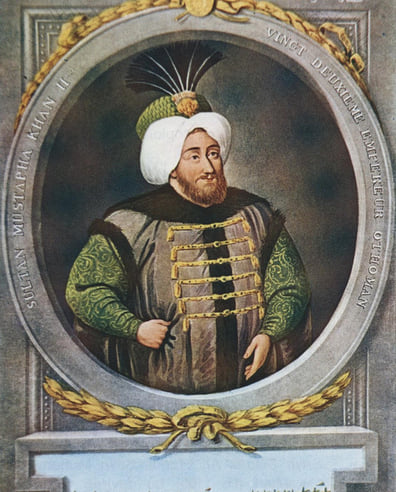
Imaginary portrait (made later) — artist and date unknown
Mustafa II
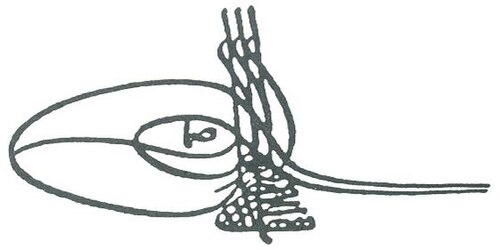
The sultan who signed Karlowitz. For the first time the Ottomans gave up territory at the peace table; the treaty is counted as the formal beginning of the age of decline and permanently changed how the state positioned itself towards Europe.
Open the reign of Mustafa II on the map▶ Watch the 1-minute video: YouTube · Instagram · TikTok
Interesting fact
As soon as he took the throne he wrote that the sultans’ love of pleasure since his father’s time had led to defeats, and announced that, like his ancestors, he would lead the army himself; he kept his word and went on campaign in person.
Source: TDV İslâm Ansiklopedisi (Turkish), article “MUSTAFA II”
Life
A prince raised in Edirne
Mustafa was born in Edirne on 2 June 1664; his birth was celebrated with festivities lasting seven days and seven nights. His father was Mehmed IV and his mother Gülnuş Emetullah Sultan. At the age of five he received his first lesson from Vani Mehmed Efendi and, on his recommendation, became the pupil of Seyyid Feyzullah Efendi, who would later become very influential in affairs of state. When his father set out on the Polish campaign in 1672, Mustafa accompanied him as far as Babadağ; in 1675 a magnificent circumcision festival was held in Edirne for him and his brother Ahmed.
After his father was deposed in 1687, he lived under watch in the palace throughout the reigns of his uncles. His accession was considered when his father was deposed (1687) and again at the death of Suleiman II (1691), but each time his uncles were preferred.
“When sultans give themselves over to pleasure”: the decision to campaign
When Ahmed II died, Mustafa, as the eldest member of the dynasty, had a throne set up in front of the Middle Gate (Ortakapı) of the Edirne Palace and proclaimed himself sultan without waiting for the grand vizier and the şeyhülislam (6 February 1695). He was thirty-one years old. The multi-front war that had begun with the siege of Vienna in 1683 was raging at full force.
As soon as he came to the throne, in an imperial rescript (hatt-ı hümayun) to the grand vizier, he declared that the state declined whenever sultans gave themselves over to pleasure and amusement, and announced that, like his ancestors, he would personally lead the army on campaign. To take control of the state into his own hands, he ordered the imperial council (Divan-ı Hümayun), which for some time had not met regularly, to sit four days a week. He made his tutor Feyzullah Efendi şeyhülislam. On his first campaign Lipova and its surroundings were taken; on 27 August 1696 he defeated the Austrians at Ulaş, near Temesvár (Tımışvar). After these victories he was given the title “gazi”. In the same period the island of Chios (Sakız) was recovered, an event celebrated with festivities in Edirne; the fleet of the grand admiral (kaptanıderya) Mezemorta Hüseyin Pasha also won victories against the Venetians around Chios, in the Morea, off Tenedos (Bozcaada) and near the island of Andros. But in 1696 the fortress of Azov, unable to hold out against the second siege by Tsar Peter I of Russia, surrendered to the Russians.
Zenta and Karlowitz
Confident after two victories, Mustafa rejected Austria's peace offer and set out on his third campaign in August 1697. At the war council held in Belgrade, Amcazade Hüseyin Pasha's proposal to march on Petrovaradin (Varadin) was not accepted; the army headed instead toward distant Temesvár, crossing many rivers and marshes. At Zenta, as the army was crossing a bridge built over the Tisza river, the Austrian army attacked; the sultan watched this heavy defeat, in which Grand Vizier Elmas Mehmed Pasha was also killed, from the far bank of the river.
After Zenta, Mustafa, like his father, turned to the pleasures of the hunt. To end the war, the mediation of the English and Dutch envoys was accepted, and lengthy negotiations were held at Karlowitz (Karlofça), near Belgrade. The Treaty of Karlowitz, signed in 1699, ended sixteen years of war: the Ottoman state ceded all of Hungary except Temesvár to Austria, the Morea to Venice, and Ukraine and Podolia to Poland. With the Treaty of Istanbul concluded with Russia in 1700, Azov too passed to Russia. Karlowitz was the first peace in which the Ottomans gave up large territories by treaty.
The Edirne Incident
In the last years of his reign the most influential figure in affairs of state was Şeyhülislam Feyzullah Efendi; his appointment of his sons and relatives to important posts provoked a strong reaction. The sultan, for his part, rarely came to Istanbul and resided in Edirne. In the summer of 1703 a revolt that began when the armorers (cebeci) who were to be sent to Georgia rose up demanding their arrears of pay grew larger; the soldiers in Istanbul, the ulema and the tradesmen marched on Edirne. According to the TDV article, Grand Vizier Rami Mehmed Pasha secretly supported the revolt in order to bring down the şeyhülislam.
Left alone when the soldiers of his own army also went over to the rebels, Mustafa went to his brother Ahmed on 22 August 1703 and handed the throne over to him with the words, “Brother, the troops (kul) want you as sultan.” Feyzullah Efendi was killed by the rebels. This event, known in Ottoman history as the “Edirne Incident”, resulted in the capital returning to Istanbul.
Last months and death
Mustafa wrote poems and hymns (ilahi) under the pen names “Ikbali” and “Meftuni”; some of them were set to music. About five months after his deposition, probably on 29 December 1703, he died in Edirne, the city he loved so much. According to some Western sources, it was widely believed among the people that he had been poisoned. His body was brought to Istanbul and buried in the tomb of Turhan Sultan at the Yeni Cami. His sons Mahmud I and Osman III later became sultans.
Source: TDV Encyclopedia of Islam (TDV İslâm Ansiklopedisi), “Mustafa II” (Abdülkadir Özcan); the main sources of this article are the Nusretname of Silahdar Fındıklılı Mehmed Ağa, Defterdar Sarı Mehmed Pasha, Raşid and Dimitrie Cantemir.
Meanwhile in the world
Contemporary rulers
- Louis XIVKing of France · 1643–1715The 'Sun King', emblem of absolute monarchy and builder of Versailles
- Leopold IHoly Roman Emperor · 1658–1705Habsburg ruler whose long reign was marked by rivalry with France
- Peter I (the Great)Tsar, from 1721 Emperor of Russia · 1682–1725Reformer who reshaped Russia along Western European lines
- Charles XIIKing of Sweden · 1697–1718Warrior king of the Great Northern War; killed besieging Fredriksten
- Sultan HusaynSafavid Shah of Iran · 1694–1722Last independent Safavid ruler; Isfahan fell to the Afghans in 1722
- AurangzebMughal Emperor of India · 1658–1707Last of the great Mughals; the empire reached its greatest extent
- KangxiEmperor of China (Qing dynasty) · 1661–1722His 61-year rule is the longest official reign in Chinese history
What was happening in the world?
- 1697Peter the Great's Grand Embassy toured Western Europe; the tsar worked incognito in Dutch and English shipyards.
- 1700The Great Northern War began; Charles XII routed the Russian army at Narva.
- 1701Elector Frederick III of Brandenburg crowned himself Frederick I, 'King in Prussia', at Königsberg.
- 1701The War of the Spanish Succession began as England, the Dutch Republic and the emperor allied against France.
- 1703Peter the Great founded St Petersburg, laying the foundations of the Peter and Paul Fortress on the Neva.
Sources: britannica.com [1] [2] [3] [4] [5] [6] [7] [8] [9] [10] [11] [12]
Family
| Father | Mehmed IV |
|---|---|
| Mother | Emetullah Rabia Gülnuş Sultan |
| Consorts | Saliha Sultan, Şehsuvar Sultan, Alicenab Kadın |
| Children | Mahmud I, Osman III, Şehzade Hasan, Şehzade Hüseyin, Safiye Sultan |
Major achievements
- Chios retaken from Venice (Feb 1695, victory at the Oinousses Islands)
- Led three campaigns against Austria in person
- Financial and naval reforms of Amcazade Hüseyin Pasha
- Efforts to adapt the state to the new reality after Karlowitz
- Defeat at Zenta (1697) and the heavy loss of the army
Treaties
- Treaty of Karlowitz (1699) — for the first time large territories were given up at the table
- Treaty of Constantinople (1700, Russia)
Grand viziers
| Name | From | To | Length |
|---|---|---|---|
| Sürmeli Ali Pasha | March 12, 1694 | May 1, 1695 | 1 year, 50 days |
| Elmas Mehmed Pasha | May 1, 1695 | September 11, 1697 | 2 years, 133 days |
| Amcazade Hüseyin Pasha | September 17, 1697 | September 4, 1702 | 4 years, 352 days |
| Daltaban Mustafa Pasha | September 27, 1702 | January 1703 | |
| Rami Mehmed Pasha | January 1703 | August 20, 1703 |
Battles and treaties
| Year | Event | Result / parties |
|---|---|---|
| 1695 | Naval battle: Oinousses Islands | The Ottoman fleet recovered Chios; the Venetians abandoned the island |
| 1696 | Siege: Azov campaigns and loss of Azov (1695–1696) | The 1695 siege was repulsed; in 1696 the fortress surrendered to the Russians |
| 1697 | Battle: Zenta | Rout of the Ottoman army; Grand Vizier Elmas Mehmed Pasha and many governors-general were killed |
| 1699 | Treaty: Treaty of Karlowitz | Dutch Republic (mediators), Kingdom of England (mediators), Ottoman Empire, Holy Roman Empire, Poland–Lithuania, Republic of Venice, Papal States, Tsardom of … |
| 1700 | Treaty: Treaty of Constantinople | |
| 1703 | Revolt: Edirne Incident | The şeyhülislam Feyzullah Efendi was killed; Mustafa II gave up the throne to his brother Ahmed III (22 August 1703) |
Full infoboxes are in the site’s “Battles and Treaties” tab; source: TDV Encyclopedia of Islam.
Death
Deposed in the Edirne Incident of 1703, he died four months later in Topkapı Palace.
Territorial change
| Year | Region | Event | Source |
|---|---|---|---|
| 1696 | − Azov (Don mouth) | Peter the Great's second siege of Azov — the fortress fell in July 1696; the Treaty of Constantinople (1700) left it to Russia | TDV İA, “MUSTAFA II” |
| 1699 | − Podolia (Kamianets) | Treaty of Karlowitz (1699) — Podolia and Kamianets to Poland | TDV İA, “MUSTAFA II” |
The lands that changed hands in this period, and the battles or treaties that brought the changes, can be seen on the map: map of the reign of Mustafa II.
Cite as: Atlas of the Sultans, “Mustafa II: Reign Map, Wars and Conquests (1695–1703)”, https://padisahlaratlasi.com/en/sultans/ii-mustafa/ (last updated 21 November 2026). Corrections · Image credits
Terms on this page: Şehzade
Grand viziers of this reign: Amcazade Hüseyin Pasha
Monuments of this reign: Grand Bazaar (Kapalıçarşı) · Sidi Mahrez Mosque
Women of the dynasty in this reign: Gülnuş Emetullah Sultan
Capital in this reign: Edirne
Myths and misconceptions: Did the Ottoman state collapse right after the 1683 defeat at Vienna?