TRENDEFRARAtlas of the Sultans · Ottoman monuments
Gazi Ali Pasha Mosque
Monument · Mosque, Babadag, 16th–17th century
- Type
- Mosque
- Location
- Romania
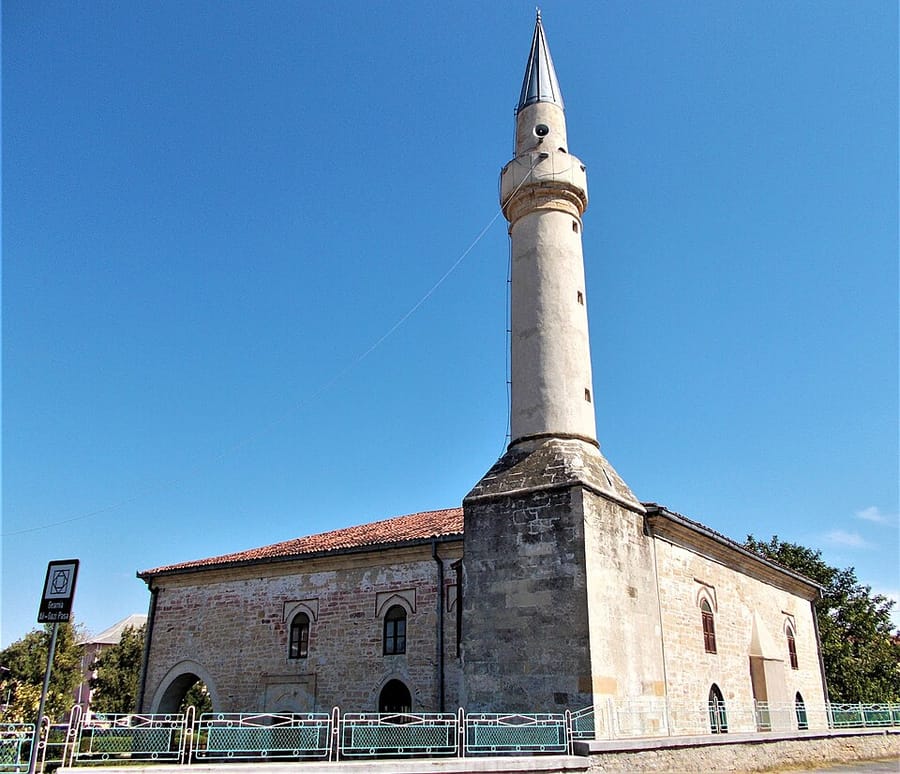

The largest Ottoman monument in Romania
Although the mosque in the town of Babadag in Dobruja has an endowment deed, its date and founder are not known for certain. According to Ekrem Hakkı Ayverdi, the deed was drawn up in the reign of Mehmed III (1595–1603) and a copy was entered in the archive in 1610; he identifies Ali Pasha, known as “Gazi”, with Kadızade Ali Pasha, four times governor-general of Buda. The hexagonal domed tomb beside the mosque gives 1620 as the year of Ali Pasha's death.
The square stone mosque has a wooden, tiled roof and a portico of three pointed arches at the entrance. The minaret was added later, and the wooden ceiling inside belongs to the repair that followed a 19th-century fire. The mosque was damaged in the Russo-Turkish wars of the 18th century, burned in the 19th century and was rebuilt, and was repaired again in 1907–1910. Dilapidated in 1966, it was later restored and turned into a museum. It is the largest Ottoman-period monument within the borders of present-day Romania.
Date and endowment deed
It is not clear what connection Kadızade Ali Pasha, whom Ayverdi considered the founder, had with Babadag. The Mufti of Romania, Yakub Mehmed Efendi, wrote that the mosque dates from 1522, but the death date of 1620 at the corner of the tomb and the record of the endowment deed support a later date. H. Stanescu reports that the mosque had a fine endowment deed, but that it was lost after 1938 and only a photocopy remains.
Inside the mosque
The three pointed arches of the portico rest on piers. Besides the main door, the mosque can also be entered through two side doors that were evidently opened later. Inside, a U-shaped wooden gallery runs along three walls. A row of crescents and stars decorates the sunburst medallion at the centre of the wood-panelled ceiling. The minaret adjoins the right-hand corner of the qibla wall; there is no other architectural decoration inside or outside the mosque.
The tomb and its surroundings
Ali Pasha's tomb is a hexagonal domed building of regular cut stone with chamfered corners; inside there is only a wooden cenotaph. A Turkish and Romanian inscription, commissioned by the deputy George Lamandi and fixed to one corner, gives Ali Pasha's death date and mentions a repair of 1910. In 1966 gravestones dated 1816–17, 1849–50 and 1866–67 were seen in the graveyard.
A madrasa once stood around the courtyard in front of the mosque; used between 1880 and 1901 as an Islamic Seminary where Muslim children were educated, its last traces were removed in 1964–65. Adjoining the portico is a spring reached by stairs, which Evliya Çelebi describes as ablution taps reached down twenty steps. The last remains of the bath that belonged to Ali Pasha's endowment were destroyed in 1955.
Source: TDV Encyclopedia of Islam (TDV İslâm Ansiklopedisi), “ALİ PAŞA CAMİİ ve TÜRBESİ” (Semavi Eyice)
Related sultans
Cite as: Atlas of the Sultans, “Gazi Ali Pasha Mosque · Ottoman monuments”, https://padisahlaratlasi.com/en/monuments/gazi-ali-pasha-mosque/ (last updated 21 November 2026). Corrections · Image credits