TRENDEFRARAtlas of the Sultans · 24 / 39 · sultan
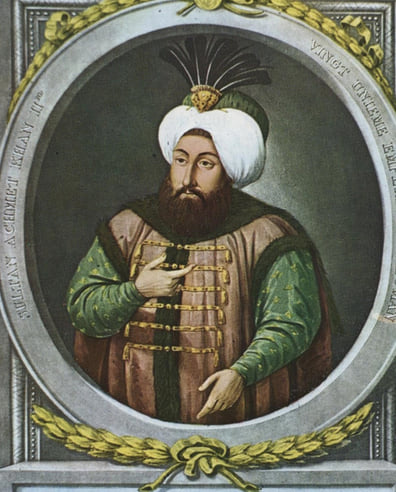
Imaginary portrait (made later) — Konstantin Kapıdağlı series · early 19th c.
Ahmed II
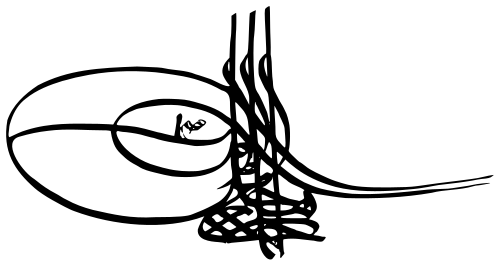
The defeat at Slankamen and the death of Grand Vizier Köprülü Fazıl Mustafa Pasha were the gravest events of his reign. He ruled for four years while the wars of the Holy League went on; there was no net territorial change.
Open the reign of Ahmed II on the map▶ Watch the 1-minute video: YouTube · Instagram · TikTok
Interesting fact
He was a sultan with a love of poetry and music, and a calligrapher as well. He died in Edirne; his body was brought to Istanbul and buried in the tomb of Suleiman the Magnificent.
Source: TDV İslâm Ansiklopedisi (Turkish), article “AHMED II”
Life
From the Cage to the throne
Ahmed was born on 25 February 1643. His father was Sultan Ibrahim and his mother Muazzez Sultan. Like his elder brothers Mehmed IV and Suleiman II, he spent his adult years in the palace's closed princes' quarters, far from affairs of state. On the death of his brother Suleiman II he came to the throne in Edirne on 23 June 1691, at the age of forty-nine.
Slankamen and changing grand viziers
When he came to the throne the Ottoman-Austrian war was still under way. Ahmed kept Grand Vizier Köprülüzade Fazıl Mustafa Pasha, who was at the front, in office; but Mustafa Pasha fell in battle at Slankamen in August 1691 and the army scattered. This defeat extinguished the hope raised by the recapture of Belgrade under Suleiman II.
Grand viziers then followed one another in quick succession. Kadı Ali Pasha was dismissed because he did not go on campaign and was gripped by greed for wealth; Merzifonlu Hacı Ali Pasha resigned after the chief treasurer (başdefterdar) was unjustly removed from office; he was replaced by Bozoklu Mustafa Pasha. Meanwhile the fortress of Várad fell to the Austrians. In 1693, when Bozoklu Mustafa Pasha marched on Belgrade accompanied by Imre Thököly, King of Middle Hungary, and the Crimean Khan Selim Giray, the Austrian army besieging the city lifted the siege and withdrew on 12 September 1693. But on the return from the campaign the sultan, under the influence of the chief black eunuch (kızlarağası), dismissed Mustafa Pasha and appointed Sürmeli Ali Pasha in his place.
In 1694 Petrovaradin (Varadin) was besieged; because the fortress received reinforcements, and because of heavy rains, the army was forced to withdraw to Belgrade after twenty-three days. When the garrisons on the Aegean islands were reduced owing to the need for troops, the island of Chios (Sakız) fell into enemy hands. Ahmed was deeply grieved by this news and ordered preparations for the island's recovery.
Governing the state: the Divan and the malikane
Ahmed took a close interest in affairs of state. As the business of the imperial council (Divan-ı Hümayun) increased, he raised its meetings from two to four days a week, in keeping with the law code of Suleiman I (Kanuni); he made it his custom to attend the meetings in person and did not give up this custom even when he was ill.
The longest-lasting measure of his reign was the introduction of the “malikane” system in the collection of state revenues. Under this system, which began in Damascus, Aleppo, Diyarbekir and other provinces and later spread to all of Anatolia and Rumelia, sources of tax revenue were farmed out for life. The people were thus to be protected from the arbitrary conduct of frequently changing tax farmers (mültezim); but according to the TDV article, in time this practice paved the way for the rise of the ayan (provincial notables), which would bring great trouble upon the state.
Character and death
The TDV article presents Ahmed as a sultan of sensitive and quick-tempered disposition, fond of poetry and music, and also a calligrapher. He was easily swayed by the suggestions of those around him, but in affairs of state he always gave priority to the rights of his subjects (reaya). During his short reign the Cibali, Ayazma Kapısı and Bedesten fires burned a large part of Istanbul.
Ahmed II died of dropsy (istiska) in Edirne on 6 February 1695, at the age of fifty-two. His body was brought to Istanbul and buried in the tomb of Suleiman I (Kanuni) at the Süleymaniye, beside his brother Suleiman II. He was succeeded by his nephew Mustafa II, the son of Mehmed IV.
Source: TDV Encyclopedia of Islam (TDV İslâm Ansiklopedisi), “Ahmed II” (Mücteba Ilgürel); the main sources of this article are Raşid, Silahdar Fındıklılı Mehmed Ağa and Defterdar Sarı Mehmed Pasha.
Meanwhile in the world
Contemporary rulers
- Louis XIVKing of France · 1643–1715The 'Sun King', emblem of absolute monarchy and builder of Versailles
- Leopold IHoly Roman Emperor · 1658–1705Habsburg ruler whose long reign was marked by rivalry with France
- William IIIKing of England, Scotland and Ireland · 1689–1702Prince of Orange; reigned jointly with Mary II until 1694
- Peter I (the Great)Tsar, from 1721 Emperor of Russia · 1682–1725Reformer who reshaped Russia along Western European lines
- Suleiman I (Safi II)Safavid Shah of Iran · 1666–1694Son of Abbas II; first enthroned under the name Safi II
- AurangzebMughal Emperor of India · 1658–1707Last of the great Mughals; the empire reached its greatest extent
- KangxiEmperor of China (Qing dynasty) · 1661–1722His 61-year rule is the longest official reign in Chinese history
What was happening in the world?
- 1692At Barfleur–La Hougue an Anglo-Dutch fleet destroyed the French fleet under Tourville.
- 1692During the Salem witch trials in Massachusetts, 19 people convicted of witchcraft were hanged.
- 1693A great earthquake and tsunami in Sicily's Val di Noto destroyed or badly damaged more than 45 towns.
- 1694The Bank of England was incorporated by Act of Parliament to raise funds for the war against France.
Sources: britannica.com [1] [2] [3] [4] [5] [6] [7] [8] [9] [10] · iranicaonline.org [1] · ncbi.nlm.nih.gov [1]
Family
| Father | Ibrahim |
|---|---|
| Mother | Hatice Muazzez Sultan |
| Consorts | Rabia Sultan |
| Children | Şehzade Ibrahim, Şehzade Selim, Asiye Sultan |
Major achievements
- Enthroned after forty-eight years in the ‘cage’
- Had the fleet readied to recover Chios, taken by Venice in 1694 — the island was retaken a few days after his death (Feb 1695)
- Spread of the life-term tax farm (malikane) — a financial remedy that in the long run weakened central control
Treaties
None recorded.
Grand viziers
| Name | From | To | Length |
|---|---|---|---|
| Köprülüzade Fazıl Mustafa Pasha | October 25, 1689 | August 19, 1691 | 1 year, 298 days |
| Arabacı Ali Pasha | August 1691? | March 1692 | |
| Hacı Ali Pasha | March 27, 1692 | March 27, 1693 | 1 year |
| Bozoklu Mustafa Pasha | March 27, 1693 | March 14, 1694 | 352 days |
| Sürmeli Ali Pasha | March 12, 1694 | May 1, 1695 | 1 year, 50 days |
Battles and treaties
| Year | Event | Result / parties |
|---|---|---|
| 1691 | Battle: Slankamen | Ottoman defeat; Köprülüzade Fazıl Mustafa Pasha killed and the army dispersed |
Full infoboxes are in the site’s “Battles and Treaties” tab; source: TDV Encyclopedia of Islam.
Death
He died of illness in Edirne in 1695.
Territorial change
The lands that changed hands in this period, and the battles or treaties that brought the changes, can be seen on the map: map of the reign of Ahmed II.
Cite as: Atlas of the Sultans, “Ahmed II: Reign Map, Wars and Conquests (1691–1695)”, https://padisahlaratlasi.com/en/sultans/ii-ahmed/ (last updated 21 November 2026). Corrections · Image credits
Terms on this page: Grand vizier · Vizier · Şehzade
Grand viziers of this reign: Köprülüzade Fazıl Mustafa Pasha
Monuments of this reign: Sidi Mahrez Mosque