TRENDEFRARAtlas of the Sultans · Grand viziers
Amcazade Hüseyin Pasha
Grand vizier, 1697–1702
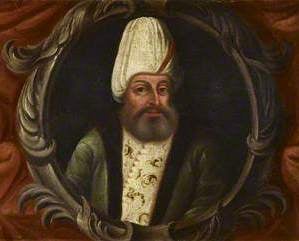

From the Köprülü family
He was the son of Hasan Ağa, the younger brother of Köprülü Mehmed Pasha; during the grand vizierate of his cousin Fazıl Ahmed Pasha he became known as “Amcazade” (the cousin). While leading a free life on his father's farm, he presented gifts to Mehmed IV and to the Haseki Sultan as they were going on the Polish campaign, and so attached himself to the Haseki Sultan. In 1683 he took part in the Vienna campaign in the retinue of Merzifonlu Kara Mustafa Pasha; after the rout he was imprisoned for a short time, and at the beginning of 1684 he was removed from Istanbul with the governorship-general of Shahrizor.
From guardianships to the grand vizierate
After the sanjak of Kastamonu and the guardianship of Çardak, in 1689 he became guardian of Boğazhisar with the rank of vizier. In May 1691 he became deputy (kaymakam) in Istanbul, but in February 1692 he was dismissed because of his carelessness in matters of fixed prices and the coinage standard and because he was held to have erred in incidents that broke out in the city. On 13 December 1694, as grand admiral, he was charged with retaking the island of Chios from the Venetians; after the island was taken he was appointed its guardian, then governor of Karaman and Adana, and in September 1696 guardian of Belgrade.
The views he put forward at the council assembled in Belgrade for operations against Austria were not accepted. But the army's defeat at Zenta and the death in battle of Grand Vizier Elmas Mehmed Pasha showed that he had been right; on 13 September 1697 it was decided to appoint him grand vizier, and on 17 September he received the seal.
Karlowitz and efforts at reform
He began his work above all by trying to secure peace. He established friendly relations with Iran and held talks with the English and Dutch envoys who offered mediation. On 26 January 1699 he signed the treaty of Karlowitz (Karlofça) with Austria, Poland and Venice, and on 13 July 1700 the Treaty of Istanbul with the Russians. After these treaties, which led to extensive territorial losses, he organized the new borders and put an end to disorder in the areas of Jerusalem, Gaza and Basra.
He undertook administrative and military reforms; in particular, with the help of Grand Admiral Mezemorta Hüseyin Pasha, he issued new laws on seafaring and took measures to renew the personnel and ships of the fleet. But he fell out with Şeyhülislam Feyzullah Efendi, the tutor of Mustafa II, and because of his pressure he several times asked to be relieved of office, pleading illness.
Resignation and works
When the dismissal and execution of some of those close to him increased his distress, on 4 September 1702 he sent the seal to the sultan and resigned, withdrawing to his farm at Kumburgaz; after an illness lasting fifteen days he died there on 22 September 1702. He was buried in his tomb in the külliye he had built opposite Saraçhane. The article describes him as a statesman who was aware of the country's situation, prudent, far-sighted and a reformer by the standards of his time; he belonged to the Mevlevi order. The surviving parts of his waterside mansion (yalı) between Anadoluhisarı and Kanlıca are among the oldest examples of wooden buildings in Istanbul. He built fountains in Istanbul and Edirne and a sebil near Babüssagir in Medina, and protected the scholars of his time. The court historian (vak'anüvis) Naima wrote his famous history at his command and, dedicating it to him, named it Ravzatü'l-Hüseyn.
Source: TDV Encyclopedia of Islam, “AMCAZÂDE HÜSEYİN PAŞA” (M. Münir Aktepe)
Related sultans
Cite as: Atlas of the Sultans, “Amcazade Hüseyin Pasha · Grand viziers”, https://padisahlaratlasi.com/en/grand-viziers/amcazade-huseyin-pasha/ (last updated 21 November 2026). Corrections · Image credits