TRENDEFRARAtlas of the Sultans · Ottoman monuments
Tiled Kiosk
Monument · Pavilion, Istanbul, 1472
- Type
- Palace and pavilion
- Built
- 1472

The Conqueror's Glass Palace
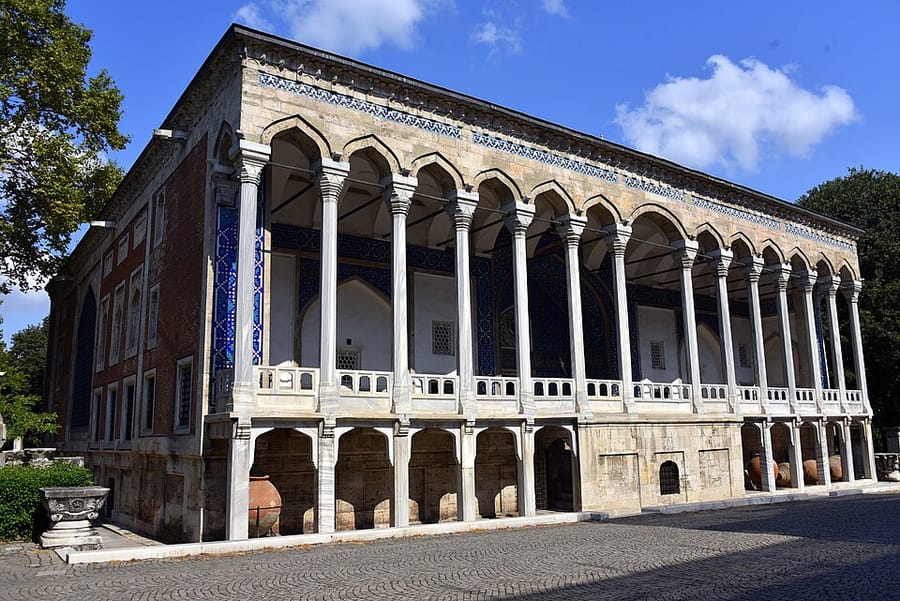
The pavilion stands within the Sur-ı Sultani, the wall enclosing Topkapı Palace, but outside the palace proper, on the slope descending towards the Golden Horn. According to its tile inscription, it was built by Mehmed II, the Conqueror, in 1472; its architect is unknown. Called the Glass Palace (Sırça Saray) by the chronicler Tursun Bey, the two-storey stone pavilion follows a plan of four iwans opening onto a central space and continues Central Asian and Seljuk architectural traditions. Its façade, great entrance iwan and some rooms are faced with mosaic and hexagonal tiles. In the reign of Murad IV the Peacock Fountain was added inside.
Ruined in a fire in 1737, the pavilion probably underwent a repair under Mahmud I that considerably altered its façade; the present portico likewise dates from after that fire. Requested for use as a museum in 1873, it opened after some alterations as the Museum of Antiquities (Asar-ı Atika Müzesi), and its architecture and tiles suffered in the process. It later became the Museum of Turkish and Islamic Works and, in 1953, the Fatih Museum. In 1967 it was turned into a museum section displaying Turkish tiles and ceramics.
Inscription and debates on its construction
The tile inscription, misread for many years, shows according to the reading published by I. Hakkı Konyalı and Tahsin Öz that the pavilion was completed in September 1472; a complete and error-free reading of the two inscriptions is still needed. The claim that Atik Sinan, an architect of Mehmed II's reign, worked on the pavilion has no documentary basis. The view that Iranian or Azeri masters built it, which arose from misreading certain words of the inscription as “Ali” and “Iranian apprentices”, is likewise unfounded. Tursun Bey reports that a second pavilion in the Ottoman style was built opposite it; this pavilion evidently stood where the Istanbul Archaeological Museums are today.
Structure and tiles
Built on a slope descending towards the Golden Horn, the pavilion's rear façade rests on an artificial terrace formed by arched and vaulted Byzantine substructures. Red brick infill was set between the white limestone walls, and on the lower storey of the Golden Horn façade this infill forms a pattern resembling a kilim. The domed room projecting in five sides at the very centre commands the Golden Horn and the entrance to the Bosphorus. The net-like ribs used in the transitions to vaults and domes continue Central Asian and Seljuk traditions.
On the underside of the great arch, Kufic lettering is set in tile mosaic, white on a turquoise ground. In the rooms the walls are covered up to about 3 m with hexagonal tiles, framed by triangular tiles of other colours, alongside turquoise tiles stamped with gilded motifs. The inscription in the entrance iwan is written in two interlaced lines of white and yellow thuluth on a dark blue ground.
Roof, fire and museum years
Melchior Lorck's panorama of Istanbul, drawn in 1553, shows the pavilion covered by a steep wooden roof that also concealed the main dome. According to Naima, Abaza Pasha, one of Murad IV's viziers, was imprisoned and executed in the Glass Palace in August 1634; in the late 17th century palace aghas lived in the pavilion. In 1874 its conversion into a museum was entrusted to a foreign architect named Monterano; the wooden roof was removed, partition walls were demolished and new doors and windows were opened. During repairs after 1942 the external staircase added in the 1880s was removed. Semavi Eyice argues that the building, the only surviving example of Turkish pavilion architecture, should be furnished and preserved as the interior of an old pavilion.
Source: TDV Encyclopedia of Islam (TDV İslâm Ansiklopedisi), “ÇİNİLİ KÖŞK” (Semavi Eyice)
Related sultans
Cite as: Atlas of the Sultans, “Tiled Kiosk · Ottoman monuments”, https://padisahlaratlasi.com/en/monuments/tiled-kiosk/ (last updated 21 November 2026). Corrections · Image credits