TRENDEFRARAtlas of the Sultans · Ottoman monuments
Murad Pasha Mosque
Monument · Mosque, Istanbul, 1471–1472
- Type
- Mosque
- Built
- 1471–1472
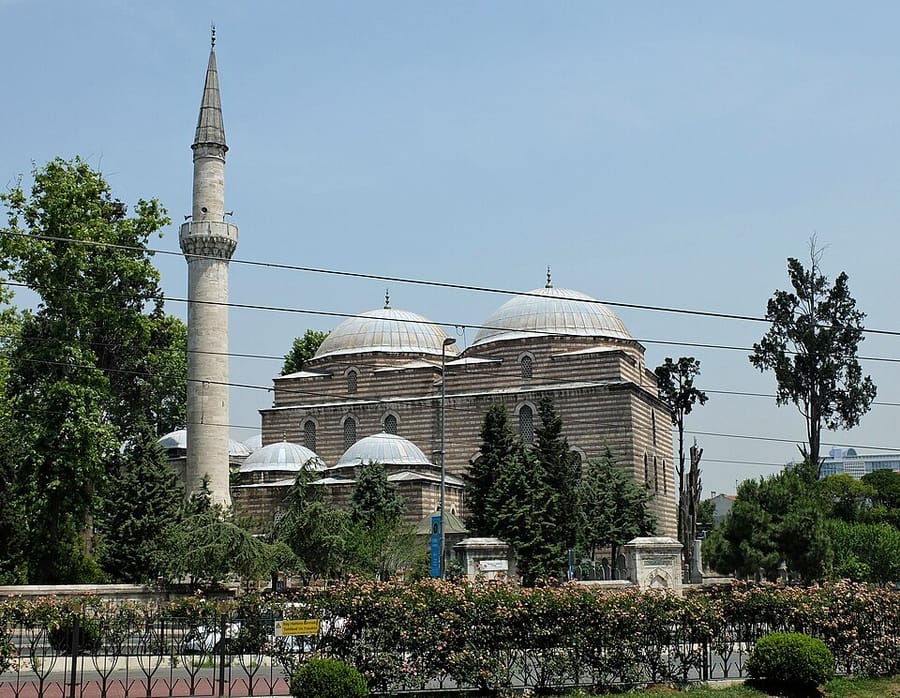

An early tabhane mosque in Istanbul
Standing at the junction of Vatan and Millet avenues in Aksaray, the mosque is the centre of a complex (külliye) built in 1471–72 by Has Murad Pasha, one of the viziers of Mehmed the Conqueror. According to its endowment deed of 1473, the complex comprised the mosque, a public kitchen, a bathhouse and a madrasa that was completed in 1477, after Murad Pasha's death, by his brother, the grand vizier Mesih Pasha. The mosque was damaged by a storm in 1640 and by the fires of 1660 and 1693. The madrasa and bathhouse were demolished in the 20th century, and the graveyard was reduced when the avenues were opened in 1957–1958.
Built as a mosque with hospice rooms (tabhane), it has two equal domed units 10.5 m in diameter on the qibla axis, flanked on each side by two domed tabhane rooms; as these are lower than the prayer hall, the exterior has a stepped appearance. The portico is of cut stone, while the other walls alternate courses of stone and brick. An inscription above the entrance records the date of construction. The mosque was restored in 1935 by the architect Vasfi Egeli. Part of a large vizier's complex built soon after the conquest, it is an important example of the tabhane mosque type in Istanbul.
Portico and portal
Of the six columns carrying the domes of the five-bay portico, two are of granite with lozenge capitals and the others of green porphyry with muqarnas capitals; the difference in height between them is made up with marble cushions. The drum of the central dome is raised higher to emphasise the entrance-mihrab axis. The depressed-arched portal, set within a niche with a Bursa arch, carries above its dated inscription the prayer 'Rabbena' written in palmette-shaped mirror calligraphy; inlays of coloured stone in the form of hexagons and six-pointed stars stand out here.
Interior layout and minaret
The lantern and pool that stood in the central hall of early hospice mosques were omitted here, and the main prayer area, raised by two steps, was extended up to the doors of the side rooms to give more space for worship. The transition to the sixteen-ribbed dome of the central hall is made with prismatic triangles, and to the dome of the prayer hall with muqarnas pendentives. The mihrab and minbar are new. Each side room has a fireplace niche. A garland motif on the upper shaft of the minaret at the north-west corner shows that it was repaired in the 19th century; its base bears two undated sundials.
Graveyard and relocated monuments
The graveyard south of the mosque holds eminent figures such as Grand Vizier Mesih Pasha, Kara Davud Pasha, Şeyhülislam Pirizade Osman Sahib Efendi and Altıparmak Ibrahim Efendi. The early 16th-century tomb of Şirmerd Çavuş, which once stood in front of the Haseki Hospital, was moved to the mosque courtyard when Millet Avenue was opened; the open tomb, resting on cut-stone piers, contains Şirmerd Çavuş and his daughter Kamerşah Hatun. The Empire-style tomb, sebil and fountain group of the Oğlanlar Lodge, dated 1870–1871 and demolished in 1957, was re-erected north of the courtyard in 1964.
The madrasa west of the mosque was rebuilt in timber in 1885, its rooms increasing from twelve to sixteen and later eighteen; in 1918 it served as a shelter and soup kitchen for fire victims. Its inscription is now in the Museum of Turkish and Islamic Arts. The double bathhouse, known as the Horhor or Aksaray Bath, was among the largest and oldest in Istanbul; during metro excavations its hypocaust was uncovered about 3 m below the present street level.
Source: TDV Encyclopedia of Islam (TDV İslâm Ansiklopedisi), “MURAD PAŞA KÜLLİYESİ” (Zeynep Hatice Kurtbil)
Related sultans
Cite as: Atlas of the Sultans, “Murad Pasha Mosque · Ottoman monuments”, https://padisahlaratlasi.com/en/monuments/murad-pasha-mosque/ (last updated 21 November 2026). Corrections · Image credits