TRENDEFRARAtlas of the Sultans · Ottoman monuments
Zeyrek Çinili Hamam
Monument · Bathhouse, Istanbul, 1540–1546
- Type
- Bathhouse (hammam)
- Built
- 1540–1546
A work of Mimar Sinan
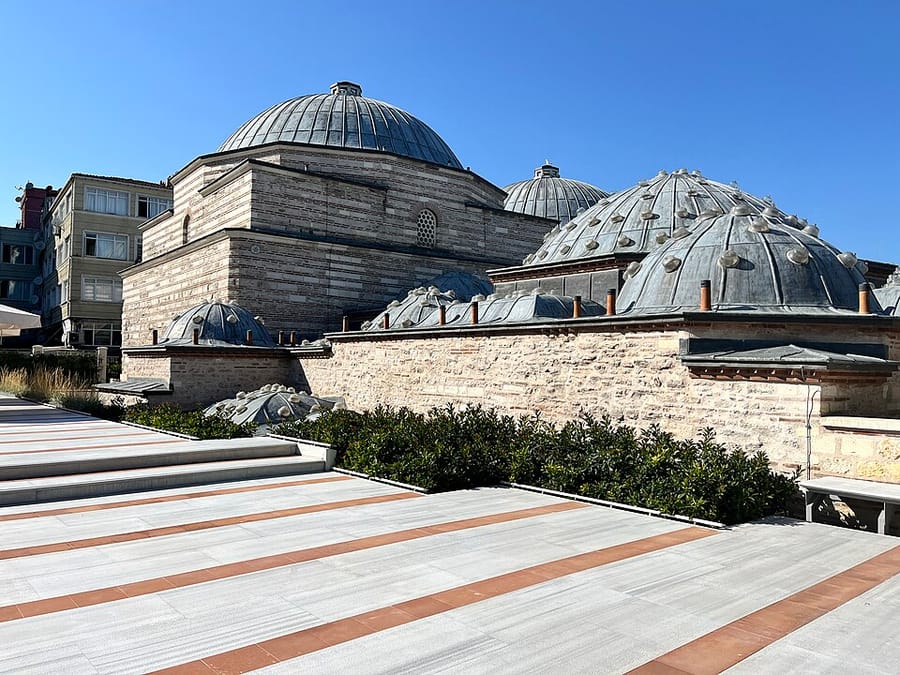

Hayreddin Pasha's double bathhouse
This bathhouse in the Kırkçeşme quarter of Istanbul's Fatih district was probably commissioned from Mimar Sinan by Hayreddin Barbarossa (Barbaros Hayreddin Pasha) between 1540 and 1546 and endowed to his madrasa in Beşiktaş, which no longer stands. After its founder it is also known as the Hayreddin Pasha or Kaptanpaşa Bath, and after its neighbourhood as the Zeyrek Tiled Bath (Çinili Hamam). One of the finest examples of Ottoman bathhouse architecture, it is a double bath whose men's and women's sections mirror each other exactly, and it still functions as such today.
Each section consists of a domed changing room, a vaulted warm room and a cruciform hot room with four iwans and four private cubicles arranged around an octagonal heated platform. The bath was badly damaged in the great Cibali fires of 1728 and 1838 and later repaired. The tiles that gave the building its name survive only in the hot room of the men's section. These panels of blue-and-white Iznik tiles from the first half of the 16th century, enriched with turquoise, carry Persian verses written in elegant taliq script beside the cubicle doors.
Plan and basins
The bath stands at the corner where Itfaiye Street meets Çinilihamam Street and, after its quarter, is also called the Tezgahçılar Bath. Its furnace in front of the water tank retains its original form. Because the street level has risen, it is now entered down a few steps. In the 19th century two-storey wooden galleries were built in the changing rooms of both sections, and a fountain pool carved from a single block of marble was placed in the middle of the men's section.
In the hot rooms the iwans are covered by mirror vaults and the square corner cells by domes on squinches. Each hot room has twenty-two basins: one in the entrance iwan for the final rinse before wrapping in a towel, the others three each in the remaining iwans and cells. The latrines and cleaning cells are entered through short corridors at the sides of the cool rooms. A domed portico with marble columns that should have stood in front of the men's section is thought to have been ruined in one of the fires and removed during repairs.
The tile panels
Above the niches on either side of the cell doors are eight rectangular tile panels in all. Over each door is a large hexagonal panel composed of hexagonal, triangular and narrow strip-shaped pieces; a panel of the same form is set in the middle of the iwan opposite the entrance. The tiles have a white body and are painted in blue and turquoise under a clear colourless glaze, outlined in dark blue. The inscriptions on the rectangular panels, written in white on a floral ground, are Persian verses on the theme of the bath.
Source: TDV Encyclopedia of Islam (TDV İslâm Ansiklopedisi), “ÇİNİLİ HAMAM” (Şerare Yetkin)
Related sultans
Cite as: Atlas of the Sultans, “Zeyrek Çinili Hamam · Ottoman monuments”, https://padisahlaratlasi.com/en/monuments/zeyrek-cinili-hamam/ (last updated 21 November 2026). Corrections · Image credits