TRENDEFRARAtlas of the Sultans · Ottoman monuments
Defterdar Mosque
Monument · Mosque, Istanbul, 1541–1542
- Type
- Mosque
- Built
- 1541–1542
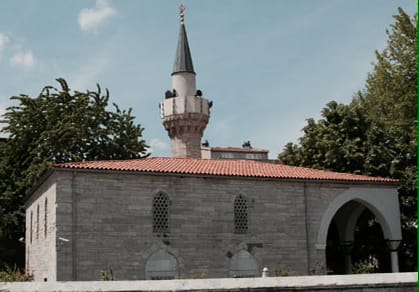

A calligrapher treasurer's mosque
Standing on the Golden Horn along the road to Eyüp, the mosque was built in 1541–42 by Nazlı Mahmud Çelebi, who served about seven years as chief treasurer (defterdar) under Suleiman the Magnificent. A calligrapher licensed by Şeyh Hamdullah, the founder wrote the Arabic verse inscription over the prayer-hall door in his own hand. For this reason the minaret finial was shaped like a pen in an inkwell; the pen, put back during the repairs after the 1766 earthquake, fell again in the 1940s, and the inkwell was lost in the 1970s. Although some publications attribute the mosque to Mimar Sinan, it does not appear in the lists of his works.
Built of cut stone on a rectangular plan, the mosque is covered by a tiled wooden roof and has not kept its original architecture; its masonry portico on marble columns was later replaced by a wooden one. In the graveyard stands the open, domed tomb of Mahmud Çelebi, who died in 1546, raised on four marble columns and far more ornate and refined than similar tombs in Istanbul. The fountain of 1543–44 in the courtyard wall is one of the oldest inscribed fountains surviving in the city.
Inscriptions and lost buildings
Nazlı Mahmud Çelebi served as chief treasurer in 1537–1542 and 1544–1546. The inscription above the prayer-hall door, written in his own hand, is a three-couplet Arabic poem; a Persian chronogram above the courtyard gate on the sea side gives the year 1540–41. According to the Hadikatü'l-cevami, there was a wooden madrasa in the courtyard and an upper-storey stone school on the landward side. The madrasa was later turned by the administrator into rooms for single men; the stone school was demolished and a wooden primary school built above the sea-side gate. No trace of these remains today. Evliya Çelebi describes the building as a small mosque of old workmanship with a low minaret beside the Defterdar landing stage.
Of the windowed courtyard wall only the section along the street survives, and houses have been built inside the courtyard. Aptullah Kuran likewise did not include the mosque in his book on Sinan.
Roof, portico and tomb
Tahsin Öz wrongly described the mosque as domed; since the prayer hall is rectangular, it cannot have had a masonry dome, though, as in the Takkeci Mosque, there may have been a wooden dome inside the tiled roof. The marble columns of the earlier masonry portico were left embedded in the wall when a wooden portico replaced the arcade, which perhaps collapsed in the earthquake of 1766. When the article was written (1993), nothing of artistic value remained inside, and the minbar and mihrab had been coated with oil paint.
The four pointed arches of the open tomb are carved in semicircular lobes, and its dome rests on a blind octagonal drum. The marble parapet slabs between the columns, 0.80 m high, are decorated on their outer faces with low-relief lattice motifs. The marble entrance frame ends in a richly carved crest, with the profession of faith carved between the arch and the crest. The headstone of the cenotaph has been destroyed; only the footstone survives, with a simple inscription giving Mahmud Çelebi's name. The three-couplet inscription of the cut-stone, pointed-arched fountain in the courtyard wall is also recorded in Ayvansarayi's works.
Source: TDV Encyclopedia of Islam (TDV İslâm Ansiklopedisi), “DEFTERDAR CAMİİ ve TÜRBESİ” (Semavi Eyice)
Related sultans
Cite as: Atlas of the Sultans, “Defterdar Mosque · Ottoman monuments”, https://padisahlaratlasi.com/en/monuments/defterdar-mosque/ (last updated 21 November 2026). Corrections · Image credits