TRENDEFRARAtlas of the Sultans · Ottoman monuments
Hamza Bey Mosque (Thessaloniki)
Monument · Mosque, Thessaloniki, 1467–1468
- Type
- Mosque
- Location
- Thessaloniki, Greece
- Built
- 1467–1468

From prayer room to Friday mosque
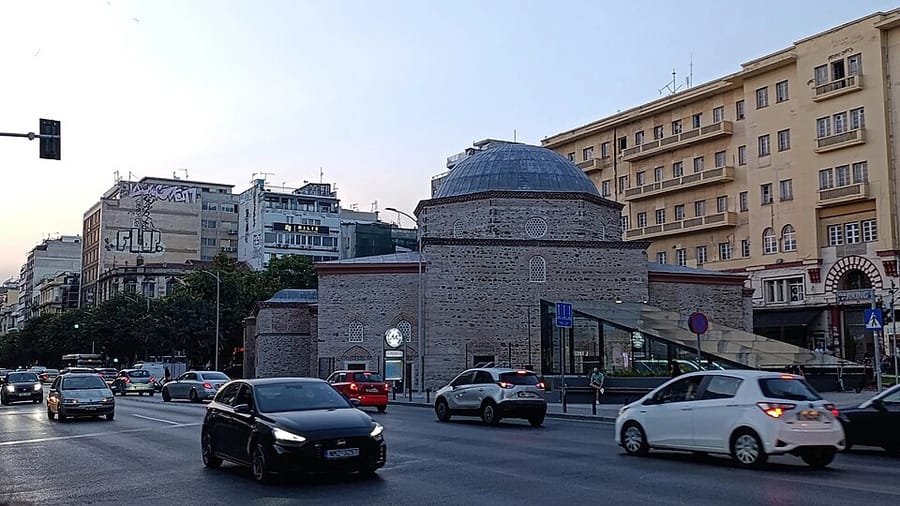
Standing on Egnatia Street in the old market quarter of Thessaloniki, the mosque was founded in 1467–68, according to its Arabic inscription, by Hafsa Hatun, daughter of Hamza Bey. Hamza Bey's identity is uncertain: one view holds that he was the Hamza Pasha killed in 1462 while on an embassy to Vlad Țepeș, Prince of Wallachia, in which case the mosque may have been built in his memory. First conceived as a small domed masjid, it was enlarged on three sides and given a courtyard when the growing city needed a place for Friday prayers. After falling into ruin, it was completely renovated in 1619–20 by Mehmed Bey, a kapıcı (gatekeeper).
The square prayer hall is covered by a single dome on corner squinches and an octagonal drum; the porticoes of the irregular courtyard reuse older columns and capitals, some carved with animal figures. After the Balkan War the minaret was pulled down, the porticoes were turned into shops and the prayer hall into a cinema. Damaged in the 1978 earthquake, part of the building was in use as a shop when the encyclopedia article was written (1997).
Endowment deed and revival
According to the Menazırü'l-avalim of Aşık Mehmed of Trabzon, Taşköprizade Kemaleddin Mehmed Efendi, judge of Salonica in 1592–93, examined the mosque's endowment deed while inspecting the city's foundations and established that it had been built by Hafsa Hatun, daughter of Hamza Bey. The mosque was first known among the people as Hafsa bint Hamza Bey, and only later came to be named after its founder's father.
About twenty-five years after this record the building had fallen into ruin; whether because of an earthquake or a fire is unknown. A two-couplet Arabic inscription of 1619 in the mosque reports that it was restored by a head gatekeeper. The copy of the endowment deed dated 25 February 1620, written by the poet and chronicler Mehmed Nergisi, was published with a German translation by Franz Babinger. Evliya Çelebi described the mosque in February 1668 as a fine domed building with a large congregation and recorded a copy of one of its inscriptions.
Wings, courtyard and lost fittings
The central bay of the marble-columned portico is domed, the side bays cross-vaulted. During the 16th-century enlargement, rectangular wings with mihrabs in their qibla walls were added on both sides of the prayer hall; the plan of the southern wing became distorted over time. Remarkably, the minaret stands outside this wing, at a distance from the main building. The irregular bays of the courtyard were covered with mirror vaults, and at a late date the courtyard itself was roofed over. Beside the reused capitals there are also Turkish lozenge capitals; O. Tafrali's identification of these capitals as Byzantine later became the basis of the claim that the Turks demolished Byzantine buildings in the city to reuse their materials.
Nothing remains of the minaret, which, like its counterparts in the Balkans, had a very tall, chamfered shaft of cut stone. Old photographs of the mosque, which remained in use for some time after the loss of Salonica, show painted decoration in the dome, calligraphic panels and candlesticks; the mihrab and the wooden minbar of interlocking work have also disappeared. The building underwent a minor restoration after 1953.
Source: TDV Encyclopedia of Islam (TDV İslâm Ansiklopedisi), “HAMZA BEY CAMİİ” (Semavi Eyice)
Related sultans
Cite as: Atlas of the Sultans, “Hamza Bey Mosque (Thessaloniki) · Ottoman monuments”, https://padisahlaratlasi.com/en/monuments/hamza-bey-mosque-thessaloniki/ (last updated 21 November 2026). Corrections · Image credits