TRENDEFRARAtlas of the Sultans · Ottoman monuments
Mustafa Pasha Bridge
Monument · Bridge, Svilengrad, 1528–1529
- Type
- Bridge
- Location
- Bulgaria
- Built
- 1528–1529
A work of Mimar Sinan
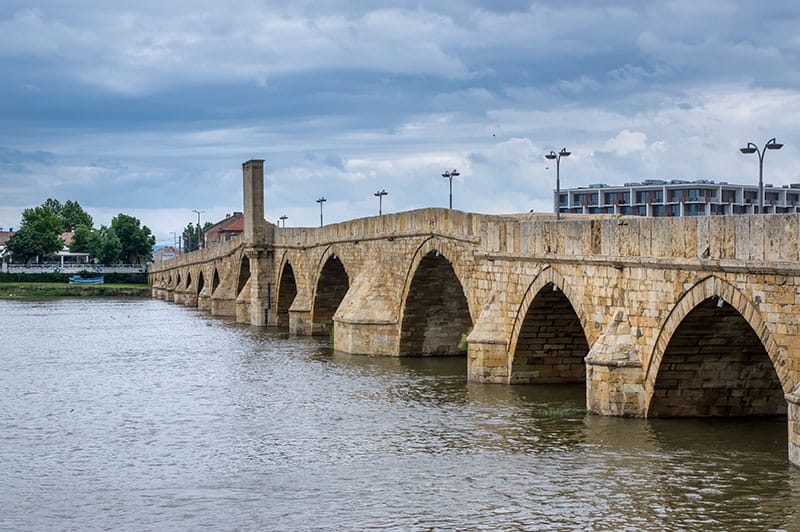

An early work of Sinan on the Maritsa
The bridge over the Maritsa (Meriç) river gave its name to the nearby town: known as Cisr-i Mustafa Pasha, the town was renamed Svilengrad when it became part of Bulgaria. The bridge was built by Çoban Mustafa Pasha, son-in-law of Selim I, who rose to second vizier under Suleiman the Magnificent. Its Arabic inscription gives 1528–29 as the year of construction; the pasha died in April 1529 and did not live to see it completed. As the Tezkiretü'l-ebniye lists it among Sinan's bridges, it is most probably one of the earliest works of Mimar Sinan.
About 300 m long, the bridge has twenty pointed arches: four large ones in the middle and eight on each side, diminishing towards the ends. It is built of finely dressed stone, with a kiosk bearing a marble inscription at its centre. Foreign travellers who crossed it praised it highly. In 1573 a mill that was damaging the bridge was pulled down by the judge of Edirne and the chief architect Sinan, and the bridge was repaired. In 1960 the Bulgarian government wanted to demolish it, but the architect R. Radzeff objected to the decision; Semavi Eyice found it in sound condition in 1964.
The inscription and a misconception
The bridge's Arabic inscription is written in an intricate interlaced composition; its calligraphy must be by Ahmed Şemseddin Karahisari or his adopted son Hasan Çelebi. The phrase 'hasaneten ebediyye' at the end gives the year 935 (1528–29) by chronogram. Evliya Çelebi calls the bridge 'twelve-arched' and a charitable work of Koca Lala Mustafa Pasha, and writes that it bore a Turkish inscription; in fact no such inscription exists. The verse chronogram he quotes is a poem by Gazali, known as Deli Birader, written on Mustafa Pasha's death; according to Ayvansarayi the poet received 100 gold pieces for it from the pasha's widow, Sultanzade Hanım Hatun.
Endowment and travellers' accounts
Recorded in 1528–29, the bridge was maintained with the revenues of the village of Karaağaç and the farmstead of Aladeresi in Çirmen. Hans Dernschwam, crossing it on 18 August 1553, notes that the bridge was Mustafa Pasha's charitable work; the envoy Busbecq, who saw it the same year, calls it 'magnificent'. Salomon Schweigger describes it on 21 December 1577 as 'a very beautiful stone bridge', and Cornelius von den Driesch, in his travel account printed in 1723, calls it a bridge whose like is rarely found in Europe. The number of arches given by travellers varies from seventeen to twenty-one and the length from 325 to 442 paces.
Structure and surroundings
The dressed stone has been identified as coming from the quarry of the village of Karabağ, about 10 km away. The piers between the arches have cutwaters, and both sides of the bridge are bordered by flat parapet slabs; in the inscription kiosk at the centre, the marble inscription is set above a mihrab-shaped arch. At the bridgehead Sinan also built the Haseki Sultan Mosque, which Evliya Çelebi praised as worthy of a sultan, together with a soup kitchen, primary school, inn, bath and market; no trace of the mosque survives today. The bridge's founder, Çoban Mustafa Pasha, also built the staging complex in Gebze and the Kurşunlu Mosque in Eskişehir.
Source: TDV Encyclopedia of Islam (TDV İslâm Ansiklopedisi), “CİSR-i MUSTAFA PAŞA” (Semavi Eyice)
Related sultans
Cite as: Atlas of the Sultans, “Mustafa Pasha Bridge · Ottoman monuments”, https://padisahlaratlasi.com/en/monuments/mustafa-pasha-bridge/ (last updated 21 November 2026). Corrections · Image credits