TRENDEFRARAtlas of the Sultans · Ottoman monuments
Pirinç Han
Monument · Han, Bursa, 1507–1508
- Type
- Inn and caravanserai
- Built
- 1507–1508
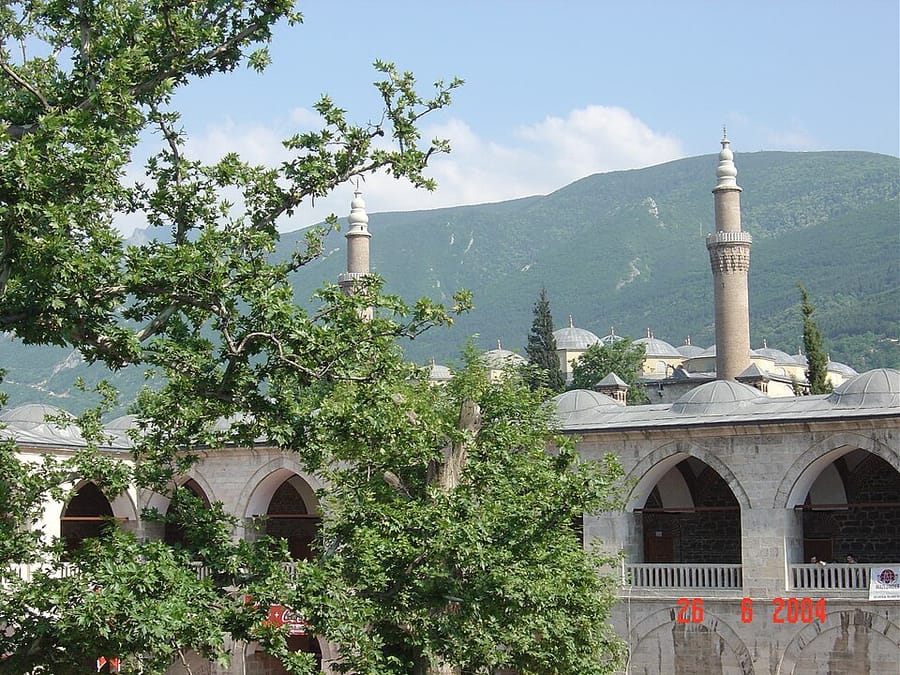

Bayezid II's second han in Bursa
Pirinç Han is the second han (urban inn) that Sultan Bayezid II built in Bursa, after the Koza Han, as an endowment for his mosque in Istanbul; for this reason it was also called Han-ı Cedid-i Sani (the Second New Han), and it has been known as Pirinç Han since the early 17th century. According to the Bursa court registers and archival documents, its architect was Yakub Şah bin Sultan Şah, assisted by Ali bin Abdullah. Construction began in May 1507 and was completed in July 1508; the sultan sent 10,000 akçe to cover the costs.
Built of rubble stone and brick, the two-storey han measures 70 × 75 metres, with its rooms arranged around an arcaded courtyard; the upper floor has forty-eight rooms with fireplaces, while the west wing served as a stable. Repaired several times in the 17th century, the building was badly damaged in the Bursa earthquake of 1855, when its west and north arcades and shops collapsed. Its north-east corner was cut off when Cumhuriyet Avenue was laid out. A major restoration begun in the 1980s lasted about twenty years; today the ground-floor shops are run as coffeehouses.
Names and construction
The inn was formerly also known by names such as Han-ı Cedid-i Hakani, Karbansaray and Han-ı Cedid-i Amire. It has been claimed that a plastered-over inscription existed above its door, but the last restoration showed the inscription panel to be empty. On completion, Zaim Ibrahim, who had rendered service in the work, was given a gift of 1,000 akçe and a robe of honour of Bursa benek cloth. Kasım, who brought its water from Pınarbaşı, was appointed maintainer of the water conduit, and Master Hayreddin permanent maintainer of the inn.
Rooms, courtyard and trade
The ground-floor rooms lie behind pointed-arched, cross-vaulted arcades carried by cut-stone piers 1.35 metres square; counting the rooms with storerooms and the shops opening outward, the total rises to thirty-eight. The windows of the ground-floor rooms open onto the courtyard, those of the upper rooms to the outside. The masjid in the courtyard mentioned in a document of 1642 and the four shops beneath it no longer exist, while traces of the sixteen-sided fountain are still visible. Remains of geometric brick decoration in the spandrels of the iwan-shaped portal on the east show that the gate was once imposing.
Documents show that European, Venetian and Russian merchants lived in the Şehreküstü quarter just below the inn and traded in furs. Until the late 1970s the inn housed leather workshops, shoemakers, silk twisters and silk dyers.
Repairs
In 1519 the two rows of the Saddlers' Market in front of the portal burned and were repaired by the inn's steward; several of these shops still stand. In 1624 and 1627–28 the water system and the courtyard masjid were repaired for 26,433 akçe, and in 1630–31 the latrines for 18,085 akçe. In 1671, 11,265 akçe were spent on the water conduit, distribution tank and fountains, and in the thorough repair of 1677, 113,350 akçe on the room floors, hearths, lead roofing, stable arches and the roof of the portal. During the restoration begun in the 1980s the upper-floor latrines were removed and a new door was opened in the west facade; the masjid and fountain were not rebuilt.
Source: TDV Encyclopedia of Islam (TDV İslâm Ansiklopedisi), “PİRİNÇ HANI” (Doğan Yavaş)
Related sultans
Cite as: Atlas of the Sultans, “Pirinç Han · Ottoman monuments”, https://padisahlaratlasi.com/en/monuments/pirinc-han/ (last updated 21 November 2026). Corrections · Image credits