TRENDEFRARAtlas of the Sultans · Ottoman monuments
Ishak Pasha Bridge
Monument · Bridge, Kyustendil, 1469–1470
- Type
- Bridge
- Location
- Bulgaria
- Built
- 1469–1470
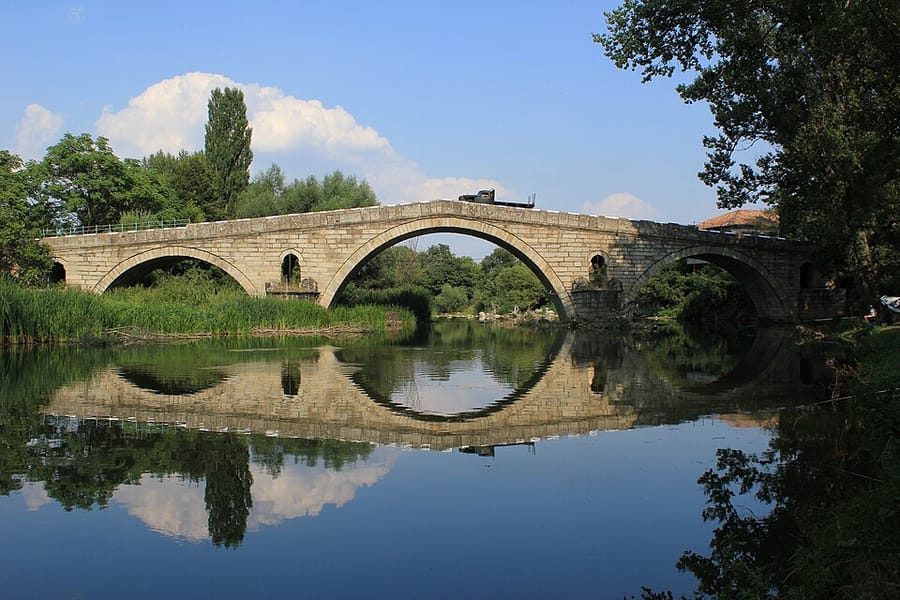

A humpbacked bridge over the Struma
Known locally as the Kadı Bridge or Kadın Bridge (Kadin Most), the bridge carries the Kyustendil–Dupnitsa road over the Struma, about 15 km east of Kyustendil. According to the badly worn three-line Arabic inscription at its centre, it was built in 1469–70 by Inegöllü Ishak Pasha, a grand vizier under Mehmed the Conqueror and Bayezid II; a copy of the inscription is in the Kyustendil Museum. Although remains of a Roman bridge are said to have been found at the same spot, its architecture shows clearly that the bridge is a Turkish work from its foundations up.
Built entirely of regular dressed stone, the humpbacked (semerdam) bridge is 89.50 metres long and 6.49 metres wide. Of its five arches the large central one spans 21.65 metres; between the arches are cutwaters, above which there are pairs of small pointed relief openings. In 1972 the bridge still preserved its original architecture, with its thick stone parapets. Once not even mentioned in tourist guides printed in Bulgaria, it was later presented in guides by Western authors as one of the most important works of the Turkish period.
Inscription and legends
The inscription in the middle of the bridge is set within a rectangular frame and topped by a decorated, arch-shaped crest. According to Semavi Eyice, the name Kadın Köprüsü (Woman's Bridge) derives from a variant of a folk legend told about many similar old structures. A second legend told about the bridge, as Cevdet Çulpan notes, seems to have been invented deliberately to encourage the destruction of the inscription; a tourist guide relates yet another legend. Guides by Western authors, after recounting rumours about its construction, claim that its architect was a man named Manuil; Eyice treats this claim with scepticism.
Arches and dimensions
According to the measurements given by Ekrem Hakkı Ayverdi, the arches flanking the large central one span 14.75 and 13.70 metres. The small pointed-arched relief (overflow) openings above the cutwaters appear to have been filled in recently. J. Ivanov's view that remains of a Roman bridge existed at the site is considered plausible, since the structure stands where an important highway crosses a river.
Source: TDV Encyclopedia of Islam (TDV İslâm Ansiklopedisi), “İSHAK PAŞA KÖPRÜSÜ” (Semavi Eyice)
Related sultans
Cite as: Atlas of the Sultans, “Ishak Pasha Bridge · Ottoman monuments”, https://padisahlaratlasi.com/en/monuments/ishak-pasha-bridge/ (last updated 21 November 2026). Corrections · Image credits