TRENDEFRARAtlas of the Sultans · Ottoman monuments
Fountain of Ahmed III (Üsküdar)
Monument · Fountain, Istanbul, 1728–1729
- Type
- Fountain and sebil
- Built
- 1728–1729
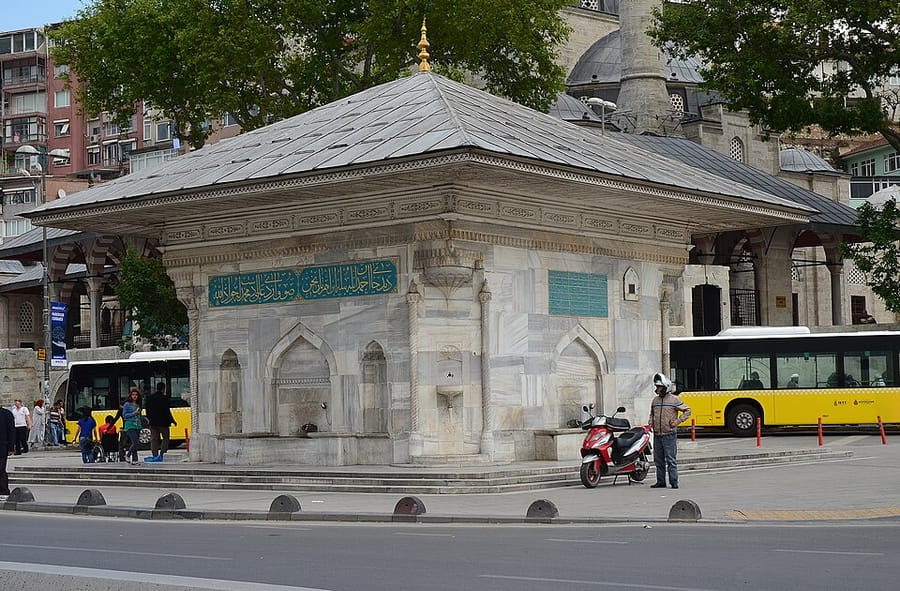

A square fountain by the Üsküdar landing
This monumental fountain on Iskele Square in Üsküdar was built in 1728–29 at the order of Sultan Ahmed III by the grand vizier Damad Ibrahim Pasha, as a charitable work in the name of the sultan's mother, Rabia Emetullah Gülnuş Sultan. Its water was brought from springs around Merdivenköy and Sazlıdere. It bears three chronogram poems by Nedim, Rahmi and Şakir. The signature beneath the single-line couplet in monumental thuluth script on the seaward side shows that Ahmed III himself was the calligrapher of that inscription.
Square in plan with chamfered corners, the four-sided fountain has a pointed-arched niche on each face and a tap on each chamfered corner; the richest relief carving in the rumi style is on the seaward face, which also carries the sultan's inscription. The centre of its broad-eaved wooden roof once rose like a lantern but was later simplified. Repaired in 1932, the fountain ended up in a hollow after the square was redesigned, so in 1955 its facing was removed, its core raised by 150 centimetres and the facing reassembled. During the 1987 restoration new painted decoration was added beneath the eaves. It is one of the elegant works of the Tulip Period.
Setting and water supply
The fountain stands at the head of the main caravan road on the Asian side of the city and of the landing that linked the two shores of the Bosphorus. Nearby are the tomb of Gülnuş Sultan, who died in 1715, and the Yeni Valide Mosque, her own foundation. Its water was drawn from springs at the Karaman farm near Merdivenköy and at Sazlıdere, carried by the channel called the Ibrahim Pasha waterway, which also supplied the Şerefabad Palace and fed many other fountains. Of the chronogram poems, the one on the north façade is by Nedim, the eastern one by Rahmi and the southern one by Şakir.
Façades and later changes
On the sea façade the central fountain niche is flanked by two further niches in the form of a mihrab. The chamfered corners have twisted colonnettes on either side, taps at a person's height and projecting basins below them. The eaves, once decorated, were later left plain. When the square was laid out in 1943–1945 the fountain ended up in a hollow; in 1955 the Water Administration removed the outer facing, raised the masonry core and reset the façade elements, and lifted the wooden roof unchanged. Semavi Eyice considers the failure to restore the roof's former two-tiered form a loss, and counts the fountain among the beautiful works of the Tulip Era, though not equal to the one in front of the Bab-ı Hümayun.
Source: TDV Encyclopedia of Islam (TDV İslâm Ansiklopedisi), “AHMED III ÇEŞMESİ” (Semavi Eyice)
Related sultans
Cite as: Atlas of the Sultans, “Fountain of Ahmed III (Üsküdar) · Ottoman monuments”, https://padisahlaratlasi.com/en/monuments/fountain-of-ahmed-iii-uskudar/ (last updated 21 November 2026). Corrections · Image credits