TRENDEFRARAtlas of the Sultans · Ottoman monuments
Yıldız Hamidiye Mosque
Monument · Mosque, Istanbul, 1881–1885
- Type
- Mosque
- Built
- 1881–1885

The mosque of the Friday procession
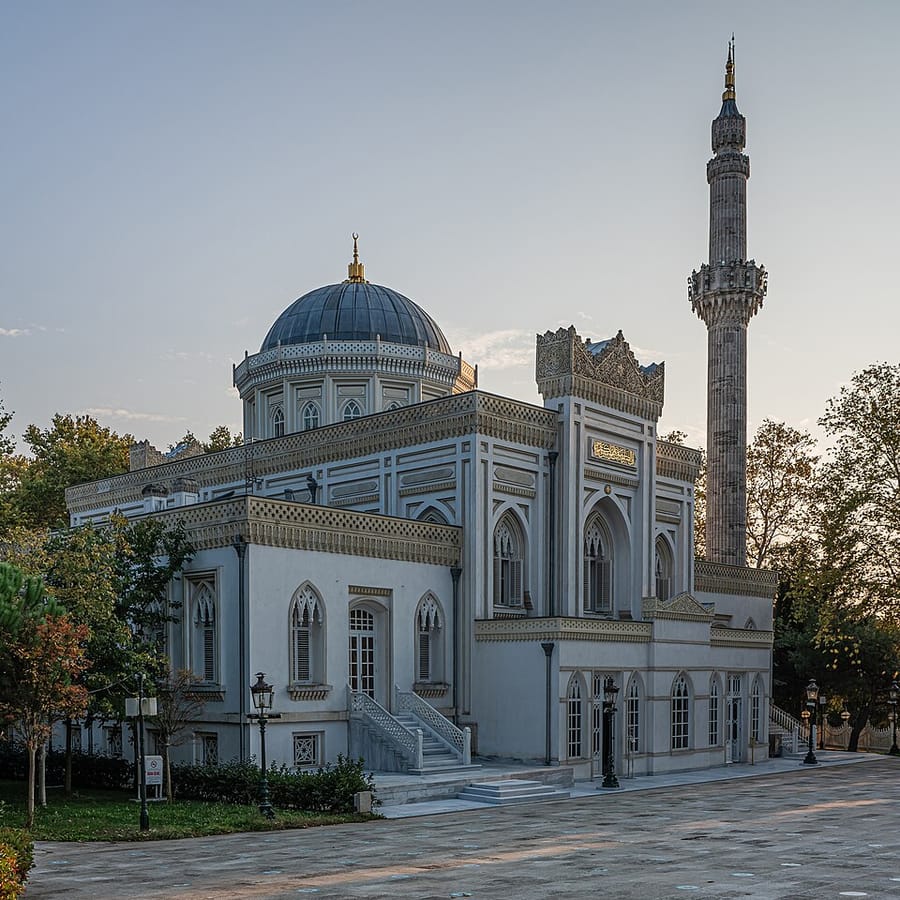
Named the Hamidiye Mosque after its founder, Abdulhamid II, the building is better known as the Yıldız Mosque. Having settled in Yıldız Palace, the sultan wanted to stay close to it and ordered a new mosque for the Friday procession (selamlık) on the high terrace at the palace entrance. Its foundation stone was laid on 20 December 1881, and it entered service at the end of September 1885. Although some publications name Sarkis Balyan as its architect, a document in the Dolmabahçe Palace Archive shows that it was designed by Nikolaidis Jelpuylo, known as Nikolaki Kalfa. Abdulhamid II made the cedar lattices of the sultan's gallery with his own hands.
In this building, which blends Orientalist and neo-Gothic elements in an eclectic manner, the rectangular prayer hall is covered by a dome on a tall drum with sixteen windows; the inside of the dome is decorated with stars on a navy-blue ground. The pair of minarets usual for imperial mosques is reduced here to one. Until the end of the reign the mosque was the scene of lavish Friday processions. In the bomb attack staged by Armenian militants at the Friday ceremony of 21 July 1905, twenty-six people were killed; the sultan escaped because he chatted a little longer than expected with the Şeyhülislam Cemaleddin Efendi. The clock tower in the courtyard was built in 1890.
Building the mosque
Abdulhamid II did not wish to leave the palace, fearing that his elder brother Murad V might be restored to the throne; the site was therefore chosen on the high terrace in front of the Koltuk Gate of Yıldız Palace. The works were supervised by the First Chamberlain Osman Bey. Nikolaki Kalfa presented the sultan with a model of the mosque together with the plans and drawings he had quickly prepared. The minbar was meant to be of wood in the style of the minbar of the Bursa Great Mosque, and a photographer was sent to Bursa for this purpose; but for an unknown reason the wish was not fulfilled and the minbar was made of marble. According to the estimates, the mosque cost 16,890 lira.
Facades, dome and inscriptions
The foundations were dug down to firm ground and foundation walls 130 centimetres thick were built. Window frames and eaves are of white Trieste stone, and the facade cornices are enriched with three rows of muqarnas. According to photographs in the Yıldız albums, the wide glazed porches of the entrance and side wings were removed in later repairs and replaced by plain steps. The slender fluted minaret rises from within the west wing. The high-drummed dome lies away from the mihrab, close to the entrance.
At the centre of the dome are the basmala and the first three verses of Surat al-Najm, and in the band Surat al-Mulk; these inscriptions in imitation Kufic were written by the journalist Ebüzziya Tevfik, while the large thuluth inscriptions are by Abdülfettah Efendi. Pairs of octagonal columns supporting the dome are linked by multifoil arches. The upper floor of the two-storey imperial pavilion, decorated with gold leaf, was reserved for the sultan.
Clock tower and courtyard
The three-storey clock tower at the north-west corner of the courtyard, like the mosque, mixes Orientalist and neo-Gothic styles. Its storeys, on a square plan with chamfered corners, are separated by muqarnas cornices, and it is covered by a pointed ribbed dome. The clock is set in the window of the north face, turned towards the palace; the large ta'liq inscriptions on all four sides are by Mehmed Nazif Bey. In the courtyard is a fountain with plaques dated 1842, 1876 and 1900. Besides those killed in the 1905 assassination attempt, fifty-eight people were wounded.
Source: TDV Encyclopedia of Islam (TDV İslâm Ansiklopedisi), “YILDIZ CAMİİ” (Selman Can)
Related sultans
Cite as: Atlas of the Sultans, “Yıldız Hamidiye Mosque · Ottoman monuments”, https://padisahlaratlasi.com/en/monuments/yildiz-hamidiye-mosque/ (last updated 21 November 2026). Corrections · Image credits