TRENDEFRARAtlas of the Sultans · Grand viziers
Damad Ferid Pasha
Grand vizier, 1919–1920 (two terms, five cabinets)
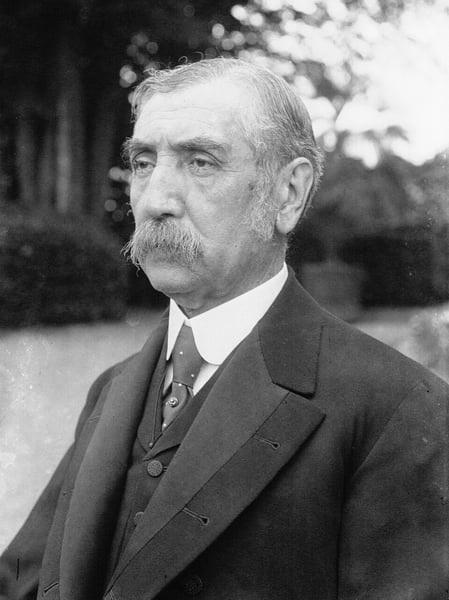

A diplomat who married into the dynasty
He was born in Istanbul in 1853. His real name was Mehmed Ferid; he was the son of Seyyid Hasan Izzet Efendi, a member of the Council of State. He began his career in the foreign service, working as second secretary at the embassies in Paris, Berlin, St Petersburg and London. In 1886 he married Mediha Sultan, the widowed sister of Abdulhamid II, and became an imperial son-in-law (damad). When his request for the London ambassadorship was not granted, he took offence at the sultan and for a long time lived a reclusive life in the waterside mansion at Baltalimanı.
The hope of the opposition
After the Second Constitutional Period began he became a member of the Senate. At first he stayed close to the Committee of Union and Progress, but when he did not get what he expected he turned against it; although the constitutional amendment motion he submitted in 1910 was rejected, he became the hope of the opposition. In 1911 he was elected chairman of the Freedom and Accord Party (Hürriyet ve Itilaf Fırkası), and the following year he resigned because of internal party rivalries. Between 1913 and 1918 he acted in the Senate almost like an opposition party against the Unionist administration.
Five cabinets in the armistice period
Because Vahdeddin wanted a government more zealous in prosecuting the Unionists, he made Tevfik Pasha resign and on 4 March 1919 appointed Damad Ferid Pasha grand vizier. The government's first act was the arrest of a large number of former Unionist statesmen. The hasty trial and execution on 10 April 1919 of Kemal Bey, the district governor (kaymakam) of Boğazlıyan, provoked reactions across the country. After the occupation of Izmir by the Greeks he resigned, but was reappointed the next day. He went to the Paris Conference and submitted a memorandum asking for acceptance of the borders of the 1878 Treaty of Berlin in Thrace and of the pre-war borders in the east; the proposals were rejected without discussion, and he returned empty-handed.
In the face of the Turkish War of Independence (Millî Mücadele) he acted under the pressure of the Entente powers; he issued arrest warrants for Mustafa Kemal Pasha and Rauf Bey. Following the reaction of the Representative Committee (Hey'et-i Temsiliyye) and the Entente powers' proposal for reconciliation, he resigned in the autumn of 1919. On 5 April 1920 he became grand vizier for the fourth time; he issued a circular declaring the national movement “rebels” and set up the Kuva-yi Inzibatiyye (the Disciplinary Forces). Against the fatwa issued over the signature of Şeyhülislam Dürrizade Abdullah, 153 muftis, led by the mufti of Ankara, signed a counter-fatwa. The Ankara Independence Tribunal (Istiklal Mahkemesi) sentenced him to death for high treason.
Sèvres and after
So as not to bear alone the responsibility for signing the treaty, he persuaded the sultan to convene a crown council (saltanat şurası); he formed his fifth government mostly of figures in favour of signing, and the Treaty of Sèvres was signed on 10 August 1920. According to the author of the article, this signature plunged the whole country into mourning. When the British and French high commissioners asked the sultan for his resignation, he left office on 17 October 1920. In 1922 he went to France and died in Nice on 6 October 1923. His total time as grand vizier was one year, one month and eight days. The author of the article, Cevdet Küçük, states that the judgements about him are divided: while most of his rivals considered him a witless administrator and laid all the sins of the armistice period at his door, some of his contemporaries never belittled his intelligence and drew attention to virtues such as courtesy, honesty in money matters and diligence.
Source: TDV Encyclopedia of Islam, “DAMAD FERİD PAŞA” (Cevdet Küçük)
Related sultans
Cite as: Atlas of the Sultans, “Damad Ferid Pasha · Grand viziers”, https://padisahlaratlasi.com/en/grand-viziers/damad-ferid-pasha/ (last updated 21 November 2026). Corrections · Image credits