TRENDEFRARAtlas of the Sultans · 18 / 39 · sultan
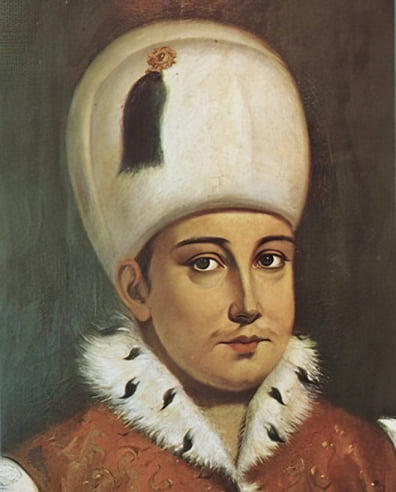
Imaginary portrait (made later) — artist and date unknown
Osman II
Genç (“the Young”)
He was murdered at seventeen when his intention to abolish the Janissary corps and raise a new army became known. His death showed that the Janissaries could depose a sultan and began two centuries of their tutelage.
Open the reign of Osman II on the map▶ Watch the 1-minute video: YouTube · Instagram · TikTok
Interesting fact
He came to the throne in 1618 aged only fourteen. In the janissary revolt of 1622 he was deposed and strangled in the Yedikule fortress.
Source: TDV İslâm Ansiklopedisi (Turkish), article “OSMAN II”
Life
Childhood
Osman was born in Istanbul on 3 November 1604. His father was Ahmed I and his mother Mahfiruz Sultan. As he was his father's first son, he was given the name of Osman Gazi, the founder of the dynasty, and his birth was celebrated in Istanbul with festivities; later sources call him “Genç Osman” (Young Osman).
Very little is known about his years as a prince. The historian Safi Mustafa Efendi, imam to Ahmed I, writes that he grew up together with his brother Mehmed, born in 1605, and that the two had Ömer Efendi as their tutor. He began his lessons at the age of four and was proclaimed heir to the throne at thirteen.
On the throne at fourteen
When his father died, the passing of the throne not to his eldest son Osman but to his uncle Mustafa I caused great controversy. When Mustafa was deposed after ninety-six days because of his mental instability, Osman became sultan on 26 February 1618, when he was only fourteen. Because there had been two accessions within a short interval, the accession bonus was distributed to the troops once again.
In the east the ground for an agreement with the Safavids took shape, and Osman II ratified the treaty. In the west peace was maintained with the Habsburgs, who were occupied with the Thirty Years' War. The grand vizier Ali Pasha had great influence over the young sultan and steered him towards a campaign against Poland-Lithuania; after Ali Pasha's sudden death, his tutor Ömer Efendi regained favour.
The Khotyn campaign
Once the decision to go on campaign had been taken, Osman II had his brother Prince Mehmed, a potential rival, killed on 12 January 1621; according to one account, a part was played in this by the sultan's being shown a letter in which Hoca Ömer Efendi had once proposed that Mehmed should take the throne. The preparations went on through an extraordinary winter in which the Bosphorus froze and food could not be found.
In May 1621 he marched on Poland at the head of the army. His supervising the distribution of pay in person and having the troops counted one by one over three days displeased the senior Janissaries; some impulsive acts of his along the way also unsettled the household troops (kapıkulu) and the viziers. The attacks on the Polish and Cossack army, which had built strong fortifications before Khotyn (Hotin), came to nothing despite all the sultan's efforts. Rivalry among the pashas and errors of command were the main reasons for the failure; the campaign ended with a peace agreement, and Osman returned to Istanbul having lost his trust in the household troops.
Ideas of reform and the revolt
Osman II wanted to be a ruler who broke with palace tradition. He married first a young woman and then Akile, the daughter of the şeyhülislam Esad Efendi; according to Venetian reports, he wished, in keeping with Islamic rules, to marry four freeborn women and in this way change the order of the harem. The TDV article notes that he adopted the model of a “gazi ruler” at one with his people, or else that such a role was cast for him by those close to him.
Five months after returning from Khotyn he had preparations made to go on the pilgrimage (hajj) and wanted to cross to the Anatolian side. This intention gave rise to rumours that he would disband the corps of household troops (kapıkulu) and raise a new army from Anatolia. All the contemporary sources agree that this was why the revolt began. In May 1622 the Janissaries and sipahis rose up and put his uncle Mustafa back on the throne.
Death
The rebels seized Osman II on 20 May 1622. Eyewitnesses relate that, bareheaded and dishevelled, he was put on a nag and taken amid gross insults to the Orta Cami, where Mustafa I was. Kara Davud Pasha, whom the rebels had made grand vizier, tried to kill him there but was prevented; that same afternoon the sultan was taken to Yedikule and strangled there. He was only seventeen.
The killing of a sultan by his own soldiers was a first in Ottoman history and caused a profound shock; in Erzurum, Abaza Mehmed Pasha, claiming vengeance for his blood, started a revolt that would last for years. Osman II wrote poetry under the pen name “Farisi”; according to the TDV article, these poems reflect considerable literary power.
Source: TDV Encyclopedia of Islam (TDV İslâm Ansiklopedisi), “Osman II” (Feridun M. Emecen); the main sources of this article are Hüseyin Tugi, Peçevi, Kâtib Çelebi, Mustafa Safi and the reports of Venetian ambassadors.
Meanwhile in the world
Contemporary rulers
- Ferdinand IIHoly Roman Emperor · 1619–1637Leading champion of the Catholic Counter-Reformation in the Thirty Years' War
- Philip IIIKing of Spain and Portugal · 1598–1621Expelled the Moriscos from Spain and governed through royal favourites
- James IKing of England and Scotland · 1603–1625First Stuart monarch on the English throne
- Louis XIIIKing of France · 1610–1643Came to the throne as a child on his father Henry IV's death
- Gustavus Adolphus (Gustav II Adolf)King of Sweden · 1611–1632Made Sweden one of Europe's great powers
- Abbas I (the Great)Safavid Shah · 1588–1629Reorganized the army and moved the capital to Isfahan
- JahangirMughal Emperor · 1605–1627Son and successor of Akbar
What was happening in the world?
- 1619The assembly meeting at Jamestown, Virginia, became the first elected governing body in an English overseas possession.
- 1620At the Battle of White Mountain near Prague, the Catholic Habsburgs crushed the Protestant revolt in Bohemia.
- 1620The Pilgrims, arriving on the Mayflower, founded Plymouth, the first permanent European settlement in New England.
- 1621The Dutch West India Company was founded with a monopoly on Dutch Atlantic trade and colonization.
Sources: britannica.com [1] [2] [3] [4] [5] [6] [7] [8] [9] [10] [11]
Family
| Father | Ahmed I |
|---|---|
| Mother | Mahfiruz Hatice Sultan |
| Consorts | Akile Hanım, Ayşe Sultan — he broke tradition by marrying outside the palace |
| Children | Şehzade Ömer, Şehzade Mustafa (both died young) |
Major achievements
- Enthroned at fourteen and led a campaign in person
- Polish campaign and the Treaty of Khotyn (1621)
- Married outside the palace, breaking a century-old tradition
- Plan to abolish the Janissaries and raise a new army in Anatolia
- The first sultan who wished to make the pilgrimage to Mecca
Treaties
- Treaty of Khotyn (1621, Poland)
Grand viziers
| Name | From | To | Length |
|---|---|---|---|
| Kayserili Halil Pasha | November 17, 1616 | January 18, 1619 | 2 years, 62 days |
| Öküz Mehmed Pasha (term 2) | January 18, 1619 | December 23, 1619 | 339 days |
| Güzelce Ali Pasha | December 23, 1619 | March 9, 1621 | 1 year, 76 days |
| Ohrili Hüseyin Pasha | March 9, 1621 | September 17, 1621 | 192 days |
| Dilaver Pasha | September 17, 1621 | May 19, 1622 | 244 days |
| Ohrili Hüseyin Pasha (term 2) | May 19, 1622? | May 20, 1622? |
Battles and treaties
| Year | Event | Result / parties |
|---|---|---|
| 1621 | Treaty: Treaty of Khotyn | |
| 1622 | Revolt: Regicide of Osman II (Haile-i Osmaniye) | Osman II was deposed and strangled in the Yedikule fortress; Mustafa I was restored to the throne |
Full infoboxes are in the site’s “Battles and Treaties” tab; source: TDV Encyclopedia of Islam.
Death
Deposed by a Janissary uprising in 1622, he was strangled in the Yedikule dungeon — the first Ottoman sultan killed by his own subjects.
Territorial change
The lands that changed hands in this period, and the battles or treaties that brought the changes, can be seen on the map: map of the reign of Osman II.
Cite as: Atlas of the Sultans, “Osman II (Genç (“the Young”)): Reign Map, Wars and Conquests (1618–1622)”, https://padisahlaratlasi.com/en/sultans/ii-osman/ (last updated 21 November 2026). Corrections · Image credits
Terms on this page: Şehzade · Janissaries
Monuments of this reign: Sultan Ahmed Mosque and Complex · Aslan Pasha Mosque
Women of the dynasty in this reign: Kösem Sultan
State organisation: The Kapıkulu corps
Myths and misconceptions: Did the eldest son always inherit the Ottoman throne?