TRENDEFRARAtlas of the Sultans · Ottoman monuments
Ibrahim Pasha Palace
Monument · Palace, Istanbul, 1521
- Type
- Palace and pavilion
- Built
- 1521

A vizier's palace on the Hippodrome
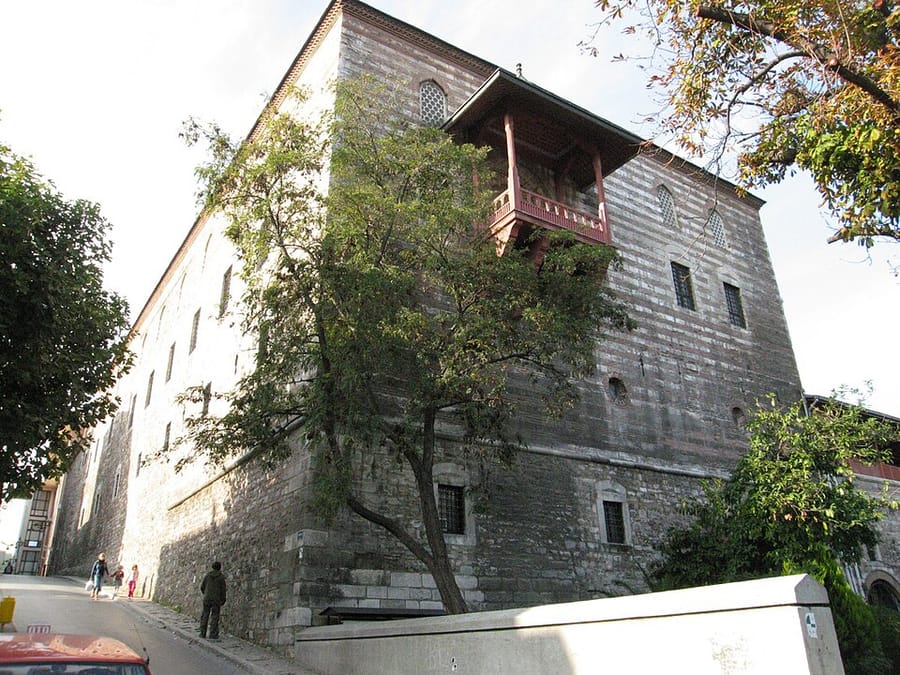
This palace beside the Hippodrome (Atmeydanı) in Sultanahmet was built by Makbul Ibrahim Pasha, grand vizier of Suleiman the Magnificent (Kanuni Sultan Suleiman). A document dated 1521 shows that it was created by substantially altering and enlarging an existing mansion. The pasha's wedding was held here in 1524, and in 1530 the sultan watched the circumcision festivities of the princes from a pavilion built in front of the palace, overlooking the square. After Ibrahim Pasha's execution in 1536 the palace was confiscated by the state and later assigned to grand viziers, grand admirals and imperial sons-in-law. Evliya Çelebi recorded it as the largest vizier's palace in Istanbul.
The palace burned in 1652, was repaired or rebuilt around 1720 by Nevşehirli Damad Ibrahim Pasha, and was never repaired again after a fire in 1741. Some of the remaining buildings served as the record office (Defterhane) and some as a prison until 1939; in 1939 the fourth courtyard was demolished entirely to make room for the courthouse. Of the four courtyards around which the palace was built, the second is the only one surviving from the original construction. Through works directed by the architect Hüsrev Tayla, some sections were reconstructed and the building was arranged as the Museum of Turkish and Islamic Arts.
Early years and changing owners
According to a document of 1521 presented to the sultan by Ömer Ağa, superintendent of Istanbul, the building had a tower with a pavilion, a kiosk, a treasury, a bath, a pantry, kitchens, a council hall and a stable. In an uprising on the night of 16 May 1525 the palace was attacked and its doors and windows smashed. Ibrahim Pasha's setting up in front of the palace of statues brought back as booty from Buda in 1526 caused an outcry; the poet Figani's satire of the pasha on this account cost him his life. After the pasha's execution the palace was granted to many statesmen and imperial sons-in-law, among them Zal Mahmud Pasha, Bosnalı Damad Ibrahim Pasha and Grand Admiral Topal Receb Pasha, and for a long time it bore Receb Pasha's name. In 1648 Sultan Ibrahim gave the palace to his favourite, known as Telli Haseki.
Courtyards and architecture
Built on ground sloping down towards the square, the palace had a facade 140 metres wide in all. The Fleming C. D. Schepper, who came to Istanbul in 1533, notes that the palace was of dressed stone and in the Italian manner, and Matrakçı Nasuh depicts it with its tower. Because of the difference in level with the square, the side of the second courtyard facing the square rests on a vaulted retaining gallery. The place from which the sultans watched the festivities in the Hippodrome was the council hall south of the second courtyard; sources indicate that its walls were decorated with tiles. The bay window seen in miniatures was rebuilt in the last restoration, and the facade was restored with red-painted wooden columns and arches on the basis of traces of red columns in the wall.
The third courtyard, the smallest in the palace, was surrounded by vaulted halls on the ground floor and domed rooms with porticoes above; during the renovation before the circumcision festival of 1582 the main entrance was moved here. The site of this courtyard is now occupied by the Archive Department of the Palace of Justice.
Source: TDV Encyclopedia of Islam (TDV İslâm Ansiklopedisi), “İBRÂHİM PAŞA SARAYI” (Semavi Eyice)
Related sultans
Cite as: Atlas of the Sultans, “Ibrahim Pasha Palace · Ottoman monuments”, https://padisahlaratlasi.com/en/monuments/ibrahim-pasha-palace/ (last updated 21 November 2026). Corrections · Image credits