TRENDEFRARAtlas of the Sultans · Ottoman monuments
Tomb of Hayreddin Barbarossa
Monument · Tomb, Istanbul, 1541–1542
- Type
- Mausoleum (türbe)
- Built
- 1541–1542
A work of Mimar Sinan
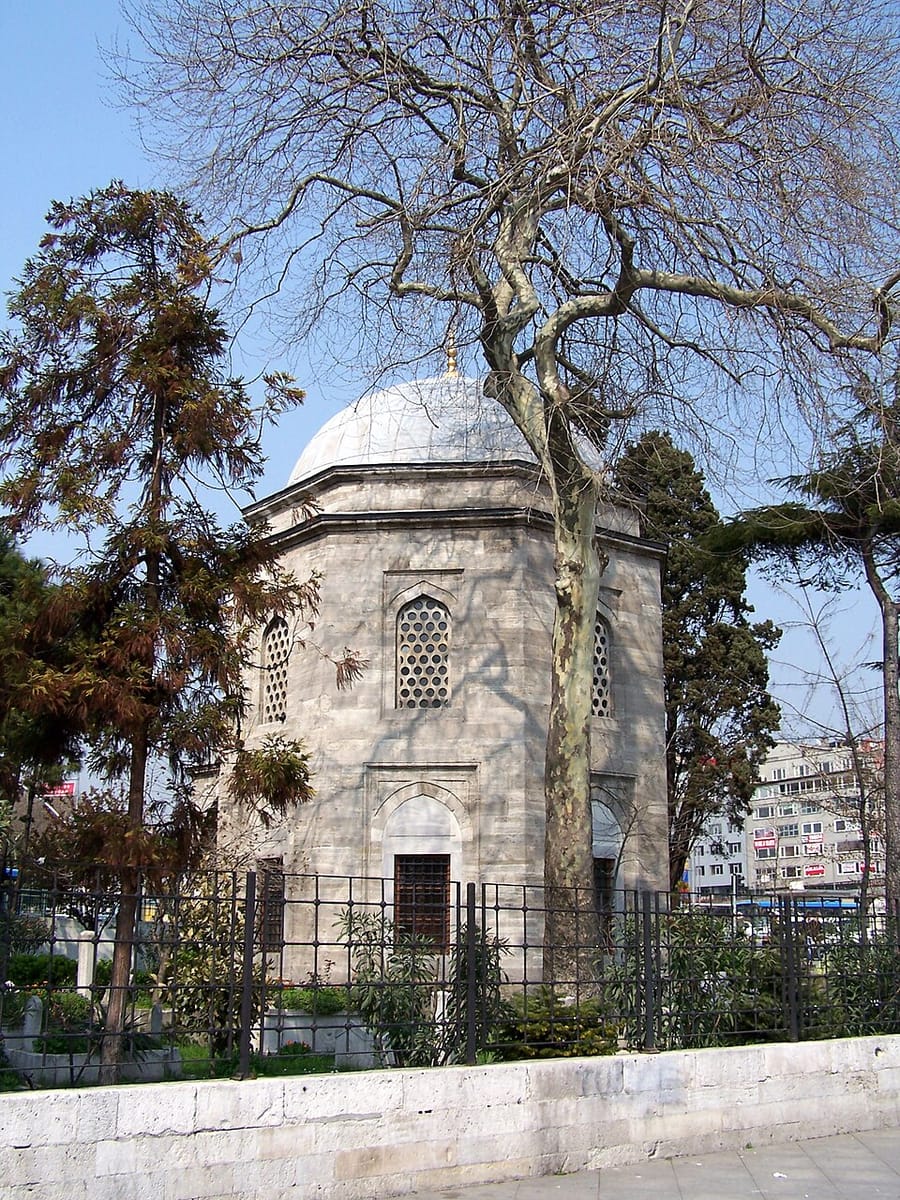

The grand admiral's tomb
This tomb, a work of Mimar Sinan, was built for Barbaros Hayreddin Pasha, the famous 16th-century seaman and grand admiral (kaptan-ı derya). The inscription above the entrance calls him 'conqueror of Algiers and Tunis' and gives the date 1541–42. The tomb was built near the waterside mansion (yalı) where the pasha lived in his last years; the mansion later disappeared. The octagonal building of cut stone follows the classical type, with a portico in front of the door whose mirror vault rests on two marble columns. Plain on the outside, the tomb has a dome set on a low octagonal drum.
The four cenotaphs inside belong to Barbaros Hayreddin Pasha, his wife Bala Hatun, Cafer Pasha and Cezayirli Hasan Pasha. Over time a large graveyard grew up around the tomb. When it was decided around 1944 to erect a Barbarossa monument here, the surroundings were cleared; the graveyard, which included the grave of Yedisekiz Hasan Pasha, guardian (muhafız) of Beşiktaş under Abdulhamid II, was removed and the tomb was restored. In a recent thorough repair, its painted decoration and woodwork were also renewed.
Inscriptions and façades
The inscription above the entrance reads: 'This is the tomb of the conqueror of Algiers and Tunis, the late gazi captain Hayreddin Pasha, may God have mercy on him, year 948.' Within the arch above it, in monumental thuluth script (celi sülüs), is the phrase Allahumma'ftah lahu abwaba rahmatik ('O Lord, open to him the gates of Your mercy'). The coved vault of the porch rests on marble columns with lozenge capitals and pointed arches.
All faces of the octagonal body are identical. Their panels bear interlacing geometric patterns, and the medallions between them carry carved palmette and rumi motifs. Each façade except the entrance has two windows: the upper ones are pointed-arched, with plaster honeycomb grilles, lattices and coloured glass; the lower ones have marble pediments and rectangular frames. The roof ends in a simple moulding.
Interior decoration and furnishings
The plain arrangement of the exterior continues inside, giving the tomb a spacious appearance. At the centre of the dome, verse 89 of Surat al-A'raf is written in gold leaf together with the basmala inside a medallion; the motifs of the dome, which rests on muqarnas squinches, consist of rumi, palmette and şemse (sunburst) designs. Besides the cenotaphs, the tomb contains two large candlesticks, a wooden Qur'an case, a relic hair of the Prophet's beard (sakal-ı şerif), a metal vase with arabesque decoration and a calligraphic panel dated 1816 and signed by Seyyid Ibrahim. Relatives of Barbaros were also buried in the graveyard outside the tomb.
Related sultans
Cite as: Atlas of the Sultans, “Tomb of Hayreddin Barbarossa · Ottoman monuments”, https://padisahlaratlasi.com/en/monuments/tomb-of-hayreddin-barbarossa/ (last updated 21 November 2026). Corrections · Image credits