TRENDEFRARAtlas of the Sultans · Ottoman monuments
Nasrullah Mosque
Monument · Mosque, Kastamonu, 1506
- Type
- Mosque
- Built
- 1506
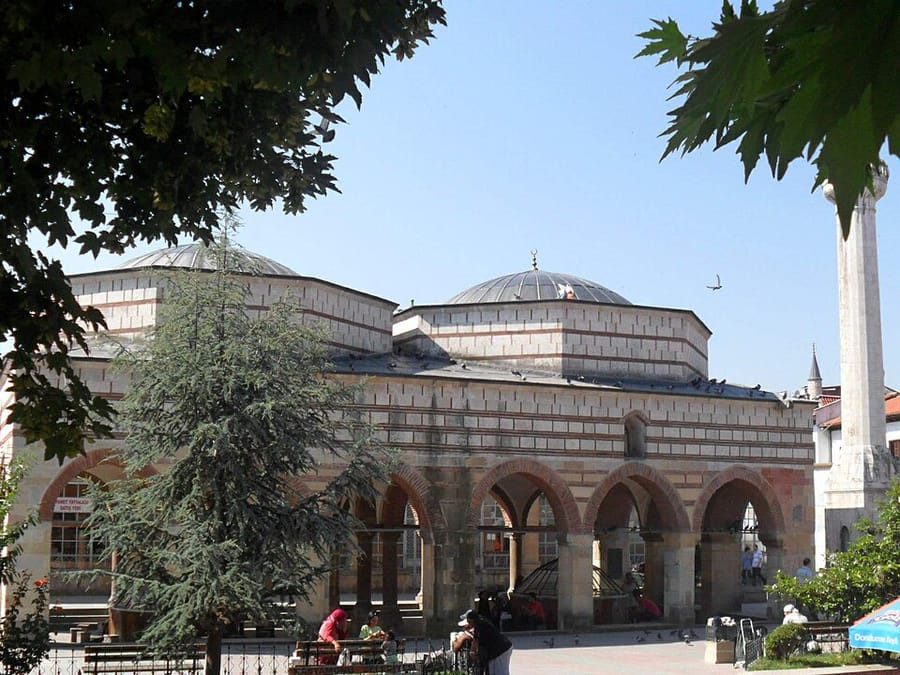

The square mosque of Kastamonu
The mosque stands in the middle of the square of the same name in the Hepkebirler quarter of Kastamonu. According to the Arabic inscription above the prayer-hall door, it was built in 1506 by Kadı Nasrullah, who had taught in Kastamonu and Istanbul and served as judge (kadı) in Diyarbekir, Manisa and Belgrade. Built of cut stone and rubble on the multi-domed plan of the great mosques (ulucami), it was originally roofed with six domes. In 1746 the chief scribe (reisülküttab) Hacı Mustafa Efendi enlarged it by adding three domes on the qibla side; a gallery and a portico were added at the same time, and a madrasa and a library were built. Today the square prayer hall, 23 metres a side, is covered by nine domes.
When the mosque was close to collapse, the governor of Kastamonu, Naşid Pasha, had it repaired in 1875 with money collected from benefactors. The monumental two-domed ablution fountain to the north was built in 1753 by Hacı Bedii Ahmed Agha. Of the complex, the Münire (Bayraklı) Madrasa is now used as a foundation student dormitory, and the domed pentagonal library building is in good condition. The Nasrullah Mosque is also remembered for the sermons Mehmed Akif Ersoy delivered here before the Turkish War of Independence.
Interior and portico
The mihrab, a plain niche, is faced with wood, and the minbar has no artistic distinction. A muezzin's gallery is on the left, and wooden women's galleries run along the north and west sides. Lit by forty windows, the mosque has 19th-century painted decoration dominated by floral motifs; the inscriptions inside are by the Kastamonu calligrapher Ahmed Şevki Efendi. The portico, 30 × 7.25 m, has seven bays, covered by a dome on a raised drum in the centre and three barrel vaults on each side. The single-balcony minaret with a lead-covered cap stands detached from the mosque and is built entirely of cut stone.
The ablution fountain
The rectangular ablution fountain, carried by eighteen thick piers, has six arched openings on its long sides and three on its short sides and is covered by two domes on octagonal drums. It has two basins with jets, and a double row of saw-tooth ornament runs along the eaves and the bases of the domes. A now-lost inscription shows that the fountain was repaired in 1862–63 by Izbelizade Mustafa Bey.
Madrasas, library and bridge
The Numaniye Madrasa east of the mosque was built around 1689 by Cecelizade Ibrahim Nureddin Efendi and named after Hoca Numan Efendi, who taught there in 1834; it has not survived, and its library of 1,245 books was moved to the Kastamonu Provincial Public Library. The Münire Madrasa, built when the mosque was enlarged, consists of twenty-one vaulted rooms fronted by an arcade. The Tevfikiye Madrasa, built after 1839, was pulled down before 1952. The 660 books of Hacı Mustafa Efendi's library were also transferred to the Provincial Public Library.
The three-arched bridge that Kadı Nasrullah built in Kastamonu is sound today, although one of its arches collapsed over time and was replaced by a stepped passage.
Source: TDV Encyclopedia of Islam (TDV İslâm Ansiklopedisi), “NASRULLAH CAMİİ ve KÜLLİYESİ” (Enis Karakaya)
Related sultans
Cite as: Atlas of the Sultans, “Nasrullah Mosque · Ottoman monuments”, https://padisahlaratlasi.com/en/monuments/nasrullah-mosque/ (last updated 21 November 2026). Corrections · Image credits