TRENDEFRARAtlas of the Sultans · Ottoman monuments
Hacı Özbek Mosque
Monument · Mosque, Iznik, 1333–1334
- Type
- Mosque
- Built
- 1333–1334
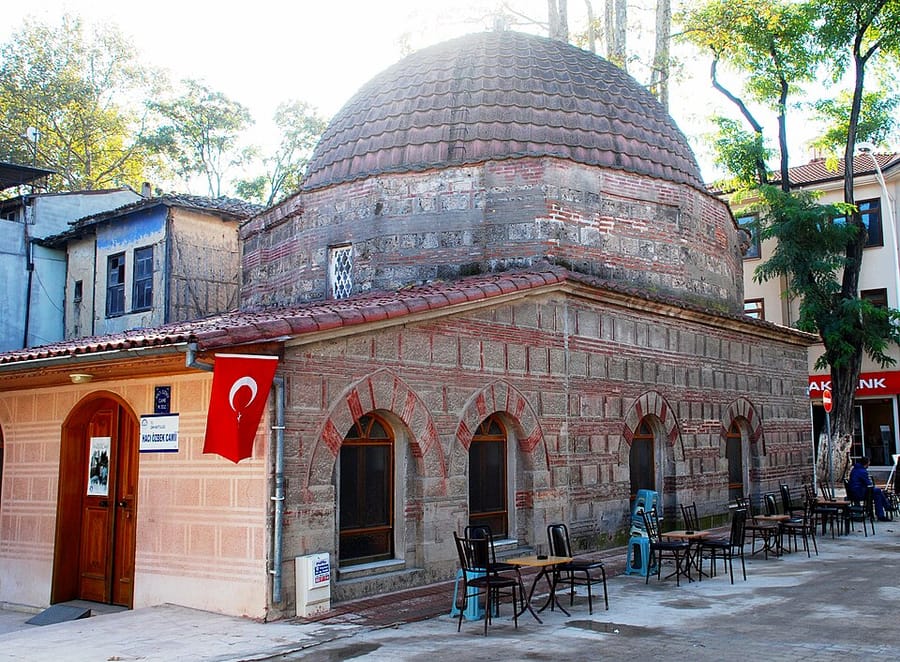

The first Ottoman building with an inscription
The mosque stands in Iznik beside the main street leading to the Lefke Gate, level with the Eşrefoğlu Rumi complex. According to its three-line inscription, it was built in 1333–34 by Hacı Özbek bin Mehmed, two or three years after the town was conquered, which makes it the oldest Ottoman building with a surviving inscription. The claim that it was originally a Byzantine church is an unfounded rumour. Its stone walls with brick courses combine an early Ottoman technique with late Byzantine masonry, showing that local Byzantine masons worked on it.
The square prayer hall, about 7.5 m across inside, is covered by a tile-roofed dome on a twelve-sided drum, with the transition made by so-called Turkish triangles. When first built, the mosque had a portico opening outward through three arches on two marble columns. This portico was demolished to widen the street, a new portico was added on another side, the entrance was moved and the inscription was reset in the window to the right of the mihrab. In a recent repair all but one of the drum windows were also blocked.
Masonry technique and lost features
Built shortly after the conquest, this small building survived the destruction of the years of the Turkish War of Independence, but in the 1950s it lost some of its parts on the grounds of widening the street. The walls use the technique of setting bricks vertically between the stones, while the arches employ the late Byzantine bond of three bricks between each limestone block. The original portico, still standing around 1935, was covered partly by a mirror vault and partly by a barrel vault. The mihrab lies not on the main axis in relation to the entrance but on a side wall, and has lost its original form; an old photograph shows that the drum had four windows. A drawing published by A. Saim Ülgen reveals an adjoining fountain whose central slab was a Byzantine parapet panel; nothing remains of it today. Semavi Eyice considers it a great loss that the building was not restored in keeping with its original form and masonry technique.
Source: TDV Encyclopedia of Islam (TDV İslâm Ansiklopedisi), “HACI ÖZBEK CAMİİ” (Semavi Eyice)
Related sultans
Cite as: Atlas of the Sultans, “Hacı Özbek Mosque · Ottoman monuments”, https://padisahlaratlasi.com/en/monuments/haci-ozbek-mosque/ (last updated 21 November 2026). Corrections · Image credits