TRENDEFRARAtlas of the Sultans · Ottoman monuments
Dükkancık Mosque
Monument · Mosque, Skopje, 1548
- Type
- Mosque
- Location
- Skopje, North Macedonia
- Built
- 1548
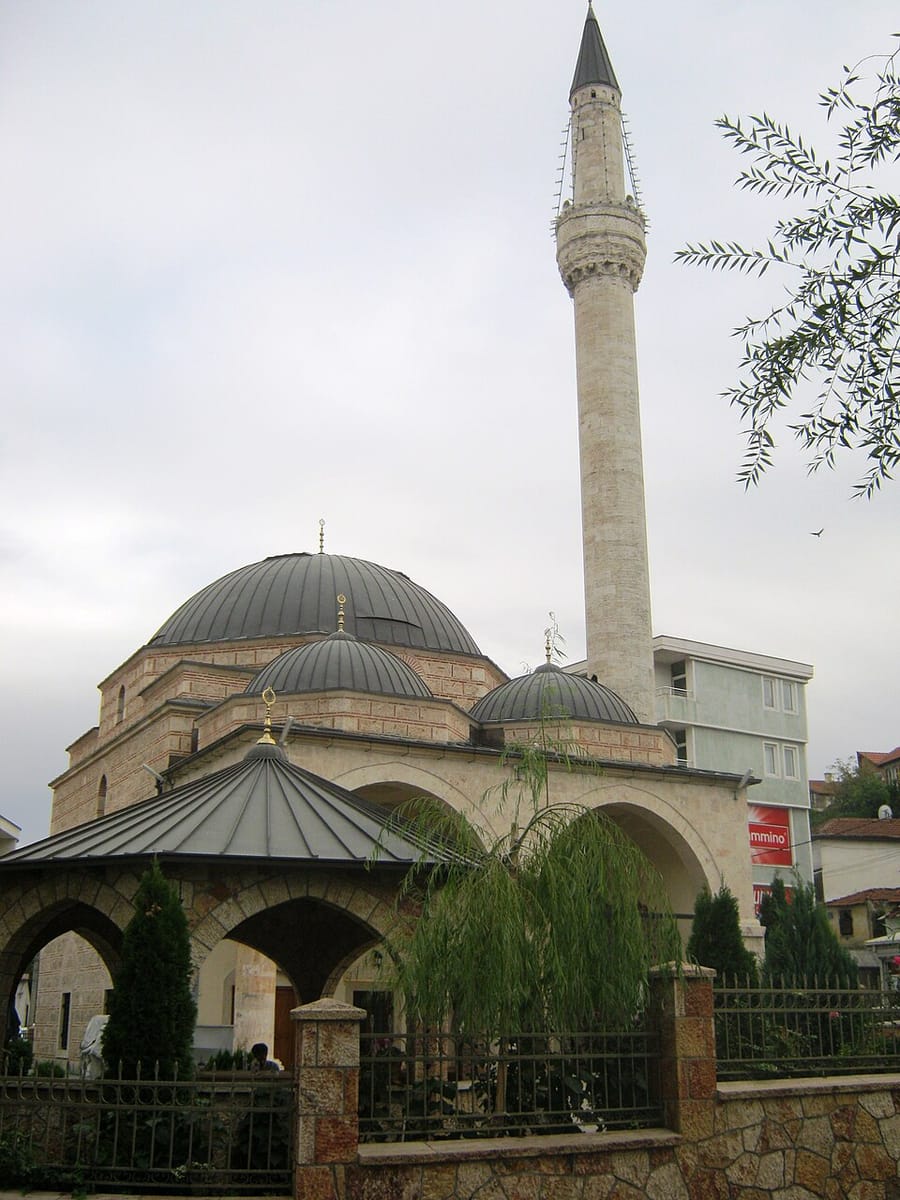

The mosque of Müezzin Hoca
This mosque in the Tanrıvermiş quarter of Skopje is also known as the Muslihuddin Abdülgani or Müezzin Hoca Mosque. Its building inscription, recorded in the sources as dated 1548, no longer survives; its Arabic endowment deed of 1549 shows that it was built by Mevlana Muslihuddin Abdülgani, known by the nickname Müezzin Hoca. To cover the mosque's expenses, the founder endowed a han, a bathhouse and many shops in and around Skopje; the nine shops he endowed in the Dükkancıklar (Little Shops) Market next to the mosque gave the building its name.
The mosque consists of a square prayer hall covered by a large dome and a two-domed portico; porticoes of this kind are rare in the Balkans. Its walls combine dressed stone and brick, while the minaret is of dressed stone alone. Damaged during the Austrian occupation and later repaired, the mosque was badly damaged in the 1963 earthquake; only parts of the west and north walls and the minaret remain. Although included in a restoration programme in 1965, no work was done for a long time, and the ruins were placed under protection in 1992.
Founder and endowments
The mosque now stands next to the Peoples' Theatre and the Jane Sandanski Primary School. According to the endowment deed, Muslihuddin Abdülgani also built the Altun Alem (Friday) Mosque and a school in Novi Pazar and, in Trepča, a small mosque where only the morning, evening and night prayers were held. To provide income for his foundations he endowed the Kurşunlu (Stone) Han in Skopje and the Şengül Bath opposite it, two Jewish lodging houses with nineteen and twenty-six rooms, twenty-three shops in the city's markets, five shops in Novi Pazar, a mill in the village of Dimitrovica, and a hostel in Trepča with the shops around it. Little is known about him; he is thought to have been one of the notables of Skopje.
The presence of two separate layers of red and blue plaster with floral motifs on the inner faces of the ruined walls confirms the repair carried out after the damage of the Austrian occupation. The remains were placed under protection in 1992, after the final declaration of the 9th International Congress of Turkish Art, held in Istanbul in 1991, drew attention to their state and UNESCO warned the responsible institution.
Architectural details
In the Balkans a portico with two domes is found in only a few 16th-century buildings, such as the Bali Bey Mosque in Niš and the Altun Alem Mosque in Novi Pazar. The equal size of the domes and the walling-in of the portico's sides caused the portal to be shifted to the left; in the broad space on the right the floor was raised and a prayer niche with three rows of muqarnas was set. The dome of the prayer hall rests on an octagonal drum reached through pendentives; the mihrab niche evidently had a hood with five rows of muqarnas. The mosque had ten windows in all.
The minaret has a polygonal shaft on a hexagonal base, one side of which adjoins the wall; the transition from base to shaft is made with prismatic triangles, the balcony rests on four rows of muqarnas, and its parapets are pierced. According to the endowment deed there was a school and a fountain in the courtyard; accounts of elderly residents and old photographs show that the courtyard was walled and contained a graveyard.
Source: TDV Encyclopedia of Islam (TDV İslâm Ansiklopedisi), “DÜKKÂNCIK CAMİİ” (Mehmet Zeki Ibrahimgil)
Related sultans
Cite as: Atlas of the Sultans, “Dükkancık Mosque · Ottoman monuments”, https://padisahlaratlasi.com/en/monuments/dukkancik-mosque/ (last updated 21 November 2026). Corrections · Image credits