TRENDEFRARAtlas of the Sultans · Ottoman monuments
Mostar Bridge (Stari Most)
Monument · Bridge, 1557–1566/67
- Type
- Bridge
- Location
- Mostar, Bosnia and Herzegovina
- Built
- 1557–1566


Who built it, and when
The bridge over the Neretva river is also known as the Old Bridge (Stari Most). When the city passed into Ottoman hands in the second half of the 15th century, it had grown up around a wooden bridge, and its name too derived from the word meaning “bridge”. The author of the article regards the claim that the bridge is a Roman work as a baseless rumour; even if there had once been a Roman bridge on the site, the present structure belongs entirely to the Ottoman period.
Different views have been put forward about its architect: some researchers have pointed to captive Dalmatian-Italian masters or to a local architect, others to Mimar Sinan; the majority, however, accept that it is the work of Sinan's pupil, the architect Hayreddin. A decree published by Ahmed Refik Altınay clearly shows that the builder of the bridge was Hayreddin. According to Ekrem Hakkı Ayverdi, construction began in October 1557 under the supervision of Karagöz Bey as building commissioner. According to the chronogram verses quoted in the sources, the bridge was completed in 1566–67, in the reign of Suleiman the Magnificent.
A single-arch architectural marvel
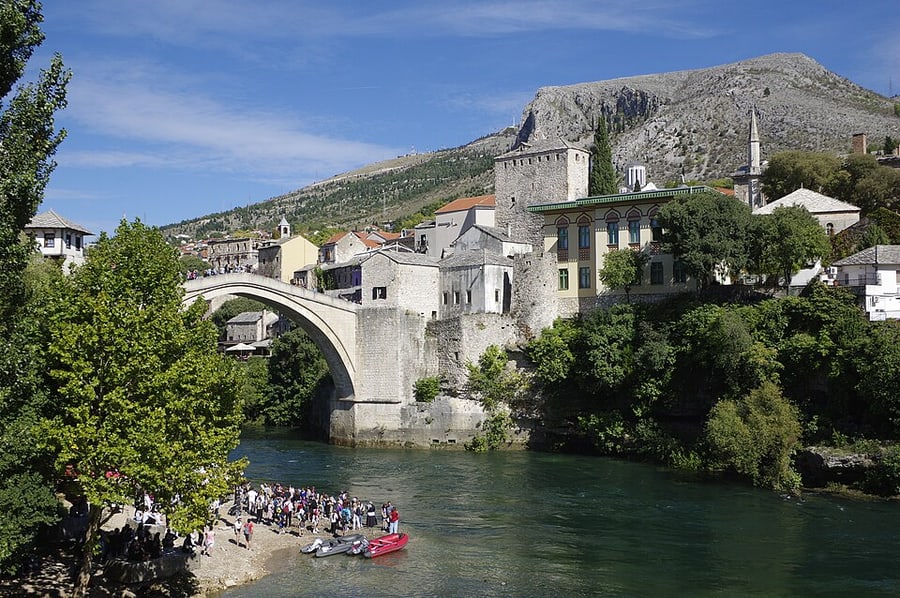
The bridge, built at the deepest and narrowest point of the Neretva, is a single-span structure of cut stone with a pointed arch. Its span is 28.59 metres and the height of its arch 12.02 metres; it rises about 21 metres above the water level. Its width at the top is 4.50 metres; its deck, sloping down to either side, is laid out in steps. One reason for keeping the arch high was to prevent material swept along in floods from blocking the arch and destroying it. At the two ends of the bridge there are two small fortified towers; in the inscription of one of them the dates 1566–67 for the bridge and 1676 for the tower can be read.
The French traveller A. Poullet, who visited the city in 1658, found the bridge wider than the Rialto Bridge in Venice, and Evliya Çelebi wrote that in the sixteen countries he had travelled he had not seen so high a bridge. Since the Ottoman period the bridge has been a place where young men show their courage by jumping into the river. On the left side of the bridge is a mescid without a minaret associated with the name of Selim II; according to tradition, until 1878 the call to prayer was recited in the middle of the bridge.
Restorations and destruction
When Mostar passed under Austro-Hungarian rule in 1878, the deck was filled in so that most of the steps were covered, and the arch and abutments were repaired in a simple manner. The hollows that the current had carved into the rocky bed were repaired towards the end of 1957; in the restoration completed on 5 November 1963 the deck was returned to its original state. The towers had been thoroughly repaired in 1951.
Protected as a historic monument in the Yugoslav period, the bridge was completely destroyed by Croatian artillery fire on 9 November 1993 during the Bosnian war.
Its rebirth
As a result of the work of UNESCO and the State of Bosnia and Herzegovina, the bridge was rebuilt by a Turkish firm and opened with a ceremony held on 23 July 2004. Today it is on the list of world architectural monuments and, according to the author of the article, single-handedly gives the city architectural value. In Ayverdi's assessment, the bridge has acquired a legendary meaning, less a thing built of stone than the embodiment of imagination.
Source: TDV Encyclopedia of Islam (TDV İslâm Ansiklopedisi), “MOSTAR KÖPRÜSÜ” (Muhammed Aruçi)
Related sultans
Cite as: Atlas of the Sultans, “Mostar Bridge (Stari Most) · Ottoman monuments”, https://padisahlaratlasi.com/en/monuments/mostar-bridge-stari-most/ (last updated 21 November 2026). Corrections · Image credits