TRENDEFRARAtlas of the Sultans · Grand viziers
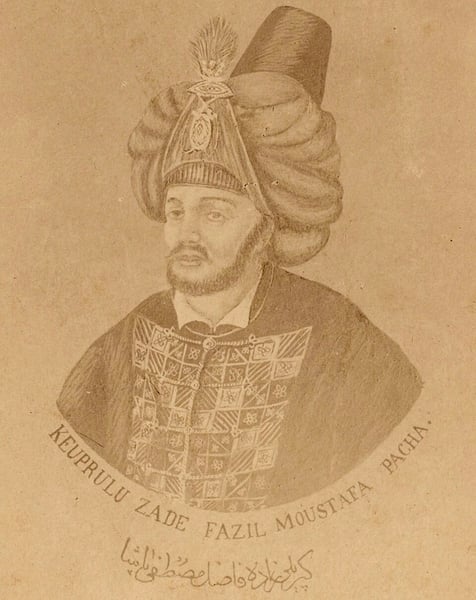
Köprülüzade Fazıl Mustafa Pasha
Grand vizier, 1689–1691
 AI

Köprülü's younger son
He was born in 1637 in the town of Köprü near Amasya; he was the son of Köprülü Mehmed Pasha. Like his elder brother Fazıl Ahmed Pasha he received a medrese education. He entered palace service during his father's grand vizierate; he took part in his elder brother's Nové Zámky campaign, in the battle of St. Gotthard and in the siege of Candia. At the wish of his brother-in-law Merzifonlu Kara Mustafa Pasha he was made a dome vizier (kubbe veziri, a member of the Imperial Council) in 1680, and during the Vienna campaign he became deputy (kaymakam) in Edirne.
After Merzifonlu's execution he was retired because of the new grand vizier Kara Ibrahim Pasha's hostility to the Köprülüs, and then sent to serve as guardian of Chios (Sakız) and the Dardanelles. During the kapıkulu revolt of 1687 he was summoned as deputy grand vizier and played an important role in the deposition of Mehmed IV and the enthronement of Suleiman II. Following threats from the Janissaries he was again removed from Istanbul.
A grand vizierate in a time of crisis
Faced with the Austrian army's advance as far as Skopje (Üsküp) and the revolts in the Balkans, he became grand vizier on 25 October 1689 on the recommendation of Şeyhülislam Debbağzade Mehmed Efendi. The wars that had continued since 1683 had exhausted the treasury; he sent the silverware of his own mansion to the mint and had coins of proper standard struck, and this exemplary act also spurred the sultan to action. He sent decrees of justice (adaletnames) to provincial administrators demanding an end to the oppression of the reaya.
With the reform of the cizye (poll tax on non-Muslims), referred to in the sources as “nizâm-ı cedîd” (new order), he returned in February 1691 to the principle of collecting this tax per head, had receipts issued to those who paid it and began the collection of the revenues in a single centre; he abolished some extraordinary taxes levied on non-Muslims and permitted the repair of churches. His encouragement of free trade by abolishing fixed prices (narh) led to price rises and criticism; the copper coin (mangır) minted in 1688, for its part, in time produced severe inflation. He had a roll call held in the Janissary corps, tried to settle the tribes, and turned the Yörüks of Rumelia into an armed force under the name “evlad-ı fatihan” (sons of the conquerors).
The recovery of Belgrade and Slankamen
In the first campaign, on which he set out in July 1690, Niš, Smederevo, Vidin and, most importantly, Belgrade were recovered; the Austrian forces were driven to the other side of the Danube. During Suleiman II's serious illness, fearing a change of reign, he arranged for the members of the dynasty to go to Edirne. In June 1691 he set out on the second campaign and on the way learned that Ahmed II had come to the throne. Disregarding the decision of the council in Belgrade to wait for the Crimean forces, he took the army across to the Zemun side.
On 19 August 1691, in the battle at Slankamen (Salankamen) against the forces of Prince Louis of Baden, he fell to a bullet when he went forward to encourage the soldiers. His death led to the dispersal of the army, and despite all searches his body was never found.
A learned reformer
The sources present him as a man of few words, outspoken, honest, brave and pious. Into a grand vizierate that did not last even two years he packed important measures; he limited the number of dome viziers and set up councils of notables (ayan) in every town. He was such an expert in hadith and lexicography that he taught scholars at the library in Vefa; for this reason, like his elder brother, he was called “Fazıl”. He did not follow his father's harsh policy. His son Numan Pasha served as grand vizier in the reign of Ahmed III.
Source: TDV Encyclopedia of Islam, “KÖPRÜLÜZÂDE FÂZIL MUSTAFA PAŞA” (Abdülkadir Özcan)
Related sultans
City: Belgrade
Cite as: Atlas of the Sultans, “Köprülüzade Fazıl Mustafa Pasha · Grand viziers”, https://padisahlaratlasi.com/en/grand-viziers/kopruluzade-fazil-mustafa-pasha/ (last updated 21 November 2026). Corrections · Image credits