TRENDEFRARAtlas of the Sultans · Ottoman monuments
Yeni Valide Mosque
Monument · Mosque, Istanbul, 1708–1711
- Type
- Mosque
- Built
- 1708–1711
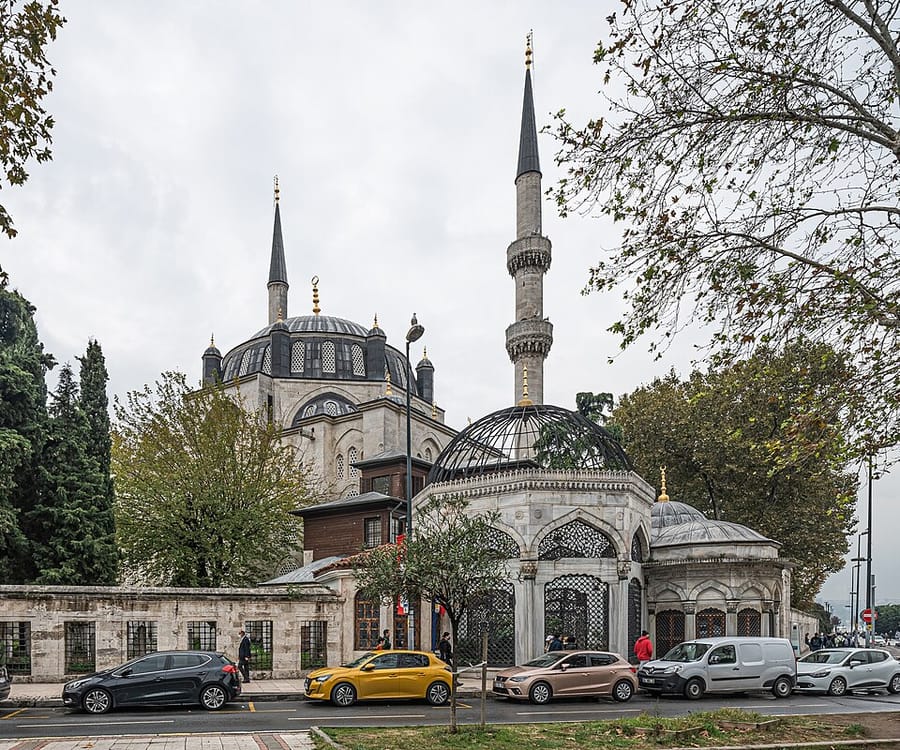

A Tulip Era complex in Üsküdar
The Yeni Valide Mosque on the quay square of Üsküdar is the centre of a complex (külliye) commissioned by Gülnuş Emetullah Sultan, mother of Ahmed III; it bears this name (“New Queen Mother”) to distinguish it from other queen mothers' complexes. Work on the complex began on 7 November 1708, and the mosque opened for worship on 5 March 1711; its building inscription is dated 1710. Whether it was the work of the chief court architect of the time, Kayserili Mehmed Ağa, is not known for certain. The complex is regarded as the last example of classical Ottoman architecture and the most important of the Tulip Era.
With its centrally domed prayer hall, octagonal support system and side sections, the mosque is almost a repetition of the Rüstem Pasha Mosque. The technical features of the tiles around the mihrab show that they were made in Kütahya. The balcony-like sultan's gallery stands out for its fine marble and bronze work. The birdhouses on the exterior are among the earliest of their kind. Gülnuş Emetullah Sultan's tomb was built before her death in 1715, and she was buried there at her request. The complex last underwent a comprehensive restoration in 1940.
The mosque and courtyard
The marble used in the complex was brought from the island of Marmara. The raised prayer hall and courtyard are reached by stone stairs that open out like a fan. The prayer hall is surrounded on three sides by galleries on columns. The text of the ta'liq verse inscription above the entrance is by Osmanzade Ahmed Taib Efendi and the calligraphy by Fındıkzade Ibrahim Efendi. In the portico is a muezzins' platform on large stone brackets, and at its ends two minarets with two balconies each. A large piece of the Kaaba covering that hung on the wall to the left of the mihrab was stolen in recent times.
Unlike classical examples, the square courtyard is larger than the prayer hall. The inscription of the octagonal ablution fountain at its centre shows it was completed in 1711; the openwork bronze grilles of its windows are carefully made. Panels above the courtyard gates carry Qur'anic verses in large thuluth by Hezarfen Mehmed Efendi of Bursa.
Tomb, sebil and fountains
The tomb consists of columns linked by pointed arches and is covered by a cage-like dome; the arched openings are closed by elegant bronze grilles. The band of the Throne Verse at the base of the dome was also written by Hezarfen Mehmed Efendi. The text of the inscription of the five-sided sebil, completed in 1709, is by Naima Mustafa Efendi.
The fountain of 1709 beside the sebil combines all the features of Tulip Period ornament; its compositions of fruit in bowls have parallels in the private chamber of Ahmed III at Topkapı Palace. The plain fountain of 1710 at the back is called the imam's fountain because of the washing room behind it; its large tank is a water distribution chamber feeding the complex. The fire pool was added in the reign of Selim III.
Imperial pavilion, school and soup kitchen
The wooden imperial pavilion to the left of the mihrab wall, with its central hall plan, is a typical example of civil architecture; its painted decoration shows it was renewed in the 19th century, and it underwent extensive repair in 1976 after falling into ruin. The primary school stands above the passage between the ablution taps and the latrines; the seven vaulted shops on the street side are now privately owned. The soup kitchen, built on a separate plot by the sea, is known to have first served as a bakery for flat bread; after its repair in 1970 it was long used as a supermarket.
Source: TDV Encyclopedia of Islam (TDV İslâm Ansiklopedisi), “YENİ VÂLİDE KÜLLİYESİ” (Tülay Sezgin Orman)
Related sultans
Cite as: Atlas of the Sultans, “Yeni Valide Mosque · Ottoman monuments”, https://padisahlaratlasi.com/en/monuments/yeni-valide-mosque/ (last updated 21 November 2026). Corrections · Image credits