TRENDEFRARAtlas of the Sultans · Ottoman monuments
Library of Ahmed III
Monument · Library, Istanbul, 1719
- Type
- Library
- Built
- 1719
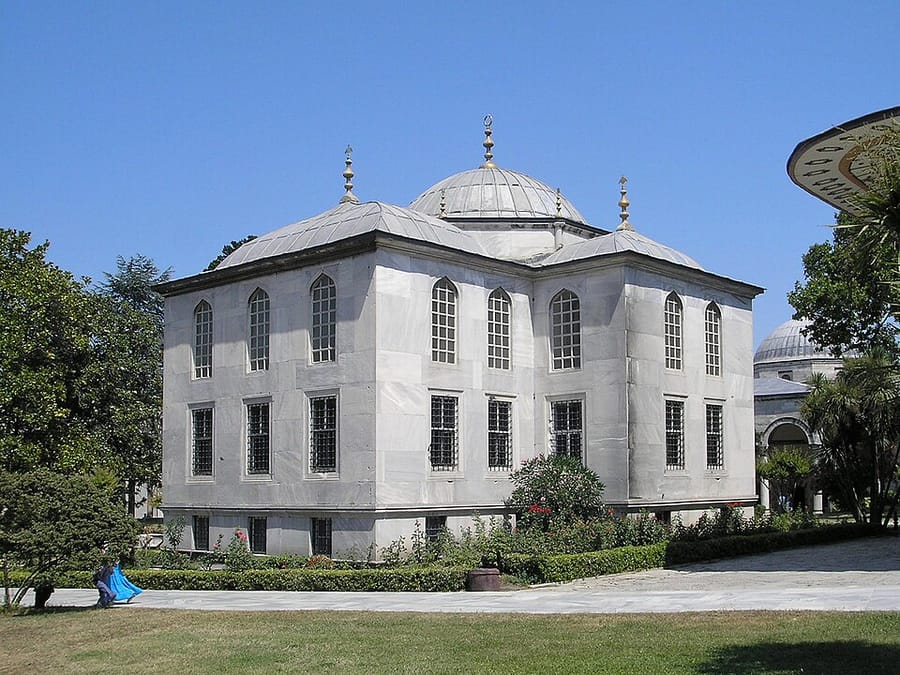

The Enderun Library of Topkapı Palace
Standing in the third courtyard of Topkapı Palace behind the Audience Chamber (Arz Odası), the building is also known as the Enderun Library. During the Tulip Era, Sultan Ahmed III decided to gather the palace's scattered books in one place; he had the neglected Pool Garden Pavilion (Havuzlubahçe Köşkü), built by Mimar Sinan for Selim II, pulled down and the library erected in its place. Work began on 17 February 1719, and the foundations were laid with the golden pickaxe that had been used for the mosque of Ahmed I. The Arabic inscription over the door is dated 1719, and the library opened on 23 November 1719. Open only to members of the palace, it was given a deed of endowment and a catalogue.
To protect the books from damp, the building stands on a high basement with windows. All its façades are faced with marble, and a porch under three domes is reached by stairs from both sides. In the middle of the façade is a unique mihrab-shaped fountain dated 1719. Inside, a dome and carved vaults with colourful raised plaster (malakari) decoration cover the hall. Some walls are clad with 16th-century tiles brought from the Kara Mustafa Pasha waterside mansion on the Bosphorus. The door and window shutters are inlaid with ivory and tortoiseshell.
Construction, cost and endowment deed
According to Silahdar Mehmed Agha of Findikli, the Havuzlubahçe Pavilion that formerly stood on the site had a marble pool in its centre and a dome resting on twelve porphyry columns; a simple outline of the pavilion appears in a miniature of the Hünername. In the Tulip Era, free-standing library buildings were preferred to book cupboards in mosques and pavilions. A record dated December 1719 shows that the library cost 19,570 kuruş to build.
The endowment deed stated why the library was founded, where its books had been gathered from and on which days it could be used; it forbade lending books outside and set out the qualifications required of the staff and their wages. Some manuscripts on Christianity collected since the reign of Mehmed the Conqueror, as well as printed books, were also placed in the collection.
Reading room and bookcases
The entrance landing has three pointed arches and four columns. The mihrab-shaped fountain on the outside has a crown richly carved with rumi reliefs and graceful drinking taps on either side; behind it, inside, is a second fountain. The main room is a transverse rectangle. Directly opposite the door is a projecting bay reserved for the reading of hadith, as a verse panel written by Sultan Ahmed III himself indicates. The dome and vaults are lead-covered outside; many windows set one above another fill the interior with light, and the upper ones have coloured-glass plaster windows (revzen).
The present bookcases date from the 19th century and clash with the interior decoration. The books were probably first kept in wire-mesh cupboards decorated with coloured and gilded motifs, like those of the Hagia Sophia Library built twenty years later.
Source: TDV Encyclopedia of Islam (TDV İslâm Ansiklopedisi), “AHMED III KÜTÜPHANESİ” (Semavi Eyice)
Related sultans
Cite as: Atlas of the Sultans, “Library of Ahmed III · Ottoman monuments”, https://padisahlaratlasi.com/en/monuments/library-of-ahmed-iii/ (last updated 21 November 2026). Corrections · Image credits