TRENDEFRARAtlas of the Sultans · 1 / 39 · bey
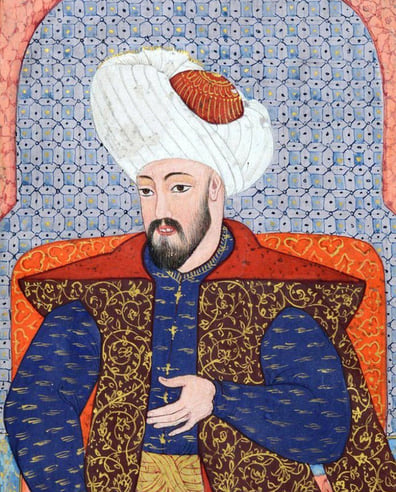
Imaginary portrait (made later) — artist and date unknown
Osman I
Founder of the state
He turned a small frontier principality at Söğüt into a state. Exploiting the collapse of Eastern Roman (Byzantine) power in Anatolia, he took Bithynia step by step and gave his name to a dynasty that would last six centuries. The founding date of 1299 is traditional and is not confirmed by any contemporary source.
Open the reign of Osman I on the map▶ Watch the 1-minute video: YouTube · Instagram · TikTok
Interesting fact
At his own wish he was buried in the citadel of Bursa, under the dome of an old monastery known as Gümüşlükubbe. When that building collapsed in the 1855 earthquake, Sultan Abdulaziz had today’s tomb built in 1863.
Source: TDV İslâm Ansiklopedisi (Turkish), article “OSMAN I”
Life
Origins and youth
Osman was the son of Ertuğrul Gazi, the leader of a Turkmen community that had settled around Söğüt. His year of birth is not known for certain; Ottoman tradition holds that he was sixty-nine years old by the Hijri reckoning when he died, which would place his birth in the late 1250s. The traveller Ibn Battuta records his name with a diminutive suffix as “Osmancuk”. The accounts of the family's lineage and of when it came to Anatolia were written in later centuries and do not agree with one another; for this reason Osman's youth is known largely from tradition.
Söğüt, where Osman grew up, was one of the most advanced points of the frontier (march) zone between the Seljuk state and the Eastern Roman (Byzantine) Empire. In this region the local Greek tekfurs (lords) paid tribute to the Seljuk sultan and mostly lived in peace with the Turkmens who moved between their summer and winter pastures. The beys of Eskişehir, Inönü and Söğüt were rivals. It was in this setting that Osman rose to prominence as an “alp”, that is, a warrior around whom companions gathered.
A bey on the frontier: the first conquests
According to the chronicles, Osman's raids began in the mid-1280s with a night attack on the small fortress of Kulaca Hisarı near Inegöl. This was followed by the capture of Karacahisar (1288). This steep fortress near Eskişehir, where the roads from Anatolia to Nicaea (Iznik) and Constantinople met, made Osman a real power in the region; people from places as distant as Germiyan settled in the fortress, and the market below it also came under his control.
Between 1288 and 1299 Osman eliminated the tekfurs of Göynük, Gölpazarı, Bilecik, Yenişehir, Inegöl and Yarhisar one by one. Once he held lands stretching from Eskişehir to Bilecik and Yenişehir (1299), he distributed the places he had taken among his companions: he gave Inönü to his son Orhan, Yarhisar to Hasan Alp and Inegöl to Turgut Alp. The year 1299, shown in the atlas as the founding year, rests on this tradition; it is not confirmed by any contemporary document.
One of the things that set Osman apart from the other frontier beys was, according to tradition, the spiritual support of Sheikh Edebali of the Vefai-Babai order. Edebali, who was versed in Islamic law, and Dursun Fakih are counted among his advisers. The story of the blessing told about the sheikh and the bey, however, belongs to the kind of folk tale related of all the Turkmen beys of the period.
Against Byzantium: Bapheus and Nicaea
In the early 1300s Osman turned directly against Byzantine territory and besieged Nicaea. According to the contemporary Byzantine historian Pachymeres, he met the Byzantine force that had come to relieve the city at Bapheus (Koyunhisar) on 27 July 1302. Osman won this battle, which Ottoman sources call Yalakova. According to Pachymeres, many warriors from the Kastamonu area had joined Osman before the battle, and the Turkish forces outnumbered the Byzantine army of about 2,000 men. This was the Ottomans' first victory over Byzantium in open battle, and it carried Osman's name beyond the frontier zone.
In these years Turkish raiders moving in small groups reached the gates of Bursa and Nicaea, and in early 1304 the Bosphorus; the panic-stricken population took refuge in Constantinople, and the city's streets filled with people suffering from hunger and disease. After Bapheus the tekfurs of Atranos, Kestel and Kite in the plain of Bursa joined forces and attacked Osman. Osman met them in the plain of Yenişehir and defeated the tekfurs, who had fallen back as far as the Dimbos pass; in this battle Aydoğdu, the son of his brother Gündüz Alp, fell as a martyr. After 1305 Osman began sending his son Orhan on campaigns together with Köse Mihal and other experienced commanders. The tekfurs of places in the Sakarya valley such as Lefke, Mekece and Akhisar either submitted or were defeated.
How the principality was organized
Osman's principality (beylik) was very different from the central bureaucracy of the later Ottoman state. The bey gave conquered districts to his comrades-in-arms as a “yurt”, and they became both the defenders and the administrators of that district. In the 1320s Karaçepüş Hisarı had been given to Konur Alp and Absu Hisarı to Akça Koca in this way. The same arrangement would later be applied in Rumelia to frontier-bey families such as the Evrenosoğulları and the Mihaloğulları. The children and grandchildren of these alps went on in later years to hold important offices of state.
The story of Köse Mihal shows Osman's relations on the frontier well: Mihal, the Greek lord of Harmankaya, became Osman's close friend and his companion on campaign, and most of his men were Greeks of Harmankaya. Osman's power on the frontier grew not only by the sword but also through bonds of allegiance of this kind with the local tekfurs.
Last years and death
In Osman's last years it was largely Orhan who led the campaigns. The area around Bursa was placed under siege, but the city did not fall in Osman's lifetime. The year of his death is inferred from two documents: in the endowment deed (vakfiye) of Asporça Hatun Osman is alive, while in the Mekece endowment deed dated 1324 he appears to have died. For this reason he is accepted as having died in 1324.
According to Ottoman tradition, Orhan was busy besieging Bursa when Osman died. In accordance with his will, after Bursa was taken Osman was buried at Tophane in the citadel, beneath the dome of an old monastery called the “Gümüşlü Kubbe” (Silver Dome). When this building collapsed in the earthquake of 1855, the present plain tomb was built in 1863 by Sultan Abdulaziz. Osman's testament to Orhan is said to have counselled him to abide by the sharia, to look after those under his command and to be generous.
Among the witnesses of the Mekece endowment deed, besides Orhan, are his sons Çoban, Melik, Hamid and Pazarlı and his daughter Fatma Melek; the chronicles mention another son named Alaeddin Ali. The same document names “Mal Hatun, daughter of Ömer Bey”; in the chronicles Mal Hatun is recorded as the daughter of Sheikh Edebali and the wife of Osman. Accounts of Osman's wives therefore vary from source to source.
What Osman Gazi left behind was a frontier principality made up of a few fortresses and towns. But the order he established, the bonds he forged with his companions and the path he opened on Byzantium's weakening Bithynian frontier became the beginning of the six-century history of the dynasty that bears his name.
Source: TDV Encyclopedia of Islam (TDV İslâm Ansiklopedisi), “Osman I” (Halil Inalcık); the chronicles of Âşıkpaşazâde and Neşri and the Byzantine historian George Pachymeres are the principal sources used in this article.
Meanwhile in the world
Contemporary rulers
- Andronikos II PalaiologosByzantine Emperor · 1282–1328Palaiologan emperor and patron of scholarship and letters
- Philip IV (the Fair)King of France · 1285–1314Clashed with the papacy and had the Templars arrested
- Edward IKing of England · 1272–1307Subdued Wales and helped develop Parliament
- GhazanIlkhanid Ruler · 1295–1304Embraced Islam and reformed taxation and administration
- Alauddin KhaljiSultan of Delhi · 1296–1316Repelled Mongol attacks and pushed into southern India
- Temür Khan (Chengzong)Yuan Emperor (China) · 1294–1307Mongol Yuan ruler who succeeded Kublai Khan
What was happening in the world?
- 1302At the Battle of the Golden Spurs near Kortrijk, Flemish town militias defeated an army of French knights.
- 1309Pope Clement V moved the papal seat to Avignon, where the papacy remained until 1377.
- 1312Pope Clement V suppressed the order of the Knights Templar.
- 1314At the Battle of Bannockburn, the Scots under Robert the Bruce defeated an English army.
- 1315Bad weather and failed harvests began the Great Famine in Europe, which lasted until 1317.
Sources: britannica.com [1] [2] [3] [4] [5] [6] [7] [8] [9] [10]
Family
| Father | Ertuğrul Gazi |
|---|---|
| Mother | Halime Hatun (disputed in the sources) |
| Consorts | Rabia Bala Hatun (daughter of Sheikh Edebali), Malhun Hatun |
| Children | Orhan, Alaeddin Ali, Çoban Bey, Melik Bey, Savcı Bey, Pazarlu Bey, Fatma Hatun (lists vary between sources) |
Major achievements
- Capture of Karacahisar, Yenişehir and Bilecik
- First pitched-battle victory over the Eastern Roman Empire (Byzantium) at Bapheus (1302)
- A coin said to have been struck in Osman's name — its authenticity is disputed; the earliest securely dated Ottoman coin belongs to Orhan's reign
- Siege of Bursa begun
- Organisation of the frontier principality into a state; first appointments of a judge (kadı) and a commandant (subaşı) (according to tradition)
Treaties
None recorded.
Viziers
—
Battles and treaties
| Year | Event | Result / parties |
|---|---|---|
| 1302 | Battle: Bapheus | Ottoman victory |
Full infoboxes are in the site’s “Battles and Treaties” tab; source: TDV Encyclopedia of Islam.
Death
According to tradition he died in 1324 (some sources give 1326) while Bursa was under siege. He is held to have been buried first at Söğüt and moved to the Gümüşlü Kümbet in Bursa after the city was taken (1326).
Territorial change
| Year | Region | Event | Source |
|---|---|---|---|
| 1299 | + Söğüt–Bilecik–Eskişehir (Bithynia) | Osman held the lands from Eskişehir to Bilecik and Yenişehir (1299); Battle of Bapheus (1302) and frontier raids | TDV İA, “OSMAN I” |
The lands that changed hands in this period, and the battles or treaties that brought the changes, can be seen on the map: map of the reign of Osman I.
Cite as: Atlas of the Sultans, “Osman I (Founder of the state): Reign Map, Wars and Conquests (1299–1324)”, https://padisahlaratlasi.com/en/sultans/osman-gazi/ (last updated 21 November 2026). Corrections · Image credits
Monuments of this reign: Tomb of Osman Gazi
Capital in this reign: Söğüt · Bursa
Myths and misconceptions: Was the Ottoman state founded in 1299?