TRENDEFRARAtlas of the Sultans · Ottoman monuments
Tomb of Gül Baba
Monument · Tomb, Buda, 1543–1548
- Type
- Mausoleum (türbe)
- Built
- 1543–1548
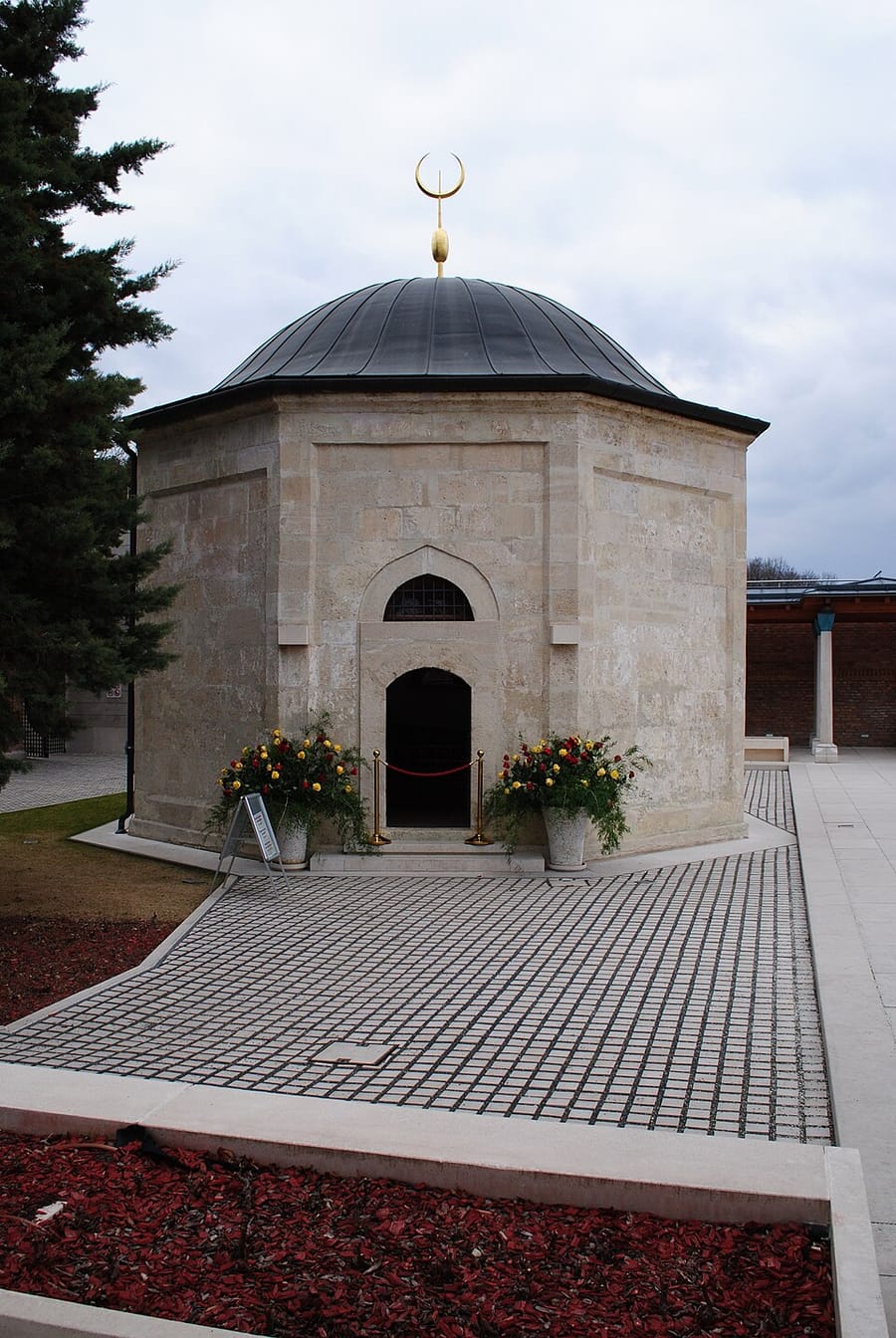

A Bektashi tomb in Buda
The tomb was built in 1543–1548, shortly after the conquest of Buda, by Yahya Pashazade Mehmed Pasha, beylerbey (governor-general) of Buda, outside the Horoz Gate on a vineyard slope called Gülbababayırı. Together with a Bektashi dervish lodge (tekke) and a large Muslim cemetery around it, it formed a single whole; according to a record of 1566, the lodge was large enough to house sixty dervishes. Evliya Çelebi wrote that Gül Baba, who had come from Merzifon, lay beneath a lead-covered dome in a flower garden.
The octagonal cut-stone tomb follows the classical Ottoman style of tombs. After Buda was lost in 1686, a monastery was founded in 1690 on part of the lodge buildings, and Jesuit priests turned the tomb into a chapel, adding an oval window to one face and a lantern to the dome. It ceased to be a church in the 19th century, was cared for as an Islamic tomb after 1867, was repaired in 1885 by the architect Lajos Grill, and came to be seen as a symbol of Turkish–Hungarian rapprochement. After 1960 a later gallery around it was demolished, and in 1973 the Turkish government completed its interior furnishings. It is one of the few architectural reminders of Ottoman rule in the heart of Europe.
The tekke seen by travellers
Evliya Çelebi relates that the dervishes of the tekke went on campaign, that its halls held candlesticks, lamps, censers and rose-water sprinklers, and that visitors wrote couplets on the marble doors and walls; he attributes the tekke to the charitable works of the Gazi Mihaloğulları. Gül Baba's cenotaph was covered with green broadcloth and topped by a Bektashi cap. Among the tekke's rich endowments were two mills on the Danube, houses and a monastery belonging to the Felheviz and Szent Mihály churches, four houses of the János Bath, fields and the whole district of Solymár.
The tekke was visited by Georg Wernher in 1551, Peter Lambeck in 1666 and Edward Brown between 1669 and 1671; Brown writes that the sheikh offered them melons and fruit. Giovanni Paolo Zenarolla reports that of Buda's three tekkes, Hıdır Baba had fifteen dervishes, Miftah Baba twenty and Gül Baba sixty, and that guests were received there with respect.
From Abdulaziz to the present
In 1867, when Sultan Abdulaziz was expected to stop in Budapest, the municipality hastily put the tomb in order and set up a tent beside it for the sultan. When he did not come, the mayor presented him, aboard his ship on the Danube, with earth taken from the floor of the tomb in a silver vessel. In the 19th century the architect Johann Wagner built a Renaissance-style gallery around the tomb; during the work it was found that the tomb was cracked from dome to foundation, that its foundations were almost non-existent and that it contained no grave.
Müftüoğlu Ahmed Hikmet, consul general in Budapest in 1911–1918, had the interior furnished with prayer rugs brought from Istanbul. Hungarians staged a play about Gül Baba and made a film. After the Second World War a rumour spread that the tomb had been demolished, but it turned out that only its furnishings had been destroyed. A project to build a mosque with a minaret next to the tomb has not been realised.
Changes to the building
When the tomb was converted into a church, two windows were walled up, and the lantern added to the dome did not light the interior because the dome was never pierced. In the latest restorations the lantern was removed and replaced by a finial that does not match its form in Turkish art. The door arch removed in the church period was later rebuilt in its original form. The panel with the poet Kemal's eulogy of Gül Baba, mentioned by Rumbeyoğlu Fahreddin, has been lost.
Source: TDV Encyclopedia of Islam (TDV İslâm Ansiklopedisi), “GÜLBABA TEKKESİ ve TÜRBESİ” (Semavi Eyice)
Related sultans
Cite as: Atlas of the Sultans, “Tomb of Gül Baba · Ottoman monuments”, https://padisahlaratlasi.com/en/monuments/tomb-of-gul-baba/ (last updated 21 November 2026). Corrections · Image credits