TRENDEFRARAtlas of the Sultans · Ottoman monuments
Süleymaniye Complex
Monument · Mosque complex, Istanbul, 1550–1557
- Type
- Complex (külliye)
- Built
- 1550–1557
A work of Mimar Sinan

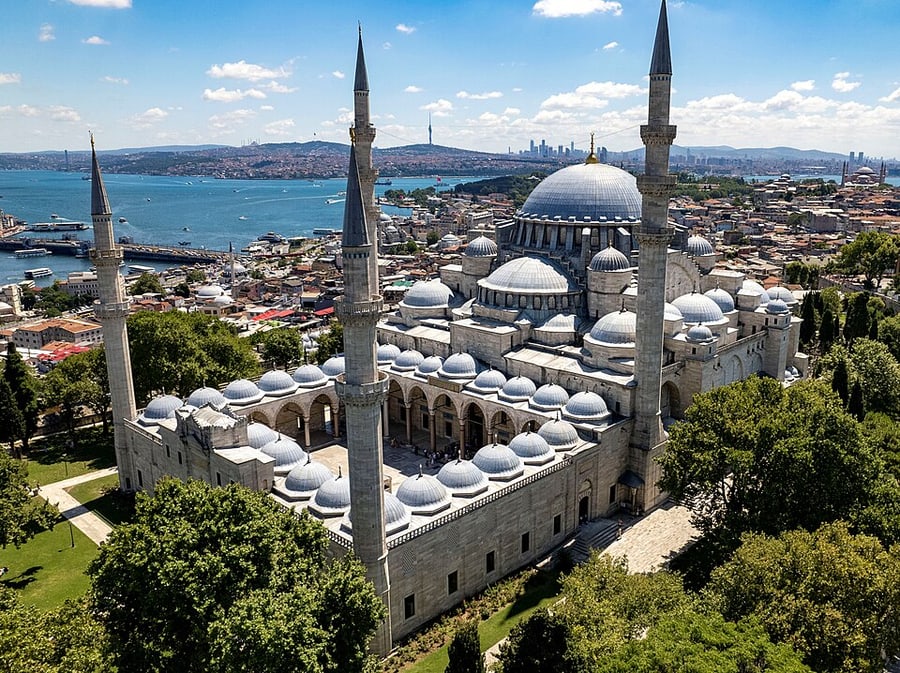

On the hill commanding the Golden Horn
Built at the wish and in the name of Suleiman the Magnificent, the complex was founded on one of the hills overlooking the Golden Horn, on part of the grounds of the Old Palace. It can be accepted that the foundation-laying ceremony took place on 13 June 1550 in the presence of the sultan; the first stone was laid by the Şeyhülislam Ebüssuud Efendi at the spot where the mihrab wall was to rise. The mosque was opened on a Friday, 15 October 1557, seven years after its foundation; Sinan relates that the sultan gave him the key, saying “It is most fitting that you yourself open this house of God that you have built.” The architect described this mosque as “my journeyman's work”.
A small city
On a site of about sixty dönüms, the buildings are arranged in a “U” layout with the mosque in the centre: madrasas offering instruction at different levels, a school of hadith (darülhadis), a medical madrasa and a hospital (darüşşifa), a school of Qur'an recitation (darülkurra), a primary school, an imaret and a tabhane, a han, a bath and rows of shops. Evliya Çelebi writes that the complex was covered by “a thousand domes” and that 3000 people worked there. The article stresses that the Süleymaniye is not merely a great mosque but the planning of a small city, embracing many areas of social life and integrated with Istanbul. In this complex, whose position completes the city's skyline for those looking from the shores of Galata and even from Üsküdar, Sinan showed, according to the article, that he was an urban planner who used topography in the most effective way.
The mosque
The main dome of the mosque, which measures 69 × 62.3 m, is 27.40 m in diameter, rests on four great piers and is supported by two semi-domes of the same diameter towards the mihrab and the courtyard; the height of the dome from the ground is a little over 50 m. The main dome was closed on 16 August 1557, a few months before the opening. Sixty-four jars set into the dome shell distribute the sound evenly while also lightening the load; the soot of hundreds of oil lamps was collected in a section called the “soot room”. Four minarets rise at the corners of the courtyard. The article states that the belief that the Süleymaniye is a copy of Hagia Sophia is outdated, and that Ottoman architecture reached this point through its own experiments before the conquest.
Tombs and today
When Suleiman died in 1566 on the Szigetvár campaign, Mimar Sinan built an octagonal tomb with an arcade in the cemetery; the tomb of Hürrem Sultan, who died in 1558, is also Sinan's work. The large garden surrounding these tombs became a dense burial ground towards the end of the 18th century. In one corner of the complex, behind the sebil, is Sinan's own tomb; the article notes that there is no parallel to an arrangement that includes the architect's tomb alongside those of the founder and his wife. As a result of 19th-century restorations, the inner surface of the main dome bears decoration in a European style. The darüşşifa was used for a time at the end of the Ottoman period as the Military Printing House (Matbaa-i Askeriyye), and the Evvel and Sani (First and Second) madrasas now serve as the Süleymaniye Library.
Related sultans
Cite as: Atlas of the Sultans, “Süleymaniye Complex · Ottoman monuments”, https://padisahlaratlasi.com/en/monuments/suleymaniye-complex/ (last updated 21 November 2026). Corrections · Image credits