TRENDEFRARAtlas of the Sultans · Ottoman monuments
Aladža Mosque
Monument · Mosque, Foča, 1550
- Type
- Mosque
- Location
- Bosnia and Herzegovina
- Built
- 1550
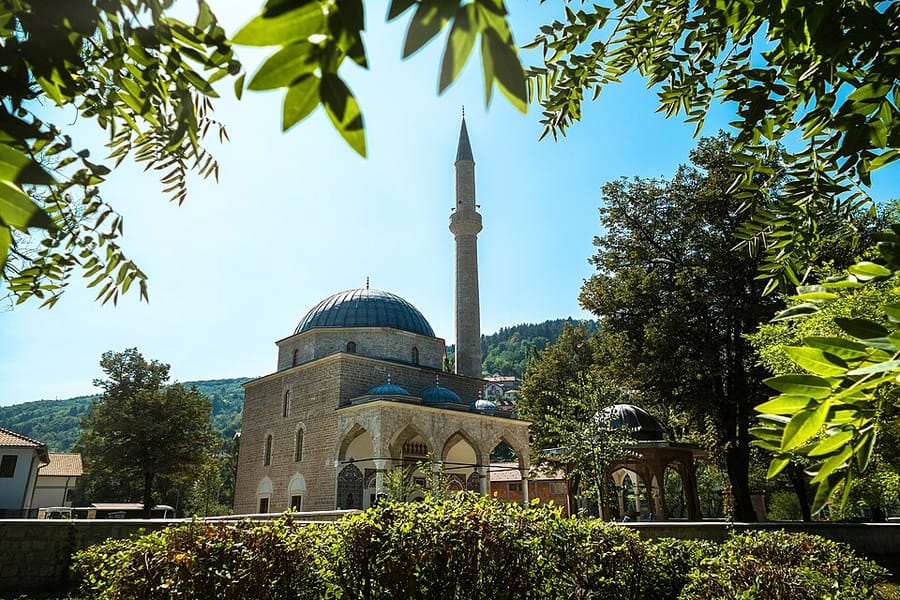

A mosque famed for its painted decoration
Standing on the right bank of the Ćehotina river in the town of Foča in Bosnia and Herzegovina, the mosque was founded by Hasan Nazır Ağa. According to its three-line building inscription, it was built in 1550. Evliya Çelebi names its architect as Ramazan Ağa, one of the chief pupils of Mimar Sinan, but no pupil of Sinan by that name is known. The single-domed building measures 13.55 × 13.65 m, with a portico covered by three domes and a minaret on its right. The marble minbar, mihrab and the muezzin's gallery on four marble columns are fine examples of marble work.
The mosque owes its fame to the rumi and hatayi painted (kalem işi) ornament that covers the entire portico wall and extends over the doors, windows, gallery arches, mihrab and interior walls. Although damaged during an Austrian restoration in 1908, the paintings kept their character. On the portico wall a two-line note written by Evliya Çelebi in 1663–64 and signed “the muezzin Evliya” still survives. The graveyard holds the tomb of Hasan Nazır Ağa, dated 1553, and the open, domed tomb of his son Ibrahim Bey on four columns.
Dome, courtyard and graveyard
The dome of the prayer hall rests on squinches with almond-shaped tips; there are eight windows in the drum and seventeen in the walls. The minaret on the right side is rather tall; a wooden eave is known to have stood in front of the portico until 1908. Besides the portico wall, the rumi and hatayi painted decoration is concentrated on the jambs, arch, tympanum and spandrels of the main door.
In the middle of the courtyard is an open marble fountain basin with a spirally fluted base and rumi decoration around it. In the graveyard, Hasan Nazır Ağa's grave has a plain, four-sided tombstone, while the open domed tomb of his son Ibrahim Bey on four columns is undated. The TDV article on Bosnia and Herzegovina counts the Alaca Mosque, together with the Gazi Husrev Bey (1530) and Ali Pasha (1561) mosques in Sarajevo, among the examples of the first phase of Ottoman urbanism, marked by monumental buildings commissioned by governors and high officials.
Source: TDV Encyclopedia of Islam (TDV İslâm Ansiklopedisi), “ALACA CAMİ” (I. Aydın Yüksel)
Related sultans
Cite as: Atlas of the Sultans, “Aladža Mosque · Ottoman monuments”, https://padisahlaratlasi.com/en/monuments/alad-a-mosque/ (last updated 21 November 2026). Corrections · Image credits