TRENDEFRARAtlas of the Sultans · Ottoman monuments
Şemsi Pasha Mosque
Monument · Mosque, Istanbul, 1580
- Type
- Mosque
- Built
- 1580
A work of Mimar Sinan
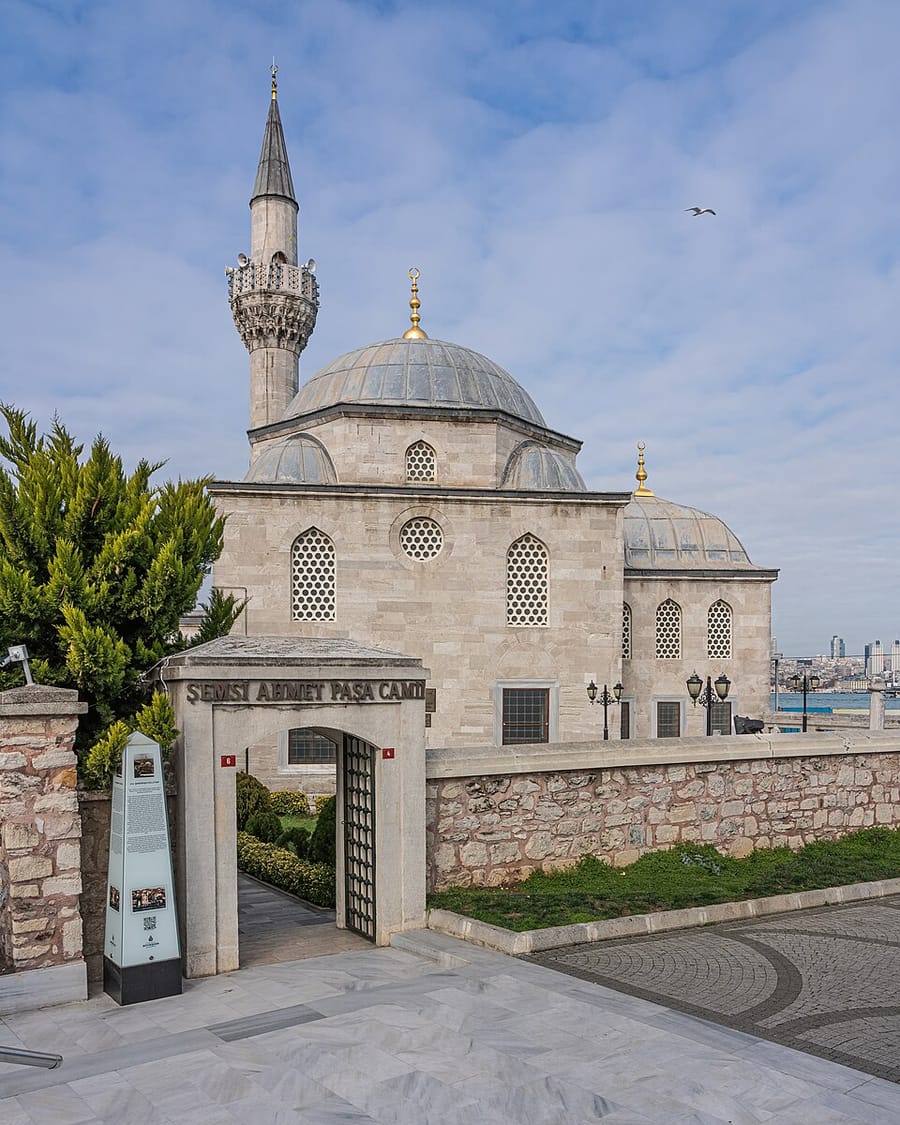

Sinan's small complex on the Üsküdar shore
This is the mosque of a small complex on the Üsküdar shore, in the district named after its founder, comprising a mosque, a madrasa (darülhadis) and a tomb. It was built by Mimar Sinan in 1580 for the vizier Şemsi Ahmed Pasha, a former governor-general of Damascus; the last couplet of the inscription, composed by the poet Ulvi, gives this date. Popularly called the Kuşkonmaz Mosque, it is a square, single-domed building of 8 × 8 metres, built entirely of cut stone, with a portico of ten slender columns along its north and west sides. The tomb of the pasha, who died in 1580 while the complex was being built, adjoins the seaward façade of the mosque and is separated from the prayer hall by a bronze grille.
Badly damaged in the earthquake of 1894, the complex was repaired the following year. It reached the Republican period in ruins: the minaret had collapsed down to its base, the domes were cracked and the madrasa was used as an animal shelter. On the orders of Mustafa Kemal Atatürk it was restored by the Directorate of Pious Foundations in 1940–1943, and in the last restoration, in 2007–2008, the minaret, which was leaning dangerously towards the sea, was repaired faithfully to the original. Since 1953 the L-shaped madrasa has served as a public library.
Courtyard, dome and decoration
The complex stands within a cut-stone enclosure wall with iron-grilled windows; two gates with depressed arches, one on the east and the other on the north facing the sea, lead into the courtyard. The mosque occupies the centre of the courtyard; at its west corner rises its graceful single-balcony minaret, with stalactite work beneath the balcony. Above the door arch, built of red and white stone, is a four-line inscription in thuluth script.
The mosque's dome, 8.20 m in diameter, sits on a high drum with stalactite squinches at the corners, carried by thick walls. The drum has two rows of windows, the upper ones fitted with plaster tracery and stained glass. The marble mihrab has a muqarnas hood; the wooden minbar and preaching chair are modern. The inside of the dome and the drum are decorated with polychrome painted ornament using classical motifs such as rumi scrolls and palmettes; the monumental thuluth inscriptions in the dome are by Ismail Hakkı Altunbezer.
Tomb and madrasa
The tomb, measuring 4.5 × 4 m, is covered by a mirror vault; its arched door is on the north-west side, while the other sides have three rows of windows on two levels. The four-line thuluth inscription above the door bears no date; the cenotaph inside was made in 1984. A small graveyard east of the mosque contains tombstones mostly from the 18th century.
In the L-shaped madrasa, which bounds the inner courtyard on the west and south, a domed lecture hall measuring 7 × 7 m with a high drum stands at the centre of the west wing, accompanied by twelve domed cells. In front runs a pointed-arched portico carried by eighteen columns with lozenge capitals. Unlike the mosque and the tomb, the madrasa was built with brick alongside cut stone. For a time it served as a dervish lodge, and during the Balkan Wars and in 1914 it sheltered refugees. To the west of the complex stood the Şemsi Pasha Palace (Şerefabad), built for Murad III.
Source: TDV Encyclopedia of Islam (TDV İslâm Ansiklopedisi), “ŞEMSİ PAŞA KÜLLİYESİ” (Ebru Karakaya)
Related sultans
Cite as: Atlas of the Sultans, “Şemsi Pasha Mosque · Ottoman monuments”, https://padisahlaratlasi.com/en/monuments/semsi-pasha-mosque/ (last updated 21 November 2026). Corrections · Image credits