TRENDEFRARAtlas of the Sultans · Ottoman monuments
Rum Mehmed Pasha Mosque
Monument · Mosque, Istanbul, 1471–1472
- Type
- Mosque
- Built
- 1471–1472
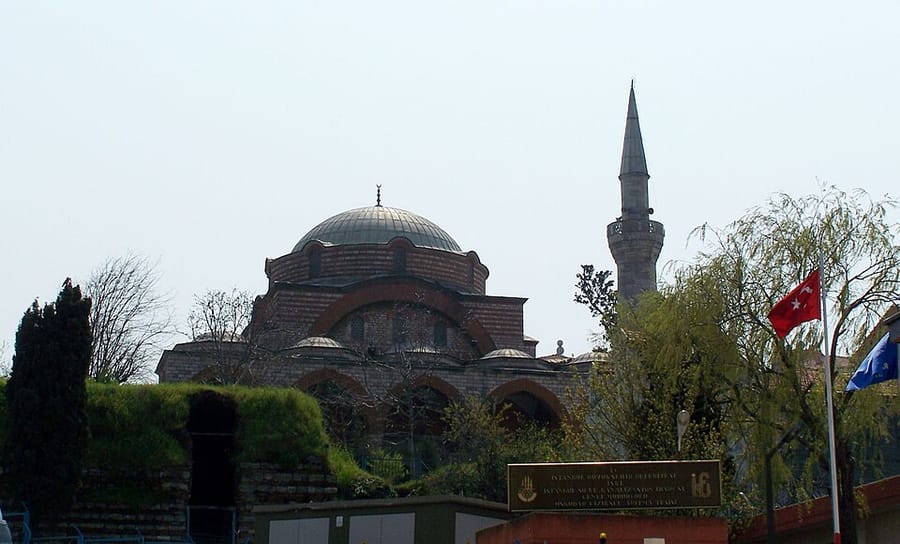

A mosque of the Conqueror's era in Üsküdar
The mosque stands on the slope above the Şemsi Pasha Mosque in Üsküdar, in the quarter named after its founder. It was built in 1471–72 by Rum Mehmed Pasha, who briefly served as grand vizier under Sultan Mehmed II (the Conqueror); a two-couplet Arabic inscription over the door gives this date as a chronogram. Of the complex (külliye) of mosque, tomb, madrasa, bath and soup kitchen, only the mosque and the tomb survive. One of the first religious buildings erected in the city after the conquest, the mosque belongs to the group of mosques with guest rooms (tabhane).
What sets it apart is a semi-dome on the mihrab side supporting the central dome; domed rooms on either side form the guest quarters. Its façades of alternating stone and brick, curving arches and round drum have been said to recall Byzantine religious architecture. The mosque has undergone repairs that changed it significantly: in the 1953 restoration the drum acquired a wavy outline and the portico was rebuilt with five domes. Rum Mehmed Pasha is believed to be buried in the octagonal tomb to the southwest.
Facades and entrance
The transition to the main dome, which rises on a round drum with eight windows, is made by pendentives, and its weight is carried by broad brick arches. The facades are of cut stone up to the arches, above which the masonry changes to alternating courses of stone and brick. Ending in dentilled brick cornices, the facades are pierced by windows with brick arches, and a gargoyle is set on each of the east and west facades. After its domed arcade collapsed, the portico was first covered with a timber roof in the 1950 repair and took its present form in 1953, with brick arches resting on six columns.
The entrance door of küfeki limestone is set within a moulded frame; the foundation inscription occupies the tympanum of the pointed arch. On either side of the marble door with its depressed arch is a polygonal niche ending in a shell-shaped hood.
The interior
A wide arch leads from the domed central space to the main prayer hall, which is raised on a platform; the transition to the half-dome of this section is made by squinches from whose ends large muqarnas segments hang. The drum, which old photographs show with sixteen windows, eight of them blind, now has eight windows. The interior, known to have been decorated with Baroque-period painting, is now plastered; traces of Conqueror-era ornament survive here and there inside the domes. The plaster mihrab ends in a muqarnas hood; the minbar and the preacher's chair are new. The guest rooms, each with a hearth and cupboards, are now used for storage. The minaret, attached on the west, has muqarnas decoration below the balcony and on its base.
The tomb and lost buildings
According to one tradition, Rum Mehmed Pasha's body is buried in the tomb beside his mosque at Tire and only his head in the tomb here. The tomb, built of küfeki limestone, appears to have once had painted decoration inside. The madrasa, which Ayvansarayi describes as ruined, has not survived. The double bath, thought to have been the oldest in Üsküdar, was repaired in 1886; like the soup kitchen, it no longer exists. The pasha endowed the complex with a bath, houses and shops at Unkapanı, a covered market he had built at Manisa and the village of Toyca-Oruzlu near Dimetoka, a gift to him from Mehmed the Conqueror.
Source: TDV Encyclopedia of Islam (TDV İslâm Ansiklopedisi), “RUM MEHMED PAŞA KÜLLİYESİ” (Tuğba Erzincan)
Related sultans
Cite as: Atlas of the Sultans, “Rum Mehmed Pasha Mosque · Ottoman monuments”, https://padisahlaratlasi.com/en/monuments/rum-mehmed-pasha-mosque/ (last updated 21 November 2026). Corrections · Image credits