TRENDEFRARAtlas of the Sultans · Ottoman monuments
Kara Ahmed Pasha Mosque
Monument · Mosque, Istanbul, 1555
- Type
- Mosque
- Built
- 1555
A work of Mimar Sinan
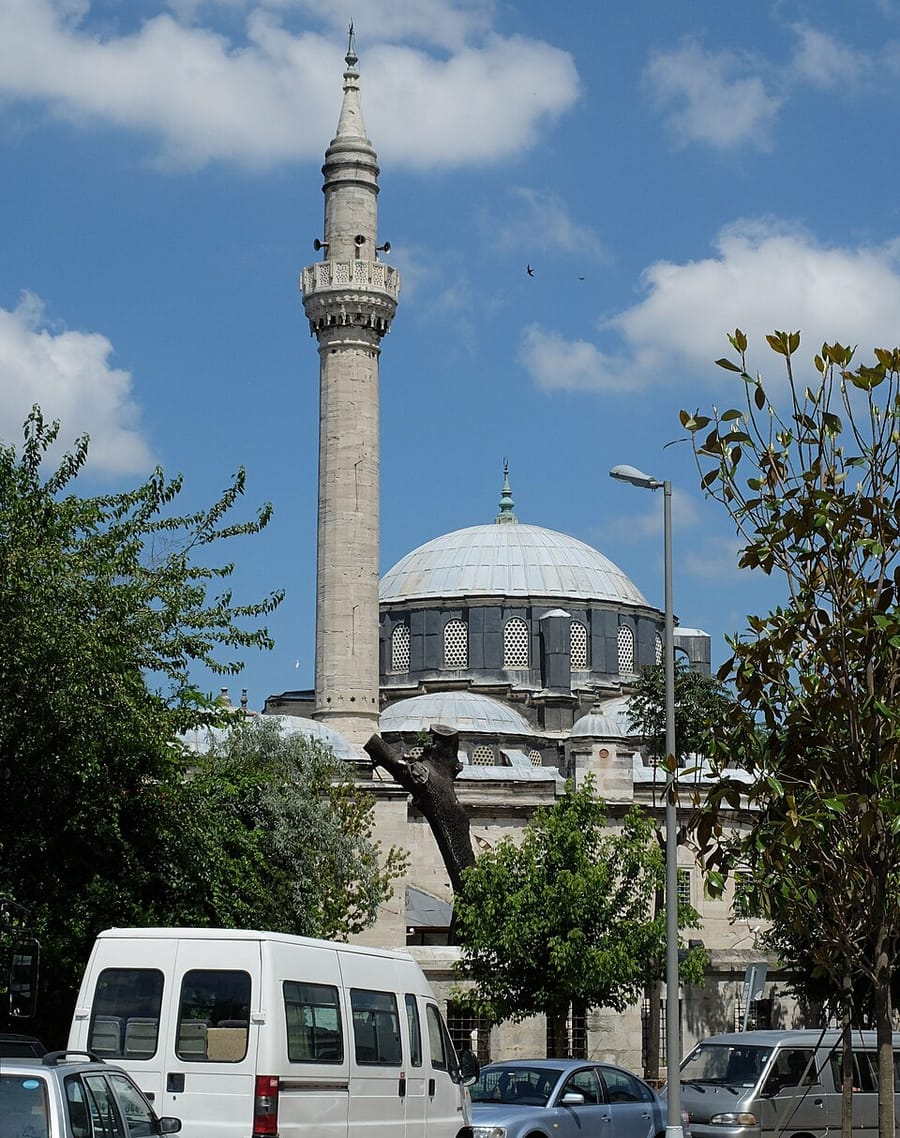

A grand vizier's unfinished mosque
Just inside the Topkapı gate, this mosque by Mimar Sinan is the centre of a complex with a madrasa, primary school, fountain and tomb, begun by Kara Ahmed Pasha, who rose to grand vizier under Suleiman the Magnificent. Its endowment deed is dated 1555. When the pasha was executed that same year as a result of palace intrigues, construction stopped for a time. The Hadikatü'l-cevami states that work resumed in 1565 on Rüstem Pasha's orders and was completed in seven years, but since Rüstem Pasha died in 1561 this date is doubtful. The pasha's hexagonal tomb is dated 1558–59.
The mosque's inner courtyard is also the courtyard of the madrasa that surrounds it on three sides. In the rectangular prayer hall, a hexagonal central space on columns carries a dome buttressed by four semi-domes. The lace-like carved marble minbar, the Iznik tiles in the portico and window lunettes, and the painted and gilded wooden ceilings beneath the galleries are its finest decoration. The mosque was repaired in 1696, and its dome, damaged in the 1894 earthquake, was promptly restored.
Endowment deed and construction
Kara Ahmed Pasha was executed on 29 September 1555 as a result of the intrigues of Hürrem Sultan, her daughter Mihrimah Sultan and Rüstem Pasha. The endowment deed dated 21 July 1555 assigns revenues from foundations in various parts of the empire to a mosque, a primary school, a madrasa with sixteen rooms and a lecture hall, a dervish lodge with sixteen rooms, and a public kitchen with its outbuildings. Since the complex today consists only of the mosque, madrasa, tomb and primary school, the lodge and kitchen were either never built or disappeared over time. The Hadikatü'l-cevami records that construction continued under the supervision of the pasha's steward Hüsrev Bey. The date 1896–97 beneath the Quranic verse in monumental script signed by Tevfik above the main door marks the repair after the 1894 earthquake.
Setting, plan and tomb
The mosque was built just inside one of the city's main landward gates, on high ground sloping on one side. This arrangement, in which the inner courtyard is shared with the madrasa, is also found in the Sokullu Mehmed Pasha Mosque at Kadırga and the Mihrimah Sultan Mosque at Edirnekapı. E. Egli suggested that Sinan had originally designed a building similar to the Sinan Pasha Mosque in Beşiktaş and abandoned the side wings after the pasha's death; Semavi Eyice regards this as a hypothesis that is hard to believe. The preaching chair and the wooden leaves of the doors and windows are fine examples of 16th-century interlocking woodwork.
The hexagonal domed tomb built by Sinan is of clean stonework; above its door is the profession of faith, and inside lies only Ahmed Pasha's cenotaph. The stones of the surrounding graveyard have been removed, leaving the grave of Fatma Sultan, the pasha's wife and daughter of Selim I. The primary school a little beyond the tomb consists of two square rooms of cut stone and brick under a wooden roof. Of the Ahmed Pasha Fountain on Arpa Emini Street only the brick water tank survives.
Source: TDV Encyclopedia of Islam (TDV İslâm Ansiklopedisi), “AHMED PAŞA KÜLLİYESİ” (Semavi Eyice)
Related sultans
Cite as: Atlas of the Sultans, “Kara Ahmed Pasha Mosque · Ottoman monuments”, https://padisahlaratlasi.com/en/monuments/kara-ahmed-pasha-mosque/ (last updated 21 November 2026). Corrections · Image credits