TRENDEFRARAtlas of the Sultans · Ottoman monuments
Fountain of Ahmed III (Istanbul)
Monument · Fountain, Istanbul, 1728–1729
- Type
- Fountain and sebil
- Built
- 1728–1729
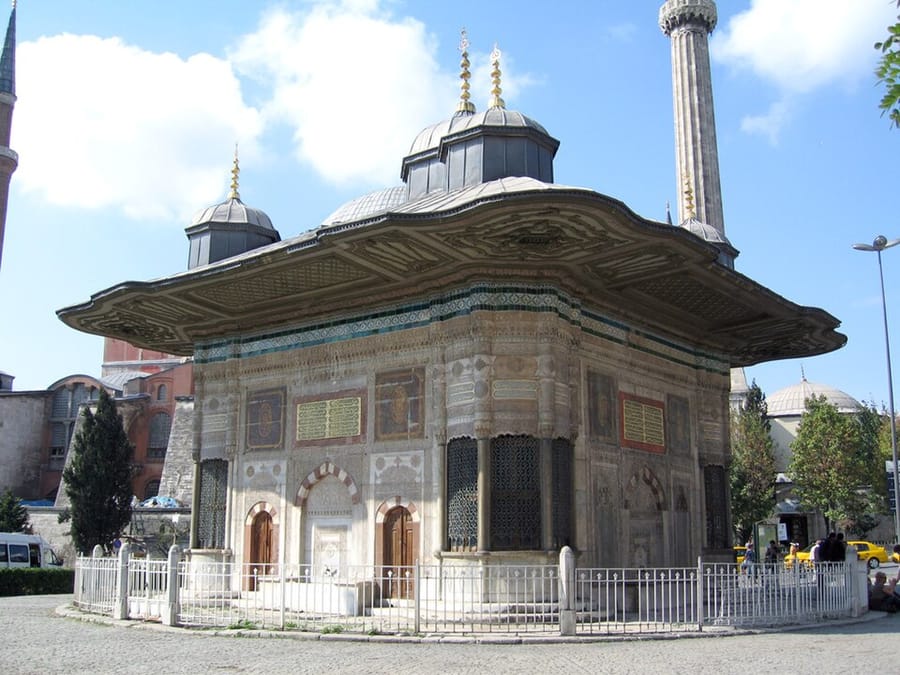

A square fountain before the Imperial Gate
This monumental square fountain with sebils (water dispensaries), between the Imperial Gate (Bab-ı Hümayun) and Hagia Sophia, was built by Sultan Ahmed III. According to its inscription it was constructed in 1728–29; the fourteen-stanza chronogram poem is by Seyyid Vehbi, and the project was recommended by the grand vizier Nevşehirli Damad Ibrahim Pasha. Ahmed III composed the final chronogram couplet himself and wrote it in large thuluth script across the main façade facing Hagia Sophia. The fountain was still unfinished in April 1729, and the sultan lost his throne in the Patrona Halil revolt of 1730 before seeing it completed. Its architect is unknown; the attribution to the chief court architect Kayserili Mehmed Ağa is supported by no record.
At the four corners of its square plan, sebils with grilles project as semicircles, and a fountain sits at the centre of each façade. Small ribbed domes rise from the middle of the wide-eaved, lead-covered wooden roof and above the sebils. A work of the period when Western art was beginning to filter in, it is covered without a gap in marble reliefs, partly gilded with gold leaf, and tiles. The fountain has undergone no major changes since it was built.
Inscriptions and building records
Seyyid Vehbi's long ode in ta'liq script is carved above the fountains and kiosks on every side. The inscription facing the Sea of Marmara reveals that Grand Vizier Ibrahim Pasha recommended the building, while the signature beneath the final chronogram couplet shows that the sultan wrote it in his own hand. A document of April 1729 asked the deputy judge of Marmara to send “pure, white and unveined” marble urgently. According to a brief archival record, Mehmed Agha, chief architect of the imperial corps, undertook only the gilding of the finials and grilles. On close inspection, traces of minor later repairs can be seen on the structure.
Kiosks, corridor and decoration
The fountains are flanked by mihrab-shaped niches; on one side only, doors were opened in their place. These doors lead into a corridor running between the central octagonal water tank and the outer walls; through it the attendants reached the water-dispensing kiosks at the corners. The five domelets are topped by gilded bronze finials with pierced inscriptions. The columns between the grilles of the kiosks are continued above by semicircular shafts, balancing the horizontal lines of the façade.
Motifs of Western origin appear above all on the underside of the broad eaves and in the scrolling frame bands around the fountains, while muqarnas and medallions occupy the horizontal bands of ornament. In technical quality the tiles do not match the Iznik tiles of the 16th century. On the façade facing Hagia Sophia, the word “mashallah” is written in a medallion above the tap, and the tulip motif recurs in the gilded bronze grilles of the kiosks. Semavi Eyice considers the building the most dazzling example of square fountains in Turkish art, and all the foreign travellers who came to Istanbul described it with admiration.
Source: TDV Encyclopedia of Islam (TDV İslâm Ansiklopedisi), “AHMED III ÇEŞMESİ” (Semavi Eyice)
Related sultans
Cite as: Atlas of the Sultans, “Fountain of Ahmed III (Istanbul) · Ottoman monuments”, https://padisahlaratlasi.com/en/monuments/fountain-of-ahmed-iii-istanbul/ (last updated 21 November 2026). Corrections · Image credits