TRENDEFRARAtlas of the Sultans · Ottoman monuments
Irgandı Bridge
Monument · Bridge, Bursa, 15th century
- Type
- Bridge
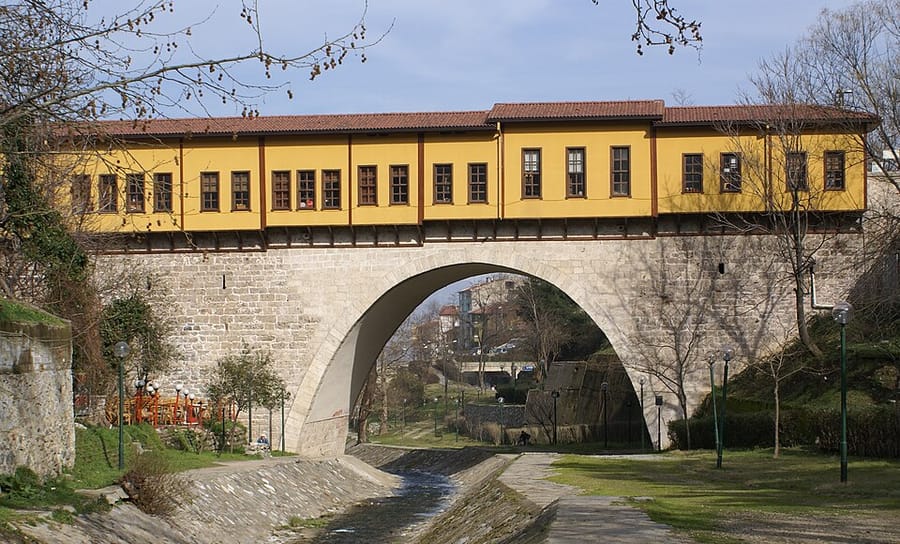

A bridge lined with shops
Spanning the Gökdere stream that divides Bursa's Yeşil quarter, this bridge is among the most important early Ottoman monuments of the city. No inscription naming its founder or date is known; Evliya Çelebi attributes it to Orhan Gazi. According to the Bursa court registers, it was built in 1442 by Hace Muslihuddin, son of Ali el-Irgandi, while a poem recorded by Ayvansarayi gives the date 1492, so the date remains uncertain. The bridge, of cut stone, has a single pointed arch with a span of about 15 m and a similar height. Lined on both sides with shops, it took on the appearance of an arasta (market street); in 1559 Muslihuddin's grandson converted one of these shops into a small mosque (mescit).
Evliya Çelebi wrote in 1640 that the market on the bridge held about 200 cotton-carders' shops, vaulted and covered with lead, with iron gates at both ends. In the 1855 earthquake the bridge was badly damaged and its vaulted shops were lost, to be replaced by wooden ones. In 1922 the retreating Greek army damaged the bridge and the shops disappeared entirely. When Bursa Municipality repaired it in 1949, the side walls were raised and the market was not revived; the bridge was reopened simply as a crossing.
The founder and the name
According to a chronogram recorded by Hüseyin Ayvansarayi, the bridge was built by Hace Muslihuddin; since the word 'hace' meant merchant at the time, the founder was probably a wealthy Bursa merchant. According to court registers compiled by Ayverdi, Muslihuddin was martyred at Bilecik around 1497; he had two sons and a daughter and had also set aside money for his other bridge over the Sakarya and for paved roads. The name of the bridge is thought to relate to the verb 'ırgalamak', to shake or sway; according to one view, Muslihuddin's father, Ali el-Irgandi, came from a place called Irgand.
When the shops were built is disputed: Ayverdi held that they were added about a century after the first construction, while Yılmaz Önge, who wrote a monograph on the bridge, argued from the spaces inside the abutments and the cells linked to the shops that bridge and shops were planned together. On this view the first shops may have been of timber and converted to masonry in 1559.
Through the eyes of travellers and documents
Court registers show that the shops were roofed with lead and were repaired in 1567, 1573, 1576 and 1632; there is also a record of urgent repair in 1848 to an abutment damaged by flooding. Reinhardt Lubenau, who came to Bursa between 1573 and 1589, took the bridge for a Christian work predating the conquest, while Julia Pardoe, who came in 1836, presented it as Roman and noted weaving looms in the shops. According to Evliya Çelebi, there were iron gates with loopholes at both ends. The city plan of 1861–62 shows the bridge as an open-air market lined with thirty-two to thirty-five shops.
Hidden spaces in the abutments
Inside the north-west abutment, entered by a door from outside, is a brick barrel-vaulted space measuring 4.50 × 14.85 m; Önge thought it may have been a stable or warehouse. Between this space and the floors of the former shops are small vaulted cells that receive air and light through slits in the outer walls; an opening in the vault of one of them, measuring 1.67 × 3.00 m, suggests that it served as the storeroom of the shop above. The polygonal stones used in the raised section added in the 1949 repair stand out clearly from the regular ashlar below. Semavi Eyice regarded it as a great loss that, unlike market bridges such as the Rialto in Venice and the Ponte Vecchio in Florence, the Irgandı Bridge was reduced to a mere crossing.
Source: TDV Encyclopedia of Islam (TDV İslâm Ansiklopedisi), “IRGANDI KÖPRÜSÜ” (Semavi Eyice)
Cite as: Atlas of the Sultans, “Irgandı Bridge · Ottoman monuments”, https://padisahlaratlasi.com/en/monuments/irgandi-bridge/ (last updated 21 November 2026). Corrections · Image credits